

Hanging Branches: Why "Widowmakers" Are So Dangerous
Quick answer: a hanging branch, or "widowmaker," is a limb that has broken but is still caught in the tree, and it is dangerous because nothing about it is secure: it can drop with no warning, on a calm day or in the next breeze. Keep everyone out from under it and do not pull, shake or cut it yourself — broken wood is often under tension. A professional crew lowers it on ropes, from a bucket truck, or with a crane. If it touches a power line, call the utility or 911 first.
- It is not stuck, it is waiting. A hanger is held by a strip of bark, a fork or another limb, and any of them can let go.
- Small ones kill. A Washington State investigation describes an experienced tree worker killed by a limb about 4 inches thick and 70 to 100 pounds.
- Never pull it down. UGA Extension Gwinnett tells homeowners to avoid pulling on limbs of storm-damaged trees; a rope puts you in its path.
- Clear the drop zone. Keep everyone well outside the spread of the canopy until the limb is down.
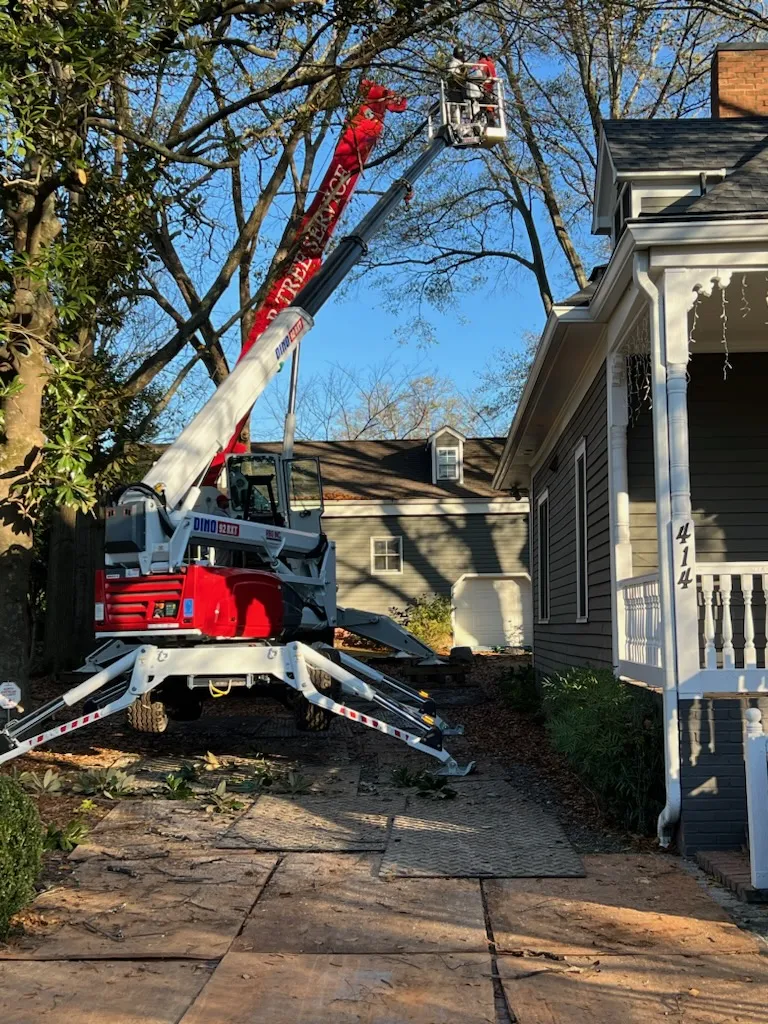
- Pros lower it, not drop it. Crews use rigging, a bucket truck or a crane, chosen by how sound the tree is and what is underneath.
- Power line involved? Utility first. No tree crew should touch a limb on a line until the utility makes it safe.
After every North Georgia storm we get the same call: "There is a big branch broken off up there, just hanging. Is it going to fall?" The honest answer is that nobody can tell you when. It might come down in the next gust, or sit there through a dry month and then drop on a still afternoon. That uncertainty is exactly why tree crews give these limbs a grim name.
This guide explains what a hanger is, why the people who work with them for a living treat them as one of the most dangerous things in a tree, what you should and should not do while one is over your yard, and how a professional crew takes it down.
What is a hanging branch, or "widowmaker"?
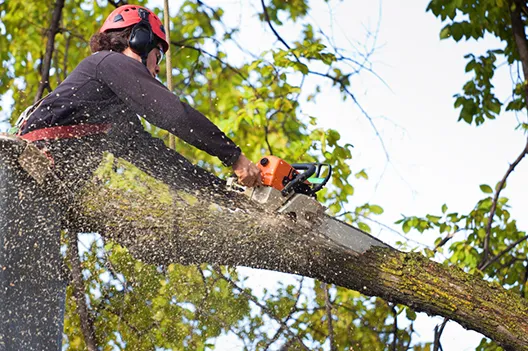
A hanging branch (arborists usually just say a "hanger") is a limb that has broken, cracked or torn loose but has not reached the ground. It may be dangling from a strip of bark, wedged in a fork, draped across a lower limb, or caught in the canopy of the tree next door. Widowmaker is the older logging word for the same thing: the name, as the Wikipedia entry on the term puts it, comes from the idea that a falling limb kills the worker under it and makes a widow of his spouse.
The terms show up in federal safety rules and guidance, which is useful because they are precise:
| Term | What it means | Source |
|---|---|---|
| Widowmaker | Broken limbs still suspended in the tree being cut or in nearby trees | OSHA logging hazard list, via Kentucky FACE |
| Lodged (hung) tree | A tree leaning against another tree or object that keeps it from falling | 29 CFR 1910.266(c) |
| Snag | Any standing dead tree or portion of one | 29 CFR 1910.266(c) |
| Danger tree | A standing tree that is a hazard because of damage or decay to roots, trunk or limbs, or its lean | 29 CFR 1910.266(c) |
| Spring pole | A tree or limb bent under stress by another tree or object | OSHA logging hazard list, via Kentucky FACE |
In a yard, a hanger is often two of these at once: a broken limb (widowmaker) bent and pinned under load (spring pole). That combination is what makes them so hard to judge from the ground.
Why are widowmakers so dangerous?
Nothing is holding them on purpose. A live limb is attached by wood that grew to carry it. A hanger is held by whatever it happened to land on. Wind, rain soaking into the leaves and bark, a squirrel, the vibration of a saw in the next tree — any of it can tip the balance.
They carry more weight than they look. In a 2023 fatality report from Washington State's FACE program (partly funded by NIOSH), a 51-year-old tree trimmer was killed by a limb that had broken off a storm-damaged fir and lodged in the canopy "without anyone noticing." It was 14 feet long, about four inches thick, and weighed 70 to 100 pounds. He was an experienced, certified arborist. That is the uncomfortable lesson of these limbs: the one that kills is often not the giant one everybody is watching.
Height turns weight into force. Simple physics, ignoring air resistance: anything that falls 40 feet is moving at roughly 35 miles per hour when it lands. A 70-pound limb at that speed does not leave a bruise.
Broken wood stores energy. UGA Extension's Fannin-Gilmer office warns that energy stored in compressed limbs and trunks after a storm "can release suddenly, explosively, and fatally." A hanger bent under load is exactly that kind of stored energy.
They hide. A broken limb in a full summer canopy, or in a mass of storm debris, may not be visible from the ground at all. The Washington investigators recommended that crews use a bucket truck, binoculars or a drone to find overhead hazards before work starts.
What the fatality numbers say
The best data comes from tree workers, the people most exposed to hangers. A review in the International Society of Arboriculture's journal, Arboriculture & Urban Forestry (Ball, Vosberg and Walsh, 2020), went through 865 fatal tree-work incidents from 2001 to 2017. Being struck by a falling branch was the fourth most common way tree workers died — 104 deaths, 12% of the total — and 54 of those were workers hit by a free-falling branch while walking or working in the drop zone. Many of the dead, the authors note, were not wearing a helmet and suffered skull fractures.
Writing in the Tree Care Industry Association's magazine, John Ball reports that tree workers have at least 15 times the fatality rate of all industries, and that falling trees and limbs are the source of most deaths in the struck-by category. These are trained crews in helmets. A homeowner under a hanger has none of that protection.
Why you should never pull or shake a hanging branch down
The urge to "just get it down" is strong, especially when the limb is over the driveway. Every method people try puts them inside the drop zone or makes the limb's path less predictable:
- Pulling it with a rope. UGA Extension Gwinnett's advice on storm-damaged trees is to avoid climbing on the tree or pulling on any limbs. A rope does not control where the limb lands; it only guarantees you are attached to it when it moves — and it can drag other broken wood down with it.
- Pulling it with a truck or tractor. Same problem, with the added risk of the limb or rope whipping back. The vehicle does not protect you the way a logging machine's cab does.
- Shaking the tree, throwing things, or poking it with a pole. You have to stand close to do any of these, and you will not know which piece is going to come loose.
- Cutting it from a ladder. UGA Extension Gwinnett says that if large sections are broken or hanging, or the work needs a ladder or a chainsaw overhead, a professional should be called. Federal logging rules prohibit cutting directly overhead with a chainsaw, even for professional loggers.
- Cutting the limb it is resting on. The hanger usually goes the moment its support is cut, and a limb under tension can spring sideways or up.
- Waiting underneath to see if it falls. Do not park under it, walk under it to look, or let children play near it while you wait.
"But OSHA says to pull them down"
You may read that OSHA's logging guidance says to knock widowmakers down or pull them down with a machine. It does — the hazard list reproduced by Kentucky's FACE program says exactly that, alongside "avoid working beneath them." But that advice is written for loggers in open timber, operating machines with protective cabs, under federal rules (29 CFR 1910.266) that bar work within two tree lengths of a danger tree that has not been brought down, and require cab canopies built to protect the operator from falling limbs. A suburban yard has a house, a fence, a neighbor's roof and a driveway inside that radius. In a yard, "pull it down" means "drop it on something."
What should you do about a hanging branch right now?
- Check for wires first. If the limb is touching, resting on or near a power line or the service line to your house, stay away and call your utility, or 911 if a line is down or sparking. Our power-line post explains who to call in North Georgia.
- Clear the drop zone. Keep everyone out from under the whole spread of the canopy, and wider on the downhill side — a falling limb can bounce, roll or swing. Close gates and tell the kids why.
- Move what you can without walking under it. Cars, grills, outdoor furniture. If you cannot reach it without passing beneath the limb, leave it.
- Look from a safe spot. Binoculars help. Note roughly how big the limb is, what is holding it, and what it would hit.
- Take photos from a distance. They help the crew bring the right equipment, and they matter if the limb later damages something and you make an insurance claim.
- Call a tree service. If it is over the house, a driveway you use, or a walkway, say so — it changes how fast we come.
How do professionals remove a hanging branch?
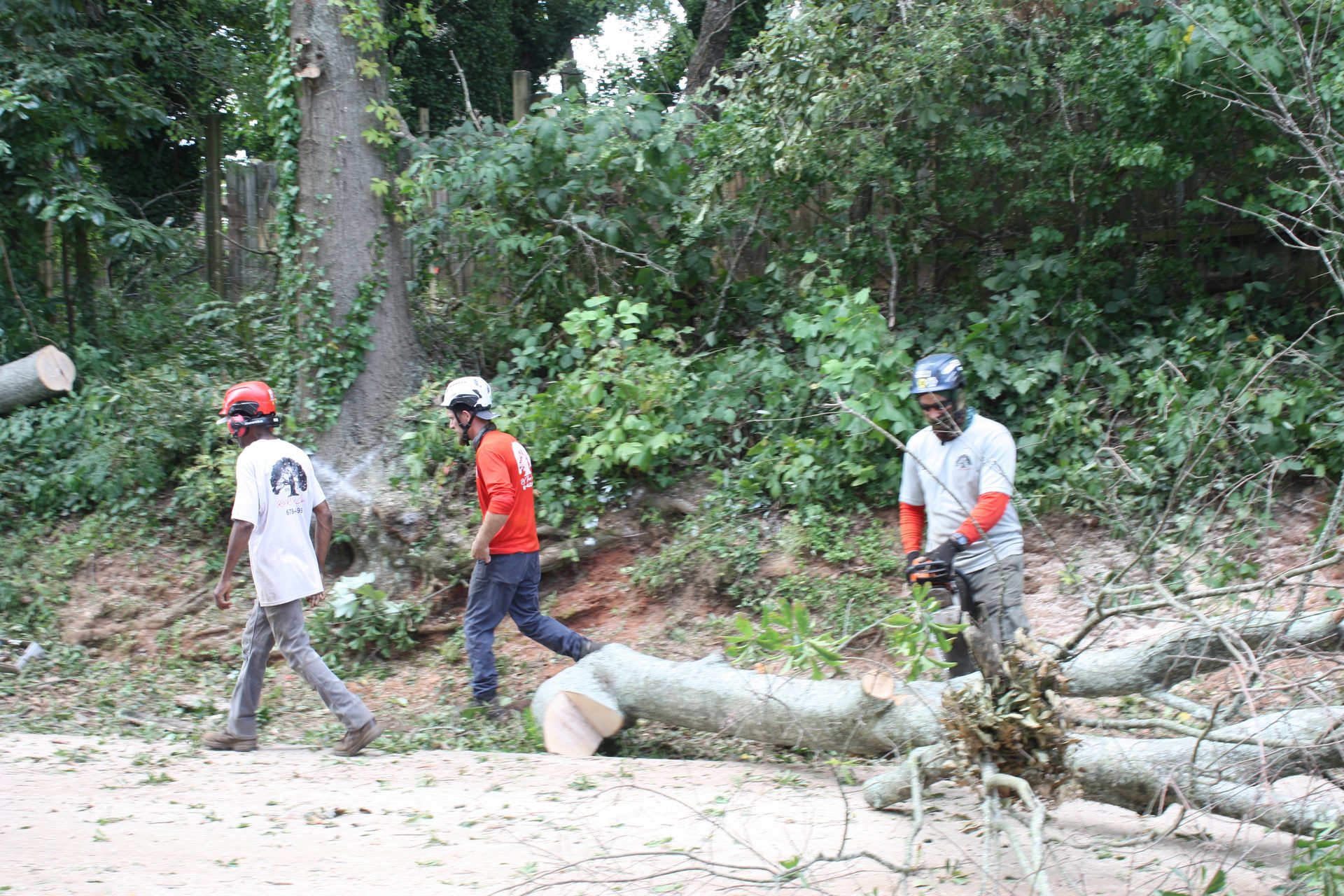
The job starts on the ground. A good crew looks at where the limb broke, what is holding it, whether the tree it is hanging in is sound enough to climb, what is underneath, and whether there are other hangers in the same tree or the trees around it — which, after a storm, there often are. The ISA's homeowner checklist, Recognizing Tree Risk, lists "detached, hanging branches" among the first things to look for, and notes that the risk depends on the size of the branch and how close it is to targets.
Then the crew picks a method. Here is how we choose:
| Method | When it is used | How it works |
|---|---|---|
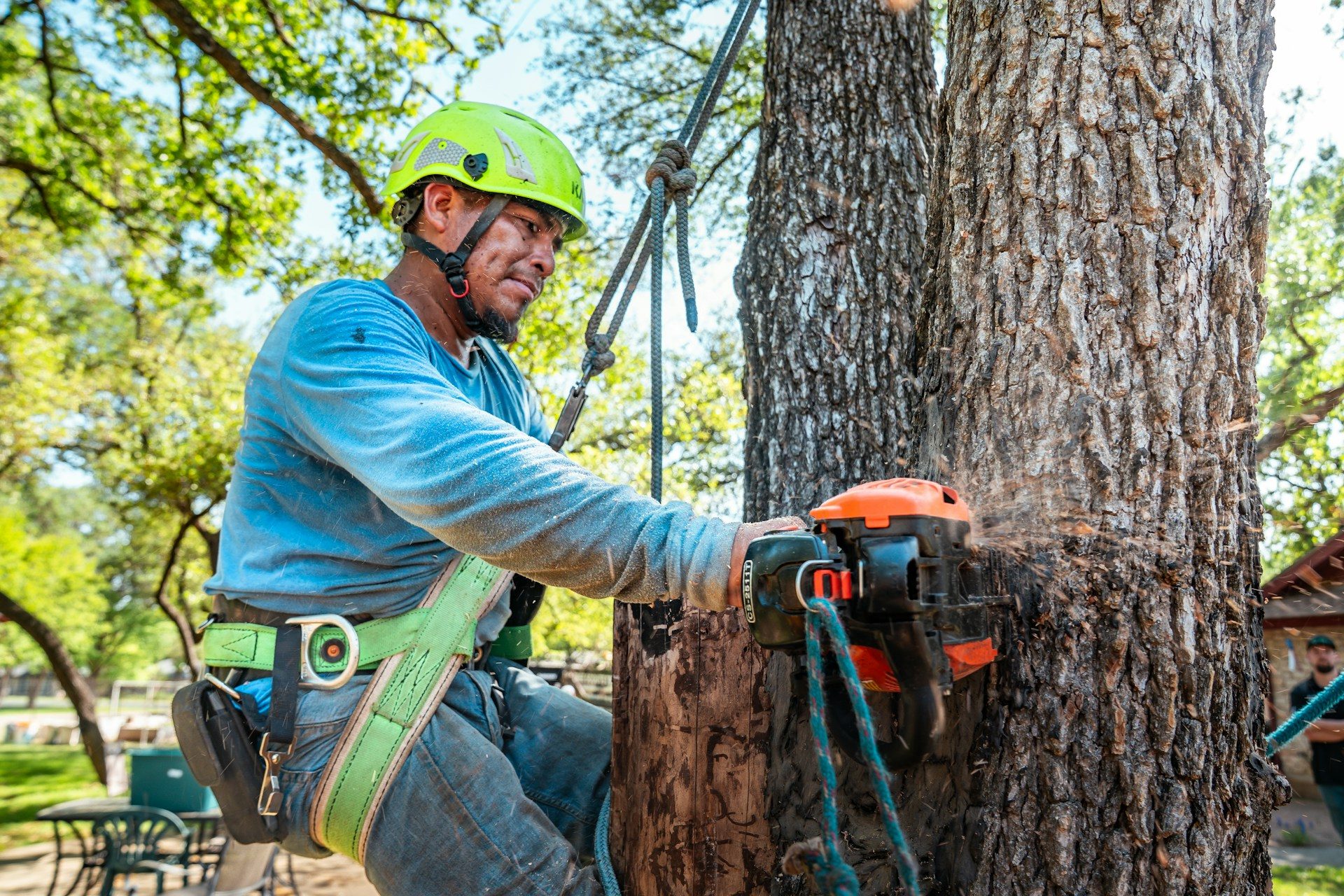
| Climber with rigging | Tree is sound enough to climb; limb is over something that must not be hit | The climber secures the hanger to a lowering line before it is cut, and the ground crew lowers it under control |
| Bucket truck | Truck can reach from a driveway, street or firm lawn | The operator works beside the limb instead of in the tree, and can inspect the canopy for more hangers |
| Crane | Tree too damaged or decayed to climb, limb very large, or it is over a house | The limb is rigged to the crane and lifted clear before it is cut free, then set down in a safe spot |
| Leave it, fence it off | Limb is small, far from anything, in woods nobody uses | Mark the area and check it after storms — only an option where a fall truly hits nothing |
Whatever the method, the crew sets up a drop zone that nobody enters, and uses a command-and-response call before every cut — both are in the ANSI Z133 tree-care safety standard, as the ISA review and TCIA's magazine point out. Everyone on the site wears a helmet; the standard requires that too. This is the part a homeowner cannot recreate: not the saw, but the second and third person, the lowering line, and the rule that nobody is underneath.
Price depends on the method, and the method depends on the tree. Hangers in dead trees cost more because dead wood cannot always be climbed — our dead-tree cost guide explains the climb, bucket and crane steps — and a limb over a roof may need a crane. The tree removal cost page covers what else moves the number.
How long can a branch hang in a tree before it falls?
There is no safe answer. We have seen hangers come down the same night, and others that hung for a season before letting go on a calm day. What we can say is that time does not make them safer.
- The support gets weaker. Torn wood and stripped bark do not heal back together. A broken limb dies, and dead wood decays — the Wikipedia entry on widowmakers notes that fungal growth over time is a common cause.
- Weather adds weight. Rain soaks into leaves and bark. Ice is worse, loading every limb with weight it was never built to carry — UGA Extension Forsyth names ice storms alongside high winds as what breaks branches in the first place. Our ice-storm guide covers how to assess a tree after one.
- The tree keeps moving. Every gust flexes the limbs the hanger rests on.
A hanger that has survived a few windy days has not "settled in." It has just not been tested by the right gust yet.
When is a hanging branch an emergency?
Use what is under it, not how big it looks, to decide:
| Situation | How urgent | Who to call |
|---|---|---|
| Touching or near a power line | Now — stay away | Utility or 911, then a tree service once it is safe |
| Over the house, a bedroom, or resting on the roof | Same day | Emergency tree service |
| Over a driveway, walkway, deck or play area you use | Same day or next; block it off | Tree service |
| Over a public road or sidewalk | Report it now | The city or county, plus the tree's owner |
| Several hangers after an ice or wind storm | Soon — the whole tree needs a look | Tree service for an assessment |
| Small limb, far back in the woods, nothing below | Schedule it; keep people away | Tree service when convenient |
If the limb is in a neighbor's tree but hangs over your yard, tell the neighbor in writing. UGA Extension's Tree Ownership and Responsibility circular notes that a Georgia owner's knowledge of a problem can be shown when someone reported it in writing before the tree fell. Our post on neighbor trees explains why that note matters in Georgia if the limb later falls, and who is responsible under Georgia law covers trees on the line and in the road.
Does one hanging branch mean the tree has to come down?
Not usually. A single limb broken in a storm is often just a pruning job: the crew removes the hanger, then cuts the broken stub back properly, just outside the branch collar, so the tree can seal it — the method UGA Extension Forsyth describes in its storm-damage guide. A clean cut matters; a ragged stub invites decay.
The question to ask is why the limb broke. Wind and ice break healthy limbs. But a limb that failed because of decay, a weak fork or a split in the trunk can be a sign the rest of the tree is not far behind. UGA Extension's Fannin-Gilmer office offers a rule of thumb for storm damage: losing more than half the branches on a hardwood, or more than 30% on a pine, usually means removal — though it stresses these are general rules, not predictions. If the break runs into the trunk, see our post on split trunks; for the wider list of warning signs, see dangerous tree warning signs.
How R & R Tree Service handles hanging branches
We have been taking hangers out of North Georgia trees since 1987, with our own crew and our own equipment — climbing and rigging gear, a bucket truck, and our own crane for limbs over houses or in trees too damaged to climb. Nothing is subcontracted. We are a TCIA member, licensed and insured with general liability and workers' compensation, which matters on a job where the crew is working over your home.
Hangers over or on a house go to the front of the line, and our 24/7 emergency crew answers after storms. While we are there, we check the rest of the tree and the trees around it for more broken wood, and we will tell you plainly whether the tree needs trimming or removal. Every estimate is free, written and itemized: (678) 482-9994.
Frequently asked questions
Why is a hanging branch called a widowmaker?
The name comes from logging: a broken limb falling from above could kill the worker beneath it and leave a widow. OSHA's logging guidance still uses the word for broken limbs suspended in the tree being cut or in nearby trees.
Can I knock a hanging branch down with a pole or a rope?
It is not safe. Any method that reaches the limb puts you close to where it will land, and broken wood under tension can swing, spring or bring other limbs with it. UGA Extension Gwinnett advises homeowners not to pull on limbs of storm-damaged trees and to call a professional for hanging sections.
Will a hanging branch fall on its own?
Eventually, almost always — but nobody can predict when. It may fall in the next gust or weeks later on a calm day, and it does not become safer with time because the broken wood keeps weakening.
Does homeowners insurance pay to remove a hanging branch?
Usually not while it is still hanging, because removing a hazard before it causes damage is generally treated as maintenance. If it falls and damages your house, that damage is normally a claim. Check your policy; our insurance guide explains the standard rules.
Should I call 911 about a hanging branch?
Call 911 if a power line is down or sparking, or if someone is hurt. If the limb is only touching a line, call your utility; for everything else, call a tree service.
A branch from my neighbor's tree is hanging over my yard. What should I do?
Keep clear of it, tell your neighbor, and put it in writing with a photo. UGA Extension explains that in Georgia a tree owner is generally liable for a falling tree only if they knew or should have known it was dangerous, and a written report is one way that knowledge is shown.
- Ball, Vosberg & Walsh — A Review of United States Arboricultural Operation Fatal and Nonfatal Incidents (2001–2017), Arboriculture & Urban Forestry 46(2), 2020 (ISA)
- OSHA — 29 CFR 1910.266, Logging operations: definitions (danger tree, lodged tree, snag) and danger-tree rules (via Cornell LII)
- Washington State FACE / L&I — Trimmer Struck by Limb from Storm-damaged Tree (Report 71-243-2023s)
- Kentucky FACE Program — Loggers Killed During Felling Operations (Hazard Alert, 2017): widowmaker, lodged tree, snag, spring pole
- UGA Extension Gwinnett (Timothy Daly) — Managing Storm Damaged Trees (via City of Peachtree Corners)
- UGA Extension Fannin-Gilmer — Assessing storm-damaged trees (2021)
 Call (678) 482-9994