

My Neighbor's Tree Fell on My House: Who Pays in Georgia?
Quick answer: in most cases your own homeowners insurance pays, even though the tree grew next door — in Georgia your neighbor is responsible only if they knew, or a reasonable person should have known, that the tree was dead, decayed or otherwise dangerous. A healthy tree felled by a storm is nobody's fault. If the neighbor was on notice, your insurer can recover what it paid from the neighbor's insurer, and you may get your deductible back. The strongest proof is written notice about that specific tree, given before it fell.
- Claim on your own policy first: it covers your house no matter whose yard the tree grew in.
- Georgia's test is notice: the neighbor pays only if they knew or reasonably should have known the tree was dangerous.
- Visible to a layperson: decay has to be "visible, apparent, and patent" — not hidden rot only an expert would spot.
- Proof before the fall wins: in a 2022 Georgia case, decay found after the tree fell was not enough on its own.
- Notice in writing, about that tree: say what is wrong with it, with dated photos — vague worries have not counted.
- Deadlines: Georgia allows four years to sue for damage to property; magistrate court hears claims up to $15,000.
The tree was theirs. The roof is yours. When a tree from next door comes through the ceiling, the first question we hear is always the same: shouldn't the neighbor pay for this?
Sometimes, yes. Usually, no. Georgia has a clear legal test for when a tree owner is responsible, and it turns on what the owner knew before the tree fell — not on whose yard it grew in. Below is how that test works, what Georgia courts have actually looked at, how the insurance side plays out, and how to put a neighbor on notice about a tree that worries you now. We are a tree service, not a law firm: for a real dispute, talk to a Georgia attorney.
Whose insurance pays when a neighbor's tree falls on your house?
Yours, first. Your homeowners policy covers damage to your house from a falling tree whoever owned it. The Insurance Information Institute puts it simply: "You are insured no matter who owns the tree", and adds that in most cases an insurer is not going to spend time working out where the tree came from.
The standard policy form even names the situation. The debris-removal section of the ISO HO-3 policy (the sample form is published by the Insurance Information Institute) pays to remove "a neighbor's tree(s)" from your property when a covered peril brought it down and it damaged a covered structure or blocked your driveway — up to $1,000 per loss and $500 per tree. Getting the tree off the house itself is normally part of the house repair. Our insurance guide explains that split in detail.
So the neighbor question is not "who do I claim from?" It is "can my insurer, or I, get the money back from the neighbor afterward?" In Georgia, that depends on notice.
When is your neighbor legally responsible in Georgia?
Georgia does not make a tree owner automatically liable when a tree falls. The Georgia Court of Appeals has said for decades that "the ordinary rules of negligence apply", and the rule it repeats in case after case is this: the owner of a tree is liable for damage from its fall only if they "knew or reasonably should have known the tree was diseased, decayed or otherwise constituted a dangerous condition" (Klein v. Weaver, 2004, quoting Willis v. Maloof, 1987).
Three details in that rule decide most cases:
- The decay has to be visible. There is no duty "to consistently and constantly check all trees" for hidden rot; "the manifestation of decay must be visible, apparent, and patent" (Cornett v. Agee, 1977, as quoted in Wesleyan College v. Weber, 1999).
- It is judged by a layperson's eyes. Your neighbor is held to what a reasonable person would notice, not to "the knowledge or understanding of an expert trained in the inspection, care and maintenance of trees" (Wesleyan College v. Weber).
- No routine inspection is required. UGA Extension's Tree Ownership and Responsibility circular says Georgia law does not impose a general duty to inspect trees, and sets no inspection schedule or pruning requirement.
Location matters too. A 2004 Georgia Bar Journal article explains that Georgia expects more care from an urban landowner than a rural one: a rural owner is not required to inspect every tree, but must act once they actually know a tree is a danger to a neighbor. Whether a lot counts as urban is a question for a lawyer, not for us.
| What happened | Who usually pays | Why |
|---|---|---|
| Healthy tree blown over in a storm | You and your insurer | No notice of danger — nobody's fault |
| Tree with hidden internal rot, looked normal | You and your insurer | A layperson could not have seen it |
| Visibly dead or rotten tree, decay obvious from the yard | Possibly the neighbor | They reasonably should have known |
| You warned the neighbor in writing about that tree's condition | Likely the neighbor | Actual notice, and they did nothing |
| You only said trees "worried" you, no condition named | Probably you | Vague concern has not counted as notice |
What counts as "should have known"? What Georgia courts have looked at
The cases are more useful than the rule, because they show what evidence actually moves a judge or jury. Five Georgia Court of Appeals decisions, in plain terms:
- Cornett v. Agee (1977) — neighbor liable. A 75- to 100-foot pine in a Fulton County neighborhood, standing near the lot line and leaning toward the neighbor's yard, with visible rot and a partly dead trunk. The owner had been told about it and advised to remove it. The judgment against the owner was affirmed.
- Wesleyan College v. Weber (1999) — a jury question. A 94-foot loblolly pine on college land fell across a four-lane Bibb County highway. It had a four-foot rotten cavity a layperson could see, workers said it had bark falling off and no green needles, it stood among many dead and leaning pines, and the owner had been told about the blighted trees. The court held that notice of a problem area meant the owner was charged with what a reasonable inspection would have found.
- Willis v. Maloof (1987) — owner not liable. An expert found curling bark at the base, a cavity and fungus after the tree fell. But the owner gardened near the tree every year and saw nothing wrong, and there was no evidence a layman should have known it was diseased.
- Klein v. Weaver (2004) — owner not liable. A limb had dropped from the same oak weeks earlier, and a relative had told the owner she did not "like the look" of some trees. But that earlier limb was not shown to be decayed, and the concern was about limbs near power lines, not the tree's health. Not notice.
- Chausmer v. Gottlieb (2022) — owner not liable, 2–1. In an August 2020 storm a neighbor's tree fell into the Chausmers' backyard and hit their house. The tree service that removed it wrote on its invoice that there was about four feet of carpenter-ant decay at the base and a rotted hole twenty feet up. It still was not enough: the neighbor had an arborist look at the tree a year earlier, watched it several times a week, and nothing showed that the decay was visible before the fall. Photos taken afterward could not show how long the problem had existed. One judge dissented, writing that laypeople can recognize rotten wood when they see it.
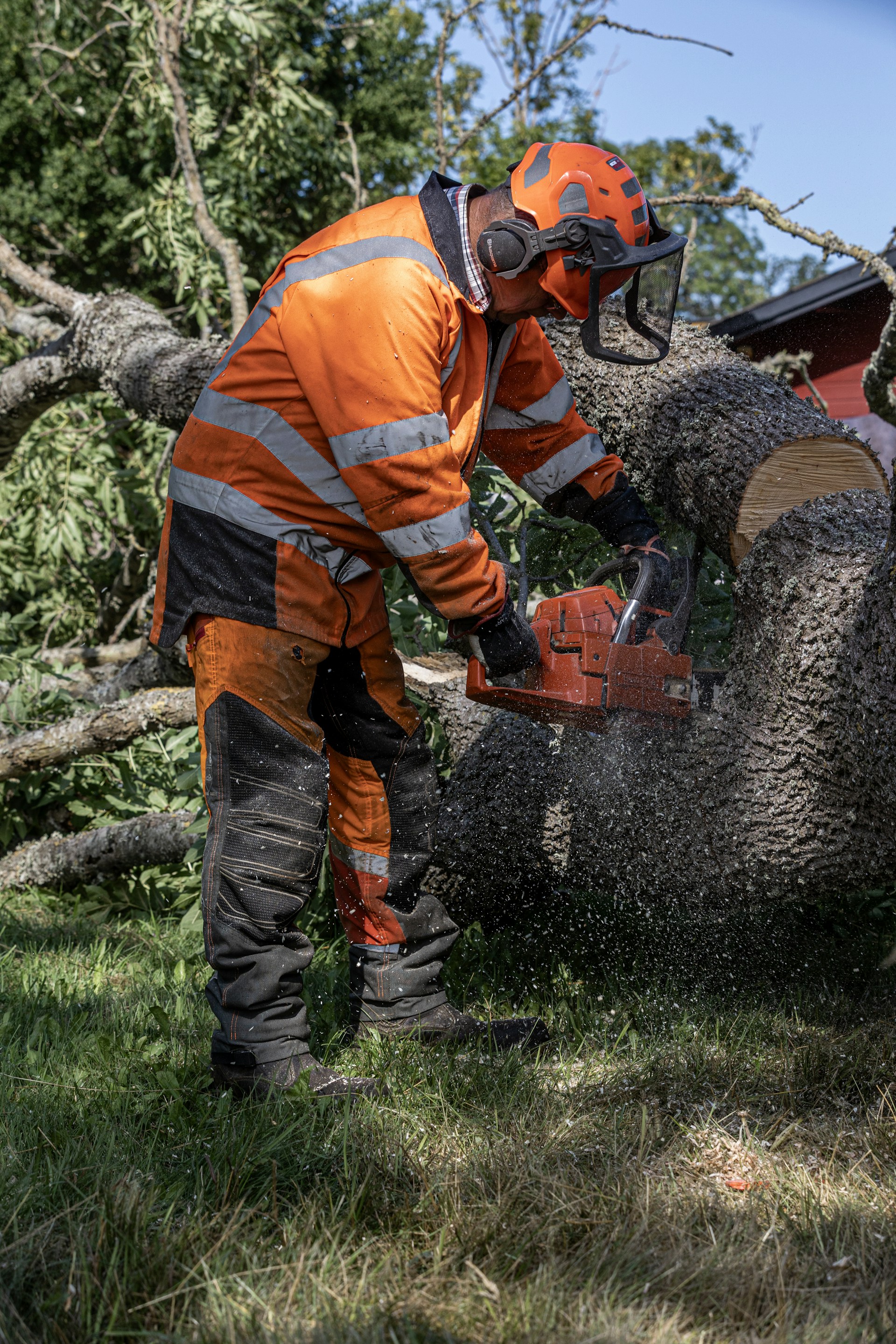
The pattern is consistent. Owners lose when the danger was visible from normal life — a partly dead tree, visible rot, a big cavity, bark falling off, no green needles, a lean toward the neighbor's yard — and there is proof it was there, or that someone said so, before the storm. Owners win when the tree looked normal, or when the only evidence of rot was found after it came down. These are the warning signs a layperson can see from the ground.
How does subrogation work, and do you get your deductible back?
Subrogation is your insurer stepping into your shoes. It pays your claim, then, if it believes the neighbor was negligent, it tries to recover that money from the neighbor or the neighbor's insurer. Triple-I says that if your insurer succeeds, you may be reimbursed for your deductible.
Two things in the standard policy wording are worth knowing:
- You have to cooperate. The HO-3 Subrogation condition lets your insurer require you to assign your rights of recovery, and you "must sign and deliver all related papers and cooperate". Do not sign a release from your neighbor, or accept money from them, until you have told your insurer.
- The neighbor's policy pays only if they are legally liable. Their personal liability coverage pays "damages for which an insured is legally liable". A healthy tree in a storm usually means no liability — which is why their insurer will often say no.
Do not count on it happening. As a former Florida deputy insurance commissioner told WKMG News 6, some companies will subrogate, "but that doesn't always happen." If there is real evidence the tree was visibly dead and the neighbor knew, give that evidence to your adjuster and ask directly whether they will pursue subrogation.
What if the damage is under your deductible, or you have no insurance?
Then the only route to recovery is the neighbor, and the same notice rule applies. Start with a calm conversation and a written estimate of the damage. If the tree was visibly dead and the neighbor knew it, many people pay or pass it to their own insurer.
If they refuse, Georgia gives you options and deadlines:
- Four years to sue. Under O.C.G.A. § 9-3-30, actions for damage to realty must be brought within four years.
- Magistrate court for smaller claims. Under O.C.G.A. § 15-10-2, Georgia's magistrate courts hear civil claims where the amount demanded does not exceed $15,000.
Be realistic about the cost. A lawsuit you cannot prove — a healthy-looking tree, no written notice, decay found only after the fall — is the Chausmer case all over again. An hour with a Georgia attorney before you file is money well spent.
How should you talk to your neighbor after their tree hits your house?
Most of these situations end well when both sides stay on facts. What tends to help:
- Safety first, then talk. If anyone is hurt, lines are down or you smell gas, call 911. What to do in the first hour covers that.
- Swap insurance details, not blame. Give each other your carrier and policy number. Neither of you has to admit or decide fault on the lawn.
- Ask one neutral question: "Had anyone looked at that tree?" An arborist's report, a past estimate or an old email about the tree is evidence either way.
- Agree on the rest of the tree. The part that landed on your side is part of your claim. The stump and anything still standing on their lot belongs to them — UGA Extension notes that ownership follows the trunk.
- Keep the wood until the adjuster says otherwise. The break, the base and the root plate show whether the tree was sound. Documenting tree damage has the full photo list.
How do you put a neighbor on notice about a dangerous tree?
If the tree has not fallen yet, this is the section that matters most. UGA Extension says the clearest proof that an owner knew is a written report — from an arborist, a tenant or another third party — that a problem existed before the tree fell, and that without it, proving the owner should have known is very difficult. A good notice is specific:
- Name the tree. Which tree, where it stands, and roughly how tall it is and which way it leans.
- Describe what anyone can see. Dead branches or a bare crown in summer, a cavity or crack in the trunk, mushrooms or fungus at the base, bark falling off, soil heaving or roots lifting on one side, a new or worsening lean.
- Attach dated photos taken from your own property or the street. You do not need to step onto their lot.
- Add an expert opinion if you can. A written assessment from an ISA Certified Arborist carries far more weight than a neighbor's opinion.
- Say what you are worried it will hit — your house, your bedroom, the driveway — and ask them to have it looked at.
- Send it in a way you can prove, keep a copy, and follow up in writing if nothing happens.
Keep it neighborly. UGA Extension encourages neighbors to talk first and put any agreement in writing; often the owner simply did not know, and an offer to share the cost of an assessment goes a long way. You may trim branches that hang over your side, but talk to the owner first and never cut a neighbor's tree itself. If the tree is in a power line, call the utility, not a tree service; if it belongs to an HOA, the city or the county, Georgia's fallen tree rules explain who is responsible.
How R & R Tree Service handles a neighbor's tree on your house
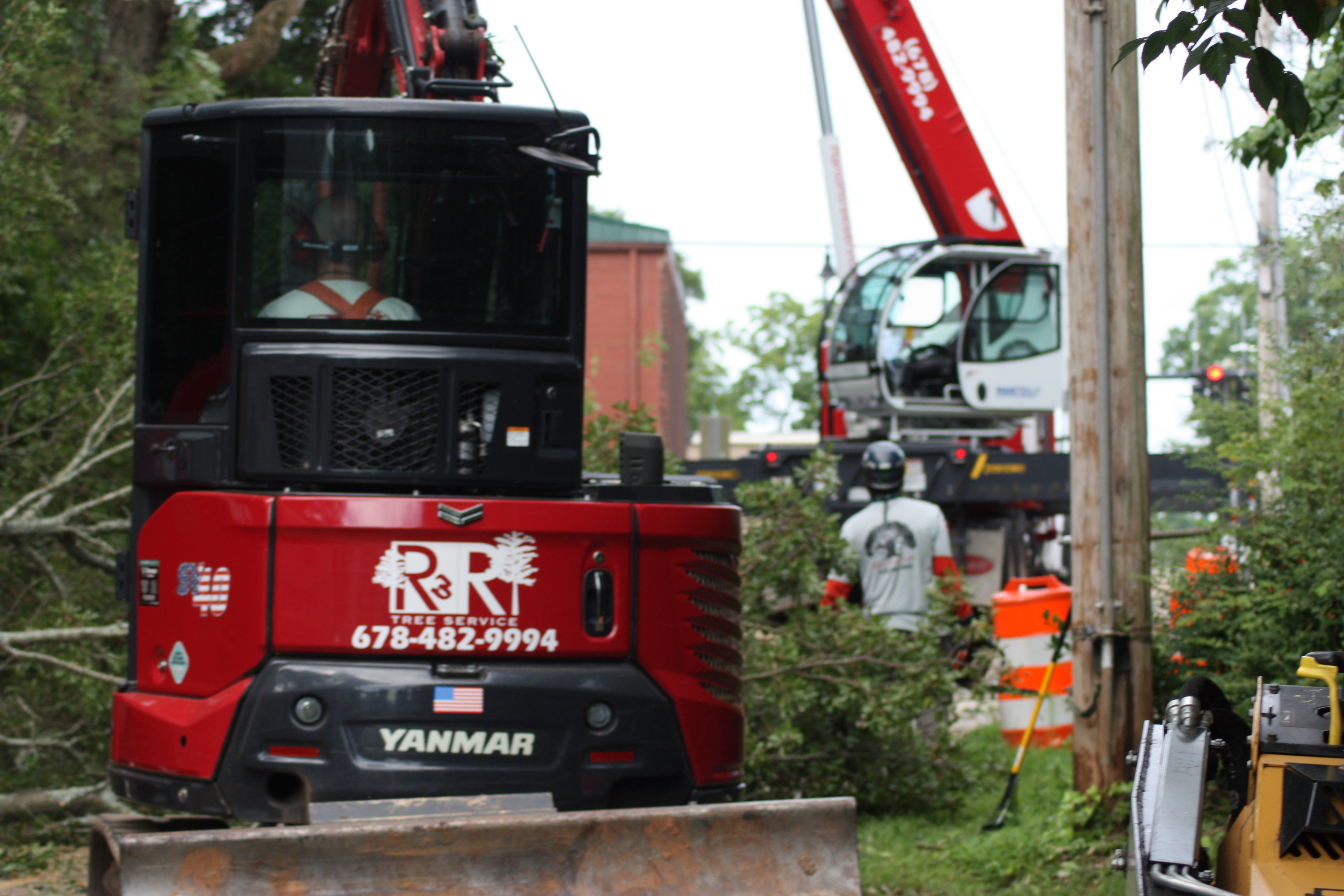
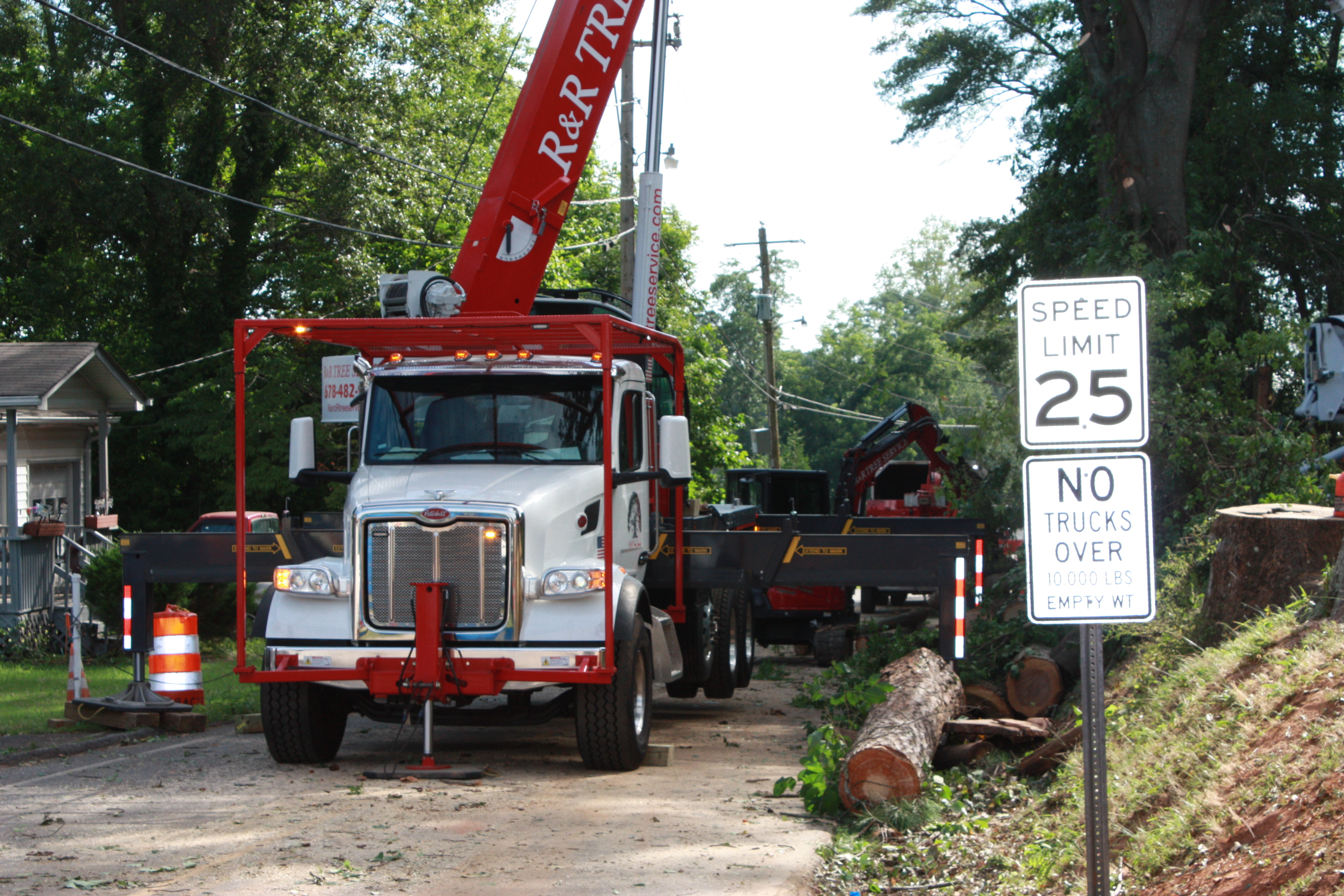
We have been taking trees off North Georgia homes since 1987 with our own crew and our own crane, and we answer emergency calls 24/7. On a neighbor-tree job we document the damage for your insurer and take the weight off your roof first. Your written, itemized estimate separates getting the tree off the house from hauling it away, in a format adjusters accept, and we can talk with your adjuster when asked.
Worried about a neighbor's tree that has not fallen yet? We can give you a free written estimate for the work, though the work itself needs the tree owner's go-ahead. Call (678) 482-9994.
Frequently asked questions
Is my neighbor responsible if their tree falls on my house in Georgia?
Only if they knew, or a reasonable person should have known, the tree was dead, decayed or otherwise dangerous. If the tree looked healthy and a storm brought it down, your own insurance usually pays and the neighbor owes nothing.
Do I have to pay my deductible if it was my neighbor's tree?
Usually, yes, at first. If your insurer recovers its payment from the neighbor's insurer through subrogation, you may get your deductible back. Ask your adjuster whether they plan to pursue it.
Who pays to remove a neighbor's tree that fell into my yard?
If it damaged your house or another covered structure, or blocks your driveway, your own policy's debris-removal coverage usually applies — typically up to $500 per tree and $1,000 per loss on the standard form. If it hit nothing, cleanup on your side is usually yours, unless the neighbor was negligent.
Can I sue my neighbor for damage from their fallen tree in Georgia?
You can, within four years for damage to property, and magistrate court hears claims up to $15,000. You would need evidence the neighbor knew or should have known the tree was dangerous, so talk to a Georgia attorney first.
Does Georgia law require my neighbor to inspect their trees?
There is no general duty to inspect on a schedule. But an owner is responsible for decay a layperson could see, and courts have held that notice of a problem charges an owner with what a reasonable inspection would have found.
Should I talk to my insurer before my neighbor offers to pay?
Yes. The standard policy requires you to cooperate with your insurer's right to recover from others. Signing a release or settling privately first can complicate your claim.
- UGA Extension — Tree Ownership and Responsibility (Circular 1099), "In Georgia…" liability and inspection
- Georgia Court of Appeals — Chausmer v. Gottlieb, No. A22A0620 (2022)
- Georgia Court of Appeals — Wesleyan College v. Weber, 238 Ga. App. 90 (1999)
- Georgia Court of Appeals — Klein v. Weaver, 265 Ga. App. 390 (2004)
- Insurance Information Institute — sample ISO Homeowners 3 policy: Debris Removal, Subrogation, Personal Liability
- Triple-I — If a tree falls on your house, are you covered?
 Call (678) 482-9994