
A Tree Fell on a Power Line: Who to Call in North Georgia
Quick answer: stay well back, treat every wire as live, and call 911 if anyone is in danger or the line is down; otherwise call the electric utility that serves your address — Georgia Power, your EMC, or your city's electric department. The utility makes the line safe and repairs its own wires. Damage to the parts bolted to your house, such as the mast, weatherhead or meter box, is fixed by your electrician before power is reconnected. The tree itself, once it is off the line, is usually the property owner's to remove.
- Live until proven dead: never touch the tree, the wire, or a fence or car it is touching — and never pull a branch off a line.
- Call the right utility: in Georgia your electric company is set by your address, not by choice. Your bill names it.
- Two different repairs: the utility fixes its lines; the mast, weatherhead and meter box on your house are yours, and need an electrician.
- The 10-foot law: Georgia's High-Voltage Safety Act bars working within 10 feet of a high-voltage line until the utility has made it safe.
- The wood stays behind: utility crews cut the tree off the line to restore power; removing what is left is usually up to the owner.
A tree on a power line is the one storm call where we tell people not to call us first. Until the electric company has made the line safe, nobody should be near that tree — not you, not a neighbor with a chainsaw, and not a tree crew. Georgia law backs that up.
Below: the order of calls, which utility serves your part of North Georgia, who fixes the wire to your house versus the main line, the state's 10-foot rule, and what happens after the utility leaves. If the tree is also on your house, start with our first-hour guide.
What should you do right now if a tree falls on a power line?
- Get back and keep everyone back. Assume the wire is energized even if it is silent and the house is dark. A downed line can energize the ground around it: Great Lakes Energy, a Michigan electric co-op passing on Electrical Safety Foundation guidance, says to stay at least 35 feet away — farther when the ground is wet.
- Touch nothing the line or tree touches. That includes the tree, a fence, a gutter, a car, and a person in contact with the line. Georgia Power warns specifically about chain-link fences, which can carry current from a downed line you cannot see.
- Call 911 if anyone is hurt, there is fire or sparking, or a line is down or on the house. Then call your electric utility (numbers below).
- If a line is on your car while you are in it, stay inside and call for help. Only if the car is on fire: jump clear with feet together, without touching the car and the ground at the same time, and shuffle away with both feet on the ground, per the same safety guidance.
- Do not drive over or under a downed line, and watch for wires hidden in branches and debris. After a storm, assume every tangle of limbs might have a wire in it.
- Do not try to free the branch. Georgia Power's storm advice is blunt: never touch a downed wire or try to remove tree branches from power lines, because "it can kill."
A branch resting on a line is not safer than a whole tree on it. Georgia Power's tree and vegetation FAQ says trees and limbs "can conduct power if they come in contact with power lines," that lines a tree tears down "may still be energized while in the air or on the ground," and that no one should climb a tree near power lines. A limb that looks still can also shift as the line sags or the wind picks up.
Should you call 911 or the power company?
Both have a role, and the utilities draw the line in a useful place. In a 2002 storm release Georgia Power asked customers not to call 911 just to report that the power is out, because it ties up the line for real emergencies. A downed wire is different: during Hurricane Helene, DeKalb County told residents to call 911 or Georgia Power immediately for a fallen or low-hanging line, and to use 911 for all downed trees and power lines.
| What you see | First call | Then |
|---|---|---|
| Someone hurt, fire, sparks, or a person or car touching the line | 911 | Your electric utility |
| Line on the ground, on the house, or hanging low over a road or drive | 911 or your utility | Tree service once the line is safe |
| Branch resting on a line, wire still up, power on or flickering | Your electric utility | Tree service after the utility's visit |
| Your house is dark and the wire to it is down or torn off | Your electric utility | A licensed electrician, then a tree service |
| Tree on a phone or cable line only (you are sure) | The phone or cable company | Tree service |
That last row comes with a warning: from the ground, most people cannot tell a cable line from a power line. Walton EMC tells its members to stay away from all fallen lines, including telephone and cable TV wires, and to call the co-op. If in doubt, treat it as a power line.
Which power company do you call in North Georgia?
In Georgia you do not pick your electric company; your address does. The 1973 Georgia Territorial Electric Service Act "assigns exclusive power supply areas throughout the state," as the City of Marietta's power department explains it, with electric membership cooperatives (EMCs) assigned 71% of the state's land area and the rest going to Georgia Power or city-owned systems. The act also gives a supplier "corridor rights" along its existing lines, which is one reason two homes on the same road can have different electric companies. Your neighbor's utility is not always yours.
In R & R's service area — Gwinnett, Hall, Forsyth and the surrounding counties — these are the companies you are most likely to be dealing with:
| Utility | Who it is | Report a downed line or outage |
|---|---|---|
| Georgia Power | Investor-owned; serves all but four of Georgia's 159 counties | 1-888-891-0938, 24/7 (or 911) |
| Walton EMC | Member-owned co-op; about 146,000 accounts in 10 northeast Georgia counties | 678-639-3300, or online at waltonemc.com |
| Jackson EMC | Member-owned co-op; the City of Dacula lists it alongside Georgia Power | The outage number on your bill or in the co-op's app |
| Sawnee EMC | Member-owned co-op based in Cumming | The outage number on your bill or in the co-op's app |
| City of Buford Electric | City-owned system (a MEAG Power member) | 678-889-4600 weekdays 8–5; 770-932-7986 nights, weekends, holidays |
| Lawrenceville Power | City of Lawrenceville's electric utility | See the city's severe weather page |
Georgia Power's line is the one it gives in its own storm releases and that DeKalb County repeated during Helene. Walton EMC's comes from its report-an-outage page, and Buford's from the city's electric department. Buford is easy to miss: if you live inside the city, your power may come from the city itself, not Georgia Power or a co-op.
Which wire did the tree hit?
Who fixes what depends almost entirely on which wire came down. The three guides that rank for this question split it the same basic way:
| Wire | What it looks like | Who repairs it |
|---|---|---|
| Transmission line | Heavy lines on tall steel towers or large poles, often in a cleared corridor | The utility |
| Main distribution line | The top wires running pole to pole along the street or a backyard easement | The utility |
| Service drop | The single twisted or bundled cable from the last pole to your house | The wire: usually the utility. The hardware on your house: you |
A tree across the main line often means a whole street is dark and the utility will come to it as part of its storm work. A limb on the service drop usually means only your house is out — and that is where the questions about who pays start.
Who is responsible for the service drop vs the main line?
The utility owns and repairs its lines. The point where the drop meets your house is the dividing line, and Georgia's utilities say so plainly.
Georgia Power, in its storm releases after Hurricanes Michael and Zeta, reminds customers that "the electrical service entry point on their home or business, including the meter box and other components, must be repaired before Georgia Power can reconnect service." It adds that the company "cannot, by law, connect power to a damaged meter box, or other non-Georgia Power components," and that property owners should hire a qualified electrician to make those repairs.
- The utility's side: the poles, the main lines and transformers — and, with most utilities, the service wire itself.
- Your side: the mast pipe the wire attaches to, the weatherhead (the curved cap at the top), the service-entrance cable down the wall, the meter base or box, and everything inside the house.
Walton EMC's right-of-way policy shows how one co-op handles trees around that wire. It will trim limbs away from the service line to your home, but "homeowners are responsible for the debris left." And if a tree threatening the service wire has to come out completely, Walton EMC says it will disconnect the wire so a tree removal company can work safely; you request that, or a trim, through its customer care line. Jackson EMC, Sawnee EMC and Georgia Power each set their own service-line rules, so ask yours before you assume.
What does Georgia's 10-foot power line law say?
Georgia's High-Voltage Safety Act (O.C.G.A. §§ 46-3-30 to 46-3-40) is why a tree crew should never start on a tree tangled in the lines. Reading the statute text Georgia 811 publishes:
- What counts as high voltage: any overhead line with more than 750 volts between conductors or to ground.
- The 10-foot rule (§ 46-3-33): no one may start work if any person, tool, ladder, machine or material "may be brought within ten feet of any high-voltage line" until the utility has been notified and has guarded the line — by de-energizing and grounding it, moving it, or installing protective covers or barriers.
- Who must comply: "work" is defined as activity done "in pursuit of his trade or business," which covers every tree service you hire. Qualified utility line workers are exempt.
- The notice (§ 46-3-34): the person responsible gives notice through the utilities protection center — today, Georgia 811 — at least 72 hours ahead, not counting weekends and holidays.
- The penalty (§ 46-3-40): a misdemeanor with a $1,000 fine for a first offense and $3,000 after that, and a violator whose work causes damage or injury is strictly liable for it and must cover the utility's claims.
Federal workplace rules point the same way. OSHA's electrical standard, 29 CFR 1910.333, keeps workers who are not qualified electrical workers, and anything conductive they hold, at least 10 feet from energized overhead lines up to 50 kV.
The 72-hour notice is written for planned work, like taking down a dead tree leaning over a service drop. In a storm, the line is usually made safe because you reported it. Either way, the order never changes: the utility first, then the tree crew. Anyone who offers to "just cut it off the line" for cash after a storm is offering to break the law with your property and their life.
What happens after the utility makes the line safe?
Utility crews are there to restore power, not to clean your yard. They will cut what is needed to free and repair the line, and the trunk and limbs left behind are generally the property owner's. After a big storm, expect a wait: Georgia Power says crews repair the larger lines that feed whole neighborhoods before the lines to individual homes, with hospitals and emergency services first.
Once the utility has been and gone, this is the order we suggest:
- Confirm the line is safe. Ask the crew, or call the utility, before anyone goes near the tree. A wire that is down but "off" can be re-energized.
- Photograph everything before it is moved — the tree, the break or roots, the wire, the mast and meter, and any damage to the house. Our documentation checklist has the full list.
- Get an electrician if the mast, weatherhead or meter box is damaged. The utility will not reconnect until that is fixed.
- Have the remaining tree removed. A tree that has been partly cut by a line crew is often under tension and hung up in other trees; it is not a homeowner chainsaw job. If it is on the roof or leaning on the house, it may need a crane.
- Call your insurer if the house was damaged. The house repair is a dwelling claim; tree removal is usually capped. What insurance covers explains the limits.
- Run any generator safely. Georgia Power warns never to plug a portable generator into household wiring, which can injure line crews working nearby. Run it outdoors, away from the house.
Whose tree it was, and whether its owner knew it was dead, can matter for who pays — Georgia's fallen-tree rules go through how that works.
Can you cut a branch off a power line yourself?
No — not a small one, not with a pole saw, and not with a "non-conductive" tool. The danger is not only the cut: a branch under tension can whip the line, drop it, or drop you.
- Pulling or pushing a branch off a line, with anything.
- Cutting a tree that is resting on, leaning into, or within 10 feet of a line.
- Climbing a tree that has a line running through its crown.
- Letting a neighbor or a storm chaser do any of the above.
What you can do is make the call that gets it done safely. For a limb on the service drop with no emergency, ask your utility to trim it or to disconnect the drop while a tree service removes the tree. For a tree growing into the main lines, report it — keeping those lines clear is the utility's job. If you have a tree near a line that worries you before the next storm, clearance trimming or removal planned with the utility is much safer than an emergency later.
How R & R Tree Service handles trees on power lines
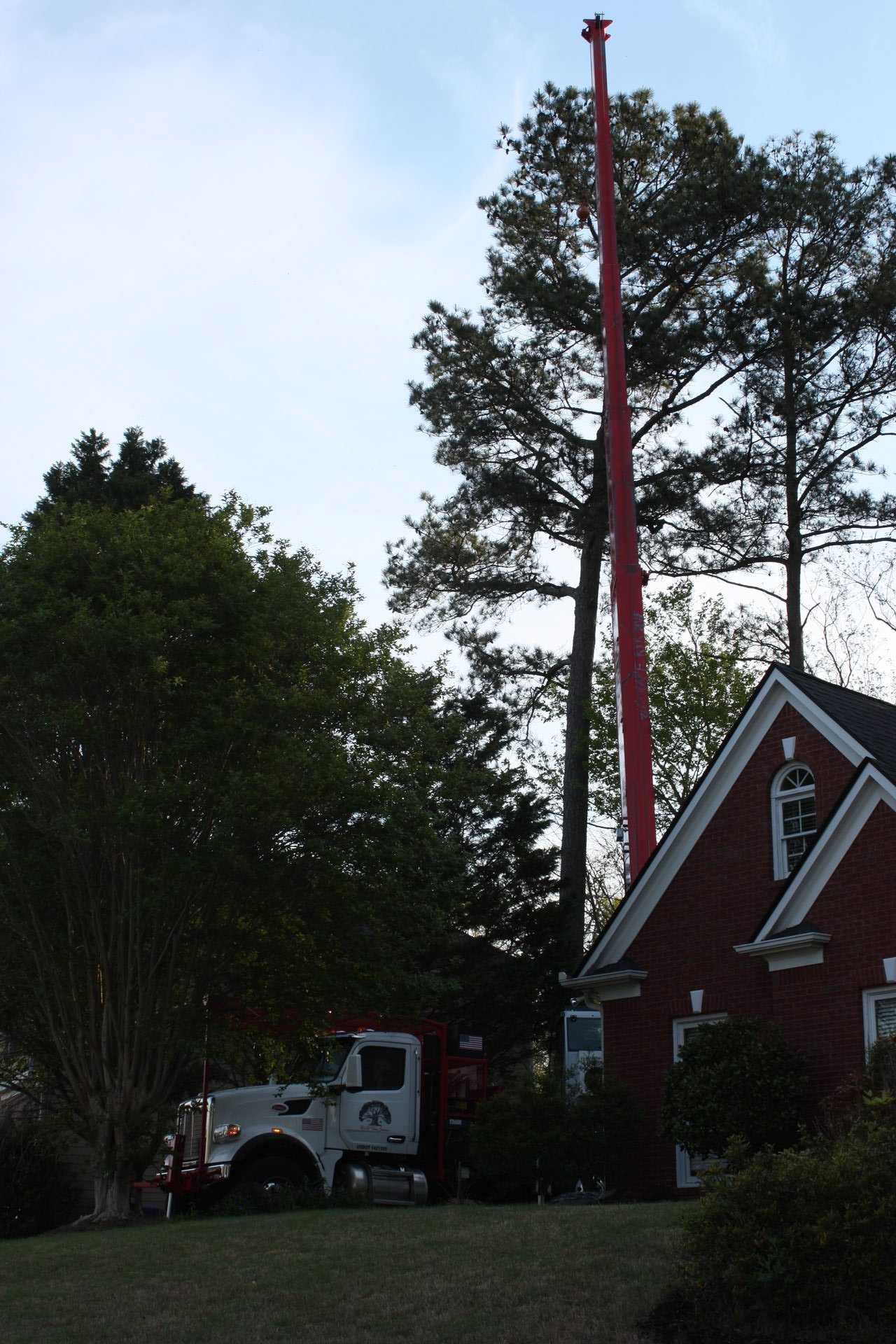
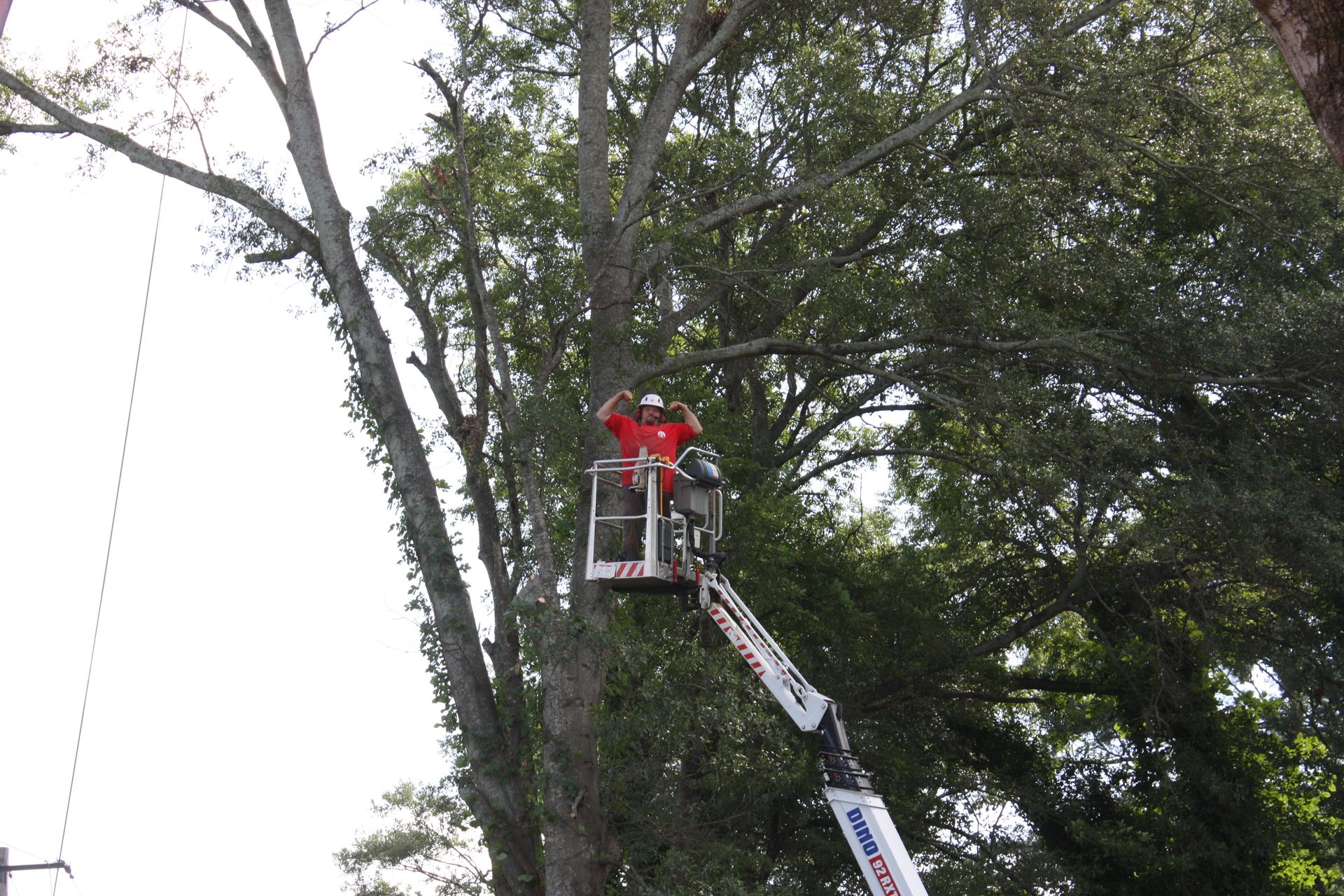
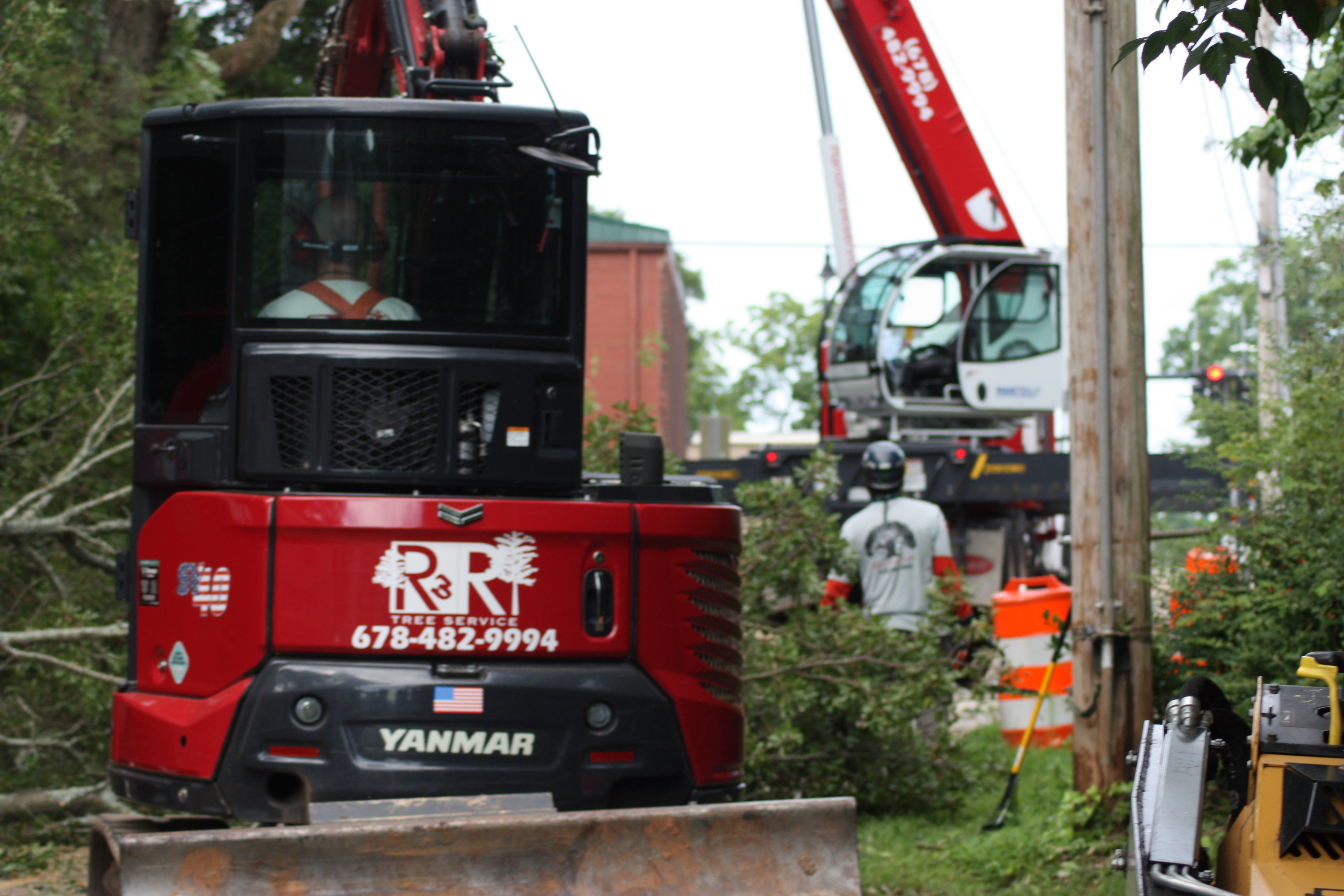
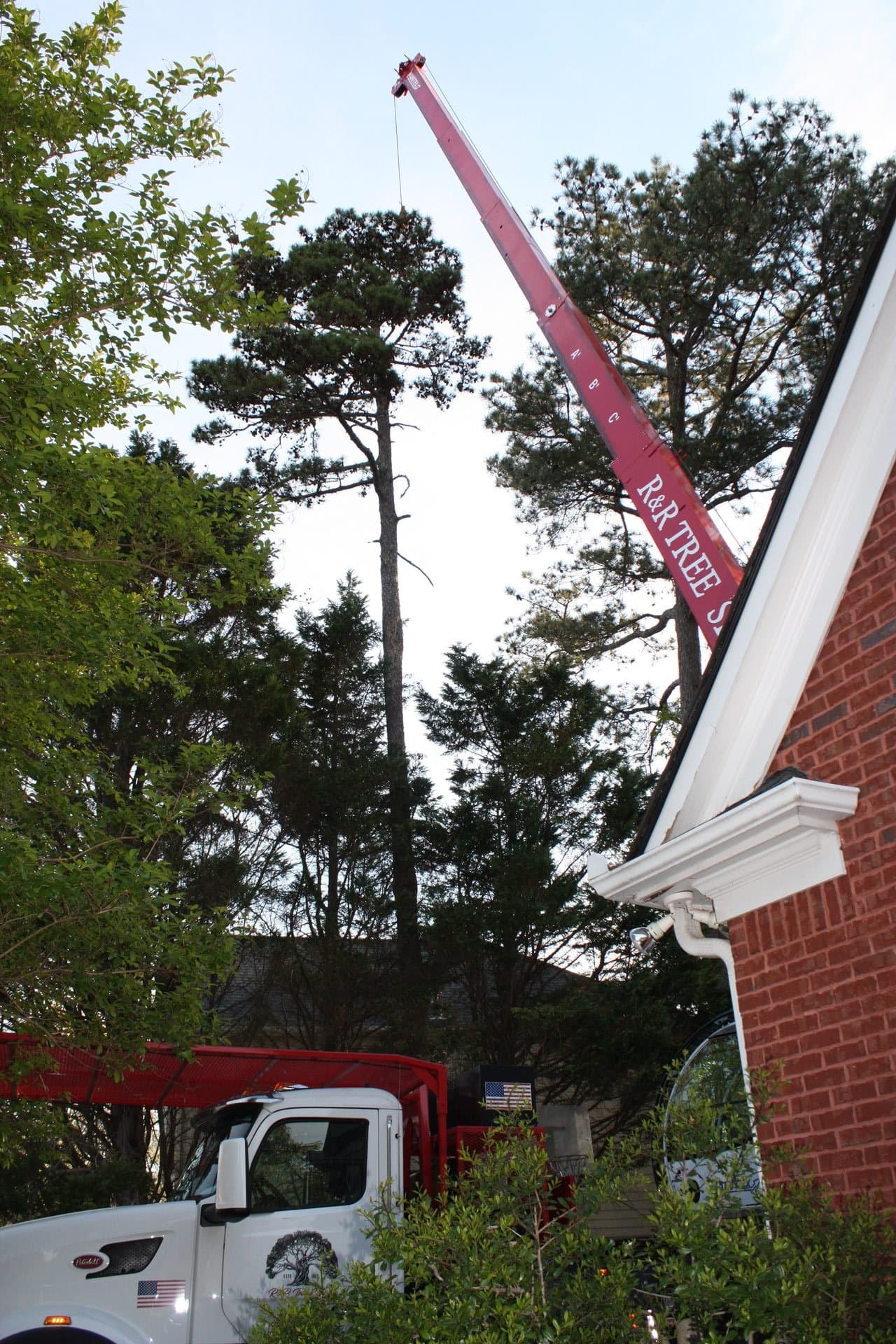
Georgia law keeps every tree crew, ours included, 10 feet from a live line until the utility has made it safe, so we tell every caller with a tree in the wires the same thing: call 911 or your electric company first. Once the utility has made the line safe, our own crew — never a subcontractor — takes the tree down and hauls it away, with our own bucket truck, chipper and, when a tree is on a roof, our own crane.
We answer emergency calls 24/7, put trees on structures first, and give written estimates in a format insurance adjusters accept. We have been doing storm work across Gwinnett, Hall and Forsyth counties since 1987, licensed and insured with general liability and workers' compensation. Call (678) 482-9994.
Frequently asked questions
Will the power company remove a tree that fell on a power line?
It will cut the tree off its line and repair the line to restore power. The remaining trunk and limbs are generally left for the property owner to remove, and Walton EMC, for example, says homeowners are responsible for the debris.
Who pays to fix the wire from the pole to my house in Georgia?
The utility usually repairs its own service wire. The mast, weatherhead, meter box and wiring on your house are yours, and Georgia Power says it cannot by law reconnect to damaged customer equipment until an electrician repairs it.
How far away should I stay from a downed power line?
At least 35 feet, and farther on wet ground, according to Electrical Safety Foundation guidance shared by utilities. Keep children and pets back, and never touch anything the line is touching.
Is a tree on a power line a 911 call?
Yes, if a line is down, sparking, on a house or car, or anyone is hurt. For a branch resting on a line that is still up, call your electric utility; do not call 911 just to report a power outage.
How do I know whether I have Georgia Power, an EMC or a city utility?
Check your electric bill. Georgia assigns electric service areas by law, so the provider depends on your address, and neighbors on the same road can have different companies.
Can a tree service remove a tree that is touching a power line?
Not until the utility has made the line safe. Georgia's High-Voltage Safety Act bars anyone working in a trade or business from coming within 10 feet of a high-voltage line until the utility has de-energized, moved or guarded it.
- Georgia 811 — High-Voltage Safety Act, O.C.G.A. §§ 46-3-30 to 46-3-40 (statute text)
- Georgia Power — Hurricane Zeta restoration update: service entry repairs and downed-line safety (Nov. 2, 2020)
- Walton EMC — Power line rights-of-way (service lines, debris, temporary disconnects)
- City of Buford — Electric Department (outage lines)
- DeKalb County — Tropical Storm Helene power outage guidance (Sept. 27, 2024)
- City of Marietta — Georgia Territorial Electric Service Act
 Call (678) 482-9994