

Split Tree Trunk: Can It Be Saved?
Quick answer: sometimes: a crack at a weak fork in an otherwise sound tree can often be held with cables and brace rods, but a trunk split clean through, or a split with decay or failing roots, usually has to come down. A split never grows back together: hardware holds it, it does not heal it. If the tree can reach your house or driveway, keep people out of its fall zone and have it looked at promptly — today if the crack is new or opening.
- Most splits start at a fork: two equal stems with bark trapped between them are a built-in weak point, and the classic place a tree splits in half.
- A split never heals shut: cables and brace rods hold the halves and cut the risk; the USDA Forest Service is plain that they do not repair the tree.
- Through-and-through is high risk: a stem split in two, a fork with included bark that is also cracked, or several cracks with decay are all rated high risk of failure.
- Not every tree is a candidate: decay, weak roots, a short-lived species like Bradford pear, or a house in the fall zone can make removal the right call.
- Never bolt it yourself: drilling and tensioning a split trunk is skilled work done to a national standard, ANSI A300 Part 3.
A split trunk usually announces itself after a storm: a dark seam down the middle of a fork, a crack you can slide a hand into, or one half of the tree suddenly hanging lower than the other. Sometimes it is quieter — a long vertical crack that seems to open in winter and close in summer.
Whether it can be saved depends on where the split is, how deep it goes, what is behind it and what is underneath it. Here is how professionals sort those cases, using the USDA Forest Service's risk ratings, and what cabling and bracing can and cannot do.
Why do tree trunks split?
Almost every split we see has one of four causes, and knowing which is most of the diagnosis.
Codominant stems and included bark
This is the big one. Codominant stems are two (or more) leaders of about the same size growing up from one point — the "V" or "Y" shape you see in many maples, oaks and pears. The International Society of Arboriculture labels codominant stems "split trunk" in its tree risk brochure and says they "can often be failure points." Purdue Extension calls them the most common risk of tree failure.
The weakness is what happens inside the fork. When two stems grow tightly together, bark gets trapped between them — "included bark." The USDA Forest Service's Urban Tree Risk Management guide explains that a strong fork has wood-to-wood connections, while a fork with included bark has bark-to-wood connections, and "bark does not adhere to wood." As the stems thicken, the trapped bark acts like a wedge. The same guide cites University of Minnesota storm surveys in which 21 percent of landscape trees that failed in windstorms failed at weak codominant unions.
Georgia winters add a local twist. UGA Extension's pruning bulletin notes that "winter ice, trapped down in crotches, often causes narrow-angled branches to split." That is exactly what we see after a North Georgia ice storm — and why ice storm damage so often shows up as split forks rather than snapped tops.
Old wounds that never closed
The Forest Service guide says the vast majority of cracks come from wounds that did not close properly, the splitting of weak forks, or flush-cut pruning. A mower scar, a torn branch stub or a bad pruning cut can become a crack years later.
Frost cracks
Frost cracks form when a sudden hard freeze follows a sunny day and the outer wood shrinks faster than the inner wood. The Missouri Botanical Garden guidance, quoted by the University of Washington's horticulture library, says they appear suddenly, can run several feet, often close in summer and reopen in later winters, and "do not seriously damage trees" on their own — though they let decay in. Maples, sycamores and tulip trees are among the most prone, which matters here: tulip poplar is one of the most common big trees in North Georgia yards.
One caution: the textbook frost crack follows temperatures well below zero, which metro Atlanta rarely sees. Do not assume a new crack is frost; have someone look at what is behind it.
Lightning
Lightning is a real cause in Georgia, not a rare one. UGA forester Kim Coder wrote that the state averages 50 to 70 thunderstorm days a year, that steam explosions from a strike "can rip off large sections of bark and wood," and that a struck tree is an open invitation to pests such as southern pine beetle. A strike often leaves a strip of bark blown off down the trunk, sometimes spiraling, according to Davey Tree. In our experience, a struck pine that is splitting or browning out is usually a removal, while a hardwood that only lost a strip of bark may be worth watching for a season.
Is a cracked tree trunk dangerous?
It depends on the kind of crack. The Forest Service defines a crack as "a deep split through the bark and into the wood," and sorts them into types that behave very differently. Here is what each looks like from the ground:
- Shear crack — the trunk or fork is split into two halves along the grain, often running through to the other side. As the tree sways, one half slides against the other and the crack lengthens. The guide's verdict: "A shear crack always has a high risk of failure."
- Inrolled crack ("ram's horn") — the edges of the crack curl inward into rolled lips of bark and wood. Serious decay is always behind this type.
- Ribbed crack — a raised ridge or rib running up the trunk, built as the tree keeps trying to seal an old crack. High risk when it comes with decay or another crack.
- Horizontal crack — runs across the grain. These are rarely seen because they form just before a tree fails; the guide calls them "a sign of imminent tree failure."
- Seam — a flush vertical line in the bark where an old wound has closed. Generally not hazardous, though it can be mistaken for a crack.
A split only in the bark is a health issue; a crack into the wood is structural. And a crack is far more serious with decay behind it: the Tree Care Industry Association's staff arborist notes that cracks "are very dangerous when combined with internal decay," and that an arborist judges them by measuring the sound shell of wood around the trunk and the width of the opening. If you suspect the tree is hollow, our guide to hollow trees covers how that shell is tested.
How do you judge how bad a split is?
The Forest Service guide gives inspectors simple risk ratings for cracks and weak forks. Put next to the situations homeowners actually call about, they make a usable decision table:
| What you see | Risk of failure | What to do |
|---|---|---|
| Trunk or fork split clean through into two halves | High | Keep everyone out of reach; call today |
| Crack running across the trunk (horizontal) | Imminent | Leave the fall zone now; call today |
| Fork with bark trapped inside that is also cracked or decayed | High | Call today; likely removal of a stem or the tree |
| Any large branch that is cracked | High | Remove the branch back to the trunk soon |
| Several cracks, or cracks with decay, in one stretch of trunk | High | Assessment this week; often removal |
| A single crack with some decay | Moderate | Assessment soon; may be supportable |
| Tight V-fork with included bark, no crack yet | Moderate | Plan pruning or a support system |
| Old closed seam or summer-closed frost crack, no decay | Generally low | Watch it; recheck after winter and storms |
What you can safely check from the yard, without touching the tree or standing under it:
- Where is the split? At a fork between two stems, in the main trunk below any fork, or in a branch.
- Does it go through? If you can see daylight through it or the crack shows on both sides, treat it as a shear crack.
- Is it moving? Photograph it from the same spot on a calm day and again after a windy one. A crack that looks wider, or bark that is newly torn along it, is active.
- What is behind it? Mushrooms or conks on the trunk, soft or crumbly wood in the crack, or a hollow sound when tapped all point to decay.
- What is the rest of the tree doing? Dead branches, a new lean, or cracked and lifted soil at the base change the picture completely. This guide to leaning trees covers the root side.
- What can it hit? Pace out the tree's height from the trunk. If the house, driveway, deck or a neighbor's roof is inside that circle, raise the urgency one level.
Can a split tree trunk grow back together?
No. This is where some of the advice online goes wrong — one guide that comes up for this search tells readers that a split tree "can grow back together" if bolted quickly. The tree can grow new wood over hardware and around the edges of a crack, but the two faces of a split do not fuse back into one piece of wood.
The USDA Forest Service guide puts it in one line: "Remember that cabling and bracing does not repair a tree." A support system adds security, cuts the strain on the weak point and, if a stem does fail, helps control which way it falls. A supported split is a managed defect for the rest of the tree's life.
Two other "fixes" do not help. Wound paint or sealer can trap moisture and encourage decay (Missouri Botanical Garden), and filling a crack or cavity with concrete does not slow decay or make the tree less likely to fail (Forest Service guide).
How do cabling and bracing work on a split tree?
Cabling and bracing are the two main support systems, and they do different jobs. Purdue Extension's guide to large tree cabling and bracing describes them this way:
- Cables run high in the crown between the stems. Traditional systems use extra-high-strength steel strand attached to bolts drilled through the wood; they limit how far the stems can move apart and share load from the weak fork to stronger wood. Dynamic or "soft" systems use synthetic rope wrapped around the stems with no drilling.
- Brace rods are threaded rods installed through a weak or split fork, lower down, to give rigid support and stop the two stems spreading or twisting against each other.
- Often both: rods through the split, cables above it. Pruning to take weight off the heavy side is usually done first.
There is a national standard for this work: ANSI A300 Part 3, the tree support systems part of the American National Standard for tree care, with the ISA's Best Management Practices: Tree Support Systems as its companion how-to guide. The Forest Service guide tells communities to hire arborists "who will agree in writing" to install all cabling and bracing to that standard. It is a good rule for a homeowner, too.
Upkeep: a support system is not install-and-forget
- Every year: look at the hardware from the ground (binoculars help) for loose, slack or rubbing cables.
- Every few years: Purdue suggests an arborist climb and inspect up close about every three years; the Forest Service guide says no installation should go more than two years without inspection, and annual is better.
- Every 7–10 years: expect the system may need replacing, per Purdue, and a new one added higher as the tree grows. Old hardware embedded in the wood is cut flush and left in place, not pulled out.
- Tell the next crew: if you sell the house or hire a different company, mention that there is steel inside the tree.
When does a split tree have to come down?
The Nebraska Forest Service's storm guidance is blunt: trees with split trunks "likely will fail completely in a later storm" and should be removed, or cabled and braced only if they have especially high value. The other authorities say the same thing more gently. A split tree is usually a removal when:
- The split runs through the main trunk below the fork, not just between two stems. There is no stronger wood to cable it to.
- There is decay behind the crack or the tree is hollow. Purdue lists decayed wood and poor health among the reasons a tree cannot be cabled or braced.
- The roots are failing — a new lean, lifted soil or snapped roots. The Forest Service guide says the roots must be strong enough to support the tree before any system is installed.
- More than a third of the trunk's circumference is torn away, for example where a big stem ripped out. The Nebraska Forest Service says that damage "cannot be repaired adequately."
- The species is short-lived or weak-wooded. UGA Extension in DeKalb County notes that Bradford pears' narrow forks make them split in storms and fail after 10 to 20 years. A split Bradford pear is not worth hardware.
- The cost does not make sense against planting a new tree — one of the questions Purdue tells owners to ask honestly.
Species matters in borderline cases. How well a tree walls off decay changes the decision, the Forest Service guide notes: the answer for a white oak may be completely different from the answer for a basswood.
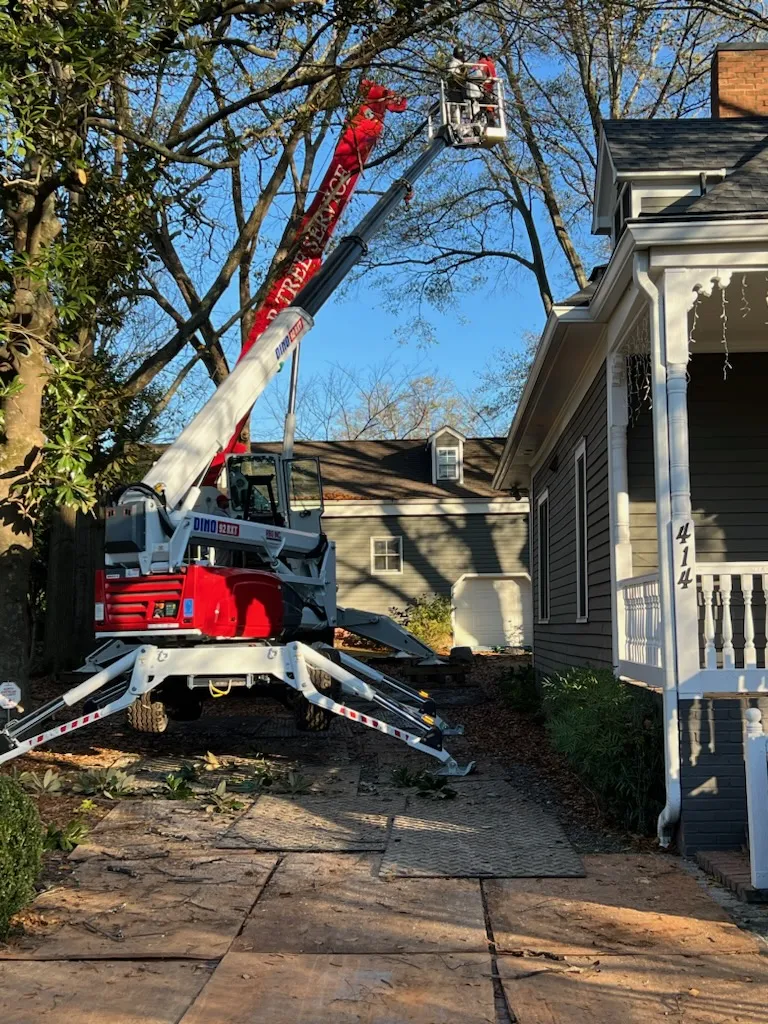
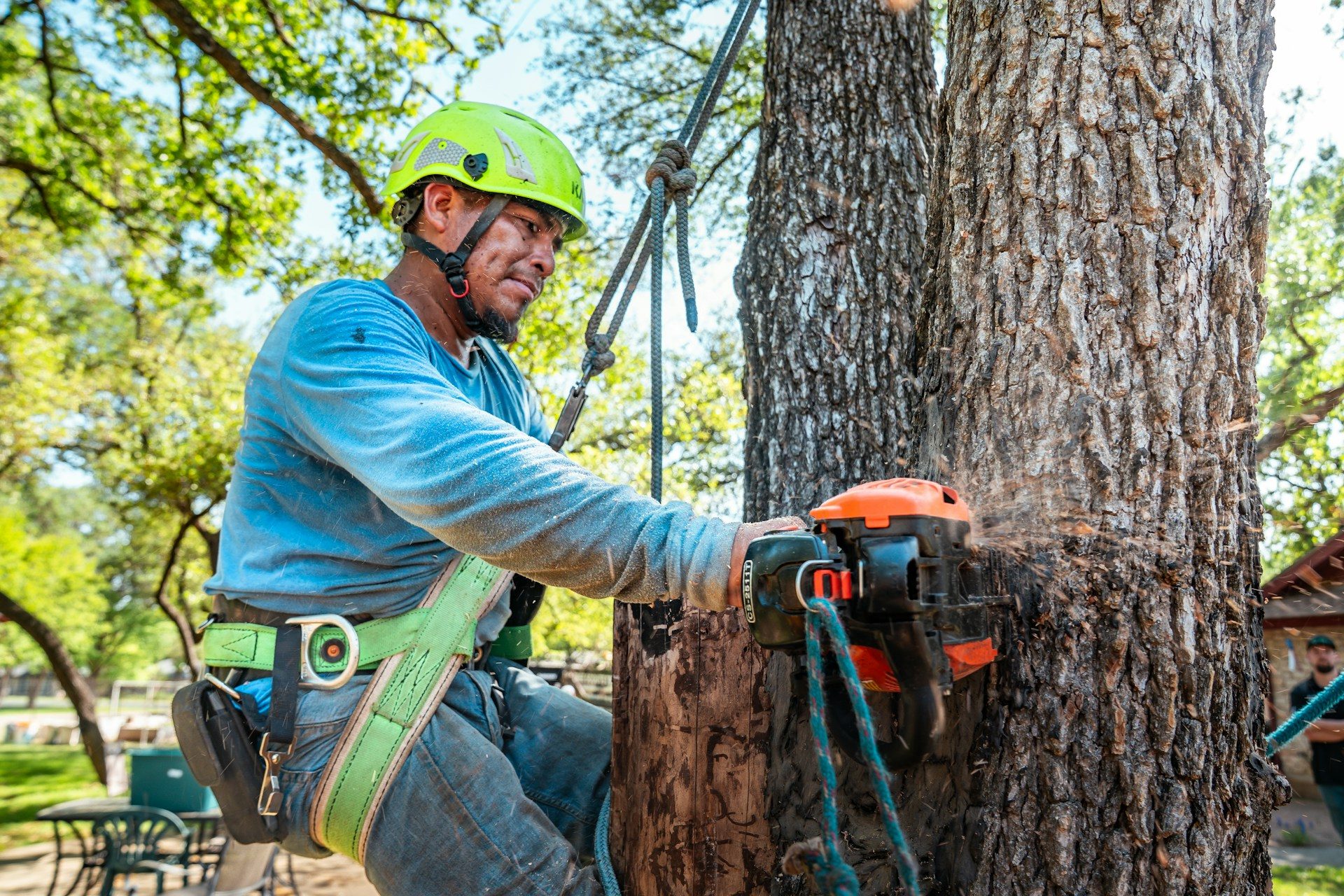
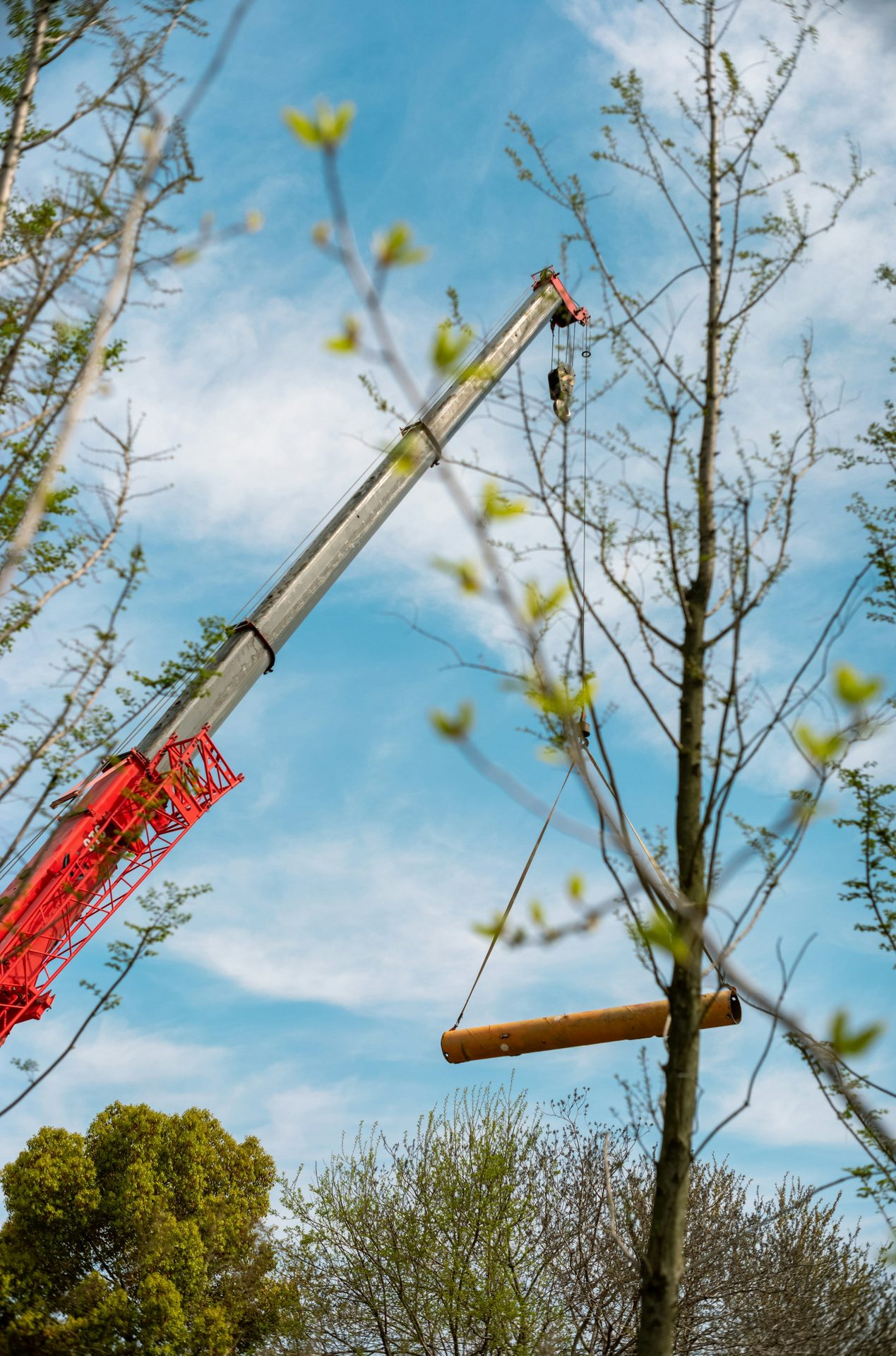
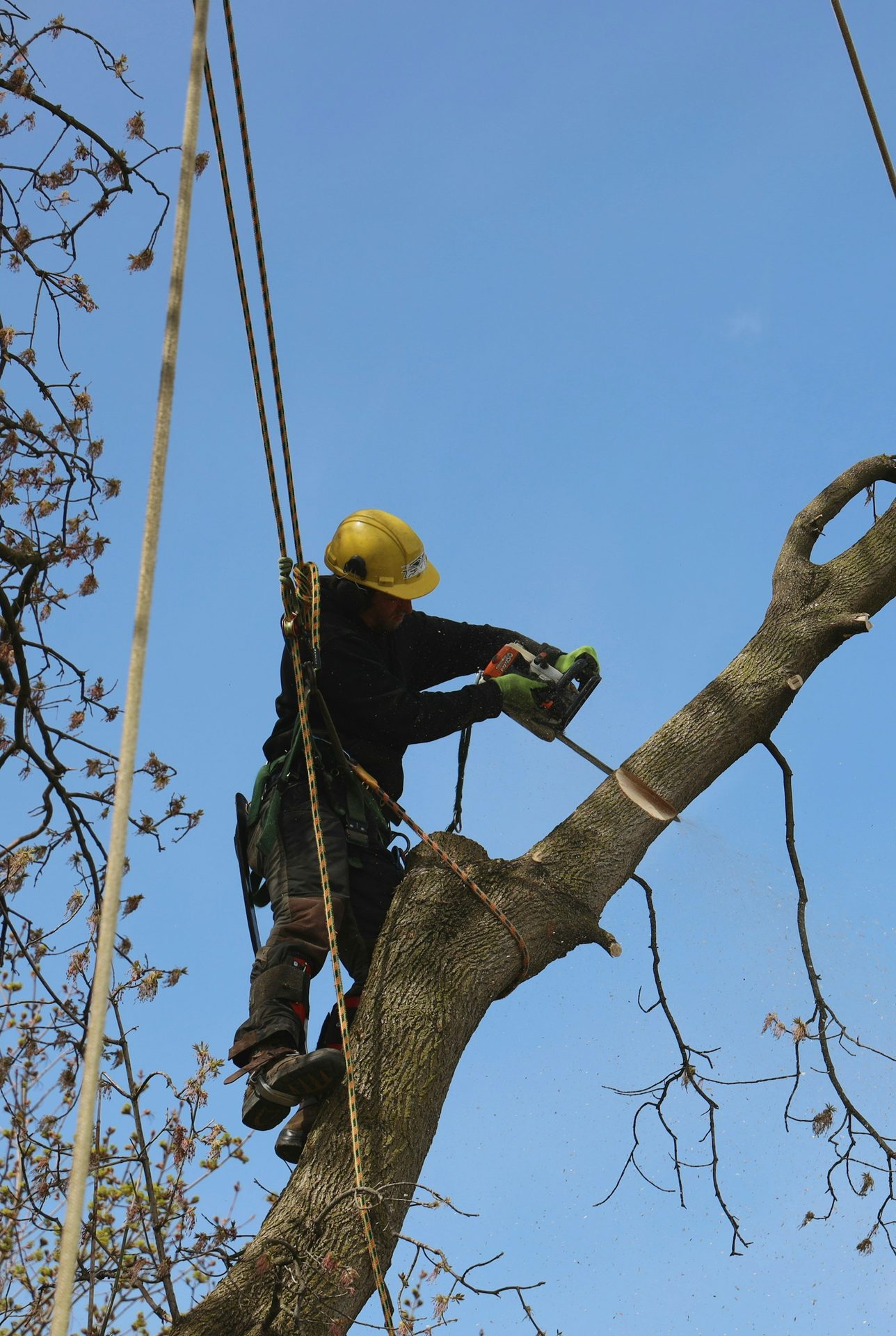
Removing a split tree is more delicate than removing a sound one: a split trunk can tear apart unpredictably when cut, so crews take it down from the top in rigged sections, or lift sections out with a crane over a roof. How we remove trees near houses and when a crane is the safer choice explain the methods.
What does a split tree near your house mean?
The ISA notes that every tree can fall, but only a small number ever hit anything. A house, driveway or play set inside the fall zone of a split tree changes the timeline.
- Act before storm season, not after. A split fork is a known weak point. Georgia's spring thunderstorms, summer storms and winter ice are exactly the loads that finish it off.
- Partial removal is an option. If one stem is cracked and the other sound, taking out the cracked stem can sometimes leave a safe tree. For a large cracked branch, the Forest Service guide says removing it back to the trunk is usually the most effective remedy.
- Insurance pays after, not before. Removing a split tree before it falls is maintenance on a standard homeowners policy; our insurance guide explains what is covered once something falls.
- If the tree is your neighbor's, put the problem in writing. Who pays when a neighbor's tree falls explains why a written notice matters in Georgia.
And if a split stem is already hanging or resting on the roof, do not go under it or onto the roof to look. Call our 24/7 emergency crew on (678) 482-9994, and see hanging branches and widowmakers for why a half-fallen stem is more dangerous than one on the ground.
How R & R Tree Service handles split trees
We have been looking at split, cracked and storm-torn trees across Gwinnett, Hall and Forsyth counties since 1987. When you call about a split, we come out, look at the split, the wood behind it, the roots and what sits in the fall zone, and tell you plainly whether it is a removal, a job for careful trimming to take out the cracked stem, or a tree that may be worth supporting — in which case we will say so, and you may want an ISA Certified Arborist's opinion as well.
When a split tree has to come down near a house, our own crew does it with our own bucket truck and crane — never a subcontractor. We are a TCIA member, licensed and insured with general liability and workers' compensation, and every estimate is free, written and itemized; the number on the estimate is the number on the invoice. If your county or city requires a permit, we handle the application (see the North Georgia permit guide). Call (678) 482-9994.
Frequently asked questions
Can a tree split in half be saved?
Sometimes, if the split is at a fork between two stems, the wood is sound and the roots are healthy; cables and brace rods can hold it. A trunk split clean through below the fork, or a split with decay behind it, usually has to be removed.
Should I fill or seal a crack in my tree?
No. Wound paint and sealers can trap moisture and encourage decay, and filling a crack or cavity with concrete or another rigid material does not slow decay or make the tree less likely to fail, according to the USDA Forest Service.
Can I bolt a split tree trunk together myself?
It is not a safe homeowner job. Support systems are installed to a national standard (ANSI A300 Part 3), and Purdue Extension warns that done incorrectly they can create an even greater hazard. A split stem under tension can shift while you work beside it.
How long does tree cabling last?
Purdue Extension says to expect regular inspections and possible replacement after 7 to 10 years. The USDA Forest Service says no cabling or bracing should go more than two years without an inspection, and yearly is better.
Are frost cracks dangerous?
Usually not on their own. Frost cracks often close in summer and reopen in winter, and they mainly let decay in. They become a concern when decay develops behind them or a second crack forms in the same part of the trunk.
What does it mean when a tree trunk looks cut in half?
Usually a shear crack: the trunk or fork has split into two halves along the grain, often at a fork with bark trapped inside it. The USDA Forest Service rates that as a high risk of failure, so keep people out of its reach and have it looked at promptly.
- USDA Forest Service — Urban Tree Risk Management: A Community Guide to Program Design and Implementation (cracks, weak branch unions, risk ratings, cabling and bracing, ANSI A300 Part 3)
- International Society of Arboriculture (TreesAreGood.org) — Recognizing Tree Risk
- Purdue Extension — Large Tree Cabling and Bracing (FNR-550-W)
- UGA Extension — Basic Principles of Pruning Woody Plants (B 949)
- UGA Extension, DeKalb County — Bradford Pears: How Did They Get Here?
- Nebraska Forest Service — Recognizing & Correcting Tree Hazards
 Call (678) 482-9994