Does Roswell require a permit to remove a tree?
Yes — a Tree Removal Permit is required for the removal of any tree larger than three inches in diameter. That threshold is low enough that it covers essentially any established tree, so treat a permit as the default rather than the exception. The city also flags several other circumstances that can require one, and points to Article 12.1.3 of its Unified Development Code for the full picture.
What is the Chattahoochee River Corridor and am I in it?
Roswell defines it as property within 2,000 feet of the Chattahoochee, and it is a far wider band than people expect — it catches lots well back from the water. If you are in it, the city requires you to contact Planning & Zoning on (770) 817-6720 before removing any trees at all, whatever their size. That is a stricter rule than the three-inch threshold, not an alternative to it.
My neighbour has a tree I think is dangerous. Will the city make them remove it?
No. Roswell is explicit that it has no legal authority to require the removal of a tree on private property unless that tree threatens public property — a public street, a pavement, a schoolyard, a park. A dispute between neighbours about a tree is a civil matter and the city will not step in. The same applies if a neighbour's tree falls onto your land: it is civil, and each owner is responsible for clearing debris on their own property.
Can I cut the branches hanging over my side of the fence?
Generally yes. The city's own guidance is that you have the right to cut any part of a neighbour's tree overhanging your property, provided you do not permanently damage the tree — which is the important limit, because "cutting back" that guts one side of a mature crown can cross it. Roswell recommends telling your neighbour beforehand to avoid the legal argument, and that is sound advice we would repeat.
My neighbour in Alpharetta was told they need a permit for any live tree. Same here?
That is Alpharetta's rule, not Roswell's — Alpharetta requires an approved application before removing any living tree from single-family residential land inside its limits. North Fulton cities diverge sharply on this, so what applies one suburb over is not a safe guide to what applies at your address.
What does the city actually want to see on an application?
Specifics rather than descriptions: the species, the size measured properly at breast height, where each tree stands on the property, and the reason it is coming out — supported by photographs and, for anything significant, an assessment. Vague submissions are what turn a short review into a long one.
Why is a job on the mill side of town more expensive?
Access, almost always. The ground around Vickery Creek and the older mill district falls away steeply and the cover is dense, so equipment cannot reach the stem and material has to be rigged and carried up rather than dropped and dragged out. Slope does more to the price than trunk diameter on that side of Roswell.
Trees near the creek keep coming down. Is something wrong with them?
Usually not with the trees — with the ground. Bottomland species like sycamore, river birch and box elder grow soft timber on shallow plates in soil that stays wet. They tip rather than snap, and they do it in wind that the same species would shrug off on drier, firmer ground uphill.
What should be done before winter?
Prioritise the pines. Glaze ice loads an evergreen crown across its whole surface and pines snap at height rather than tipping, so forked tops, old lightning scars and leans towards a roof are autumn work. Hardwoods are more about root plate and lean in saturated ground than about crown weight.
We have a very old tree in the historic district. Is it treated differently?
Practically, yes — and it should be. Veteran trees are not simply large young trees; they have retrenching crowns, hollowing stems that may still be structurally sound, and root systems that have adapted to a century of the same conditions. The instinct to "tidy them up" with heavy pruning is usually the worst thing you can do, because an old tree has far less stored energy to respond with. Where a veteran can be retained, the right work is normally a light crown reduction to lower the leverage, selective deadwood removal over targets only, and leaving the rest alone.
Is a hollow trunk automatically a reason to remove a tree?
No — and this is one of the most common misunderstandings we correct. Trees are engineered as hollow tubes and a surprising amount of the strength sits in the outer shell. A stem can carry a substantial central cavity and remain sound, while another with intact-looking wood can be badly compromised by a decay pocket at a union or by root loss underground. What matters is the ratio of sound wood remaining, where the defect sits relative to the load, and what stands beneath it. That is an inspection question, not something to judge from the size of the hole.
Can you work on a tight historic Roswell lot?
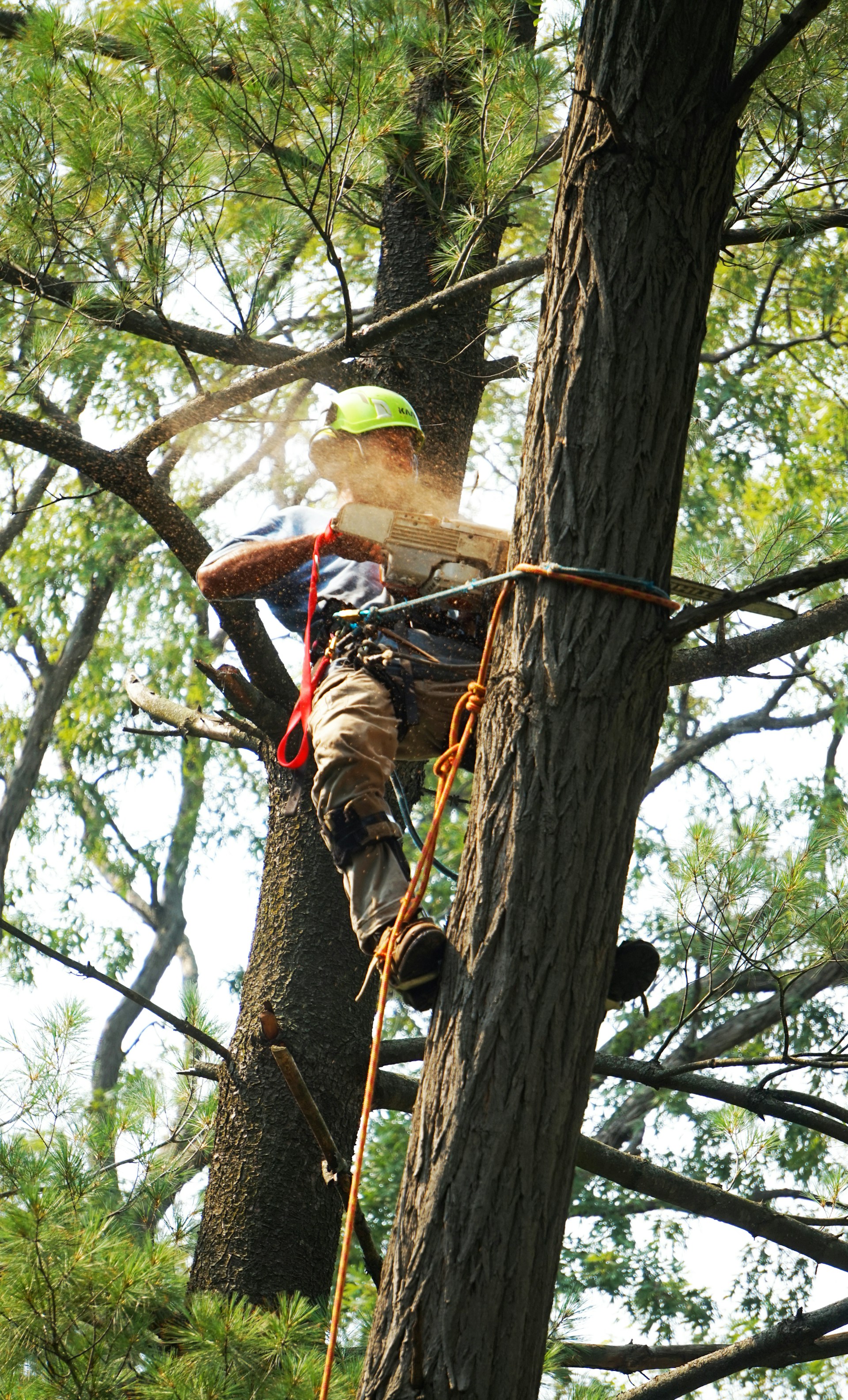
Yes, and it is most of what we do there. Mature stems over rooflines with no drop zone means controlled sectional dismantling with rigging, or lifting sections out by crane — which we own rather than hire, so the option is always available. R & R has been family-run in North Georgia since 1987, is licensed and insured and a member of the Tree Care Industry Association, and never subcontracts. Free estimates on site; 24/7 emergency cover on (678) 482-9994.