
Ice Storm Tree Damage: What to Remove and What to Save
Quick answer: most ice-damaged trees can be saved if the main trunk is intact and at least half the crown is left; a tree that lost half its crown, split its trunk, snapped its top out (pines) or lifted its root plate usually has to come down. Remove hanging limbs and anything over the house right away, make clean pruning cuts over the next few weeks, and judge borderline trees after spring leaf-out. Bent young trees often straighten; broken conifers and split Bradford pears rarely recover.
- Wait for the melt: knocking ice off branches breaks more of them. Stay out from under the tree until the ice is gone.
- The 50% line: a healthy tree with its leader intact and half its crown left has a good chance; past half, removal is the standard advice.
- Automatic removals: a split trunk, a snapped pine top, a lifting root plate, or a broken-apart Leyland cypress or arborvitae.
- Species matter: Bradford pear, water and laurel oak, Leyland cypress, maples and pecan break worst; river birch, crape myrtle and bald cypress hold up.
- Timing: hazards now, clean cuts within weeks, final save-or-remove calls after spring leaf-out, and no more than about a quarter of the crown pruned in a year.
After a North Georgia ice storm the yard can look like a total loss. Usually it is not. Most trees that lose twigs and small limbs recover on their own, and many that look terrible from the porch can be pruned back into shape. A few cannot, and leaving those standing is how a second failure happens weeks later.
Below: how ice breaks trees, which Georgia species fail, how to read crown loss, and when to prune versus remove, drawn from UGA, NC State and Clemson Extension, the NC Forest Service, the USDA Forest Service and the International Society of Arboriculture (ISA). If a tree is on your house or a power line right now, skip this and start here.
How does an ice storm damage trees?
Ice storms break trees by weight. Freezing rain coats every twig, and on a broad crown that adds up fast: a study of Urbana, Illinois street trees after a 1990 ice storm, published in the ISA's journal, notes that ice can increase branch weight up to 30 times. The same paper sets out the thickness bands most foresters still use:
| Ice on branches | Typical damage | What you see |
|---|---|---|
| Under 1/4 inch | Light | Bent twigs, a few small limbs down |
| 1/4 to 1/2 inch | Small and faulty limbs break | Weak forks and dead wood fail first |
| 1/2 to 1 inch | Conspicuous breakage | Large limbs, tops and whole trees |
| Any ice plus wind | Much worse | Even light wind breaks or uproots loaded trees |
The ISA warns that a quarter to half inch of ice with 25 to 35 mph gusts can cause excessive limb damage that is not always visible from the ground. Three other things decide which trees break:
- Size. In the Urbana survey, 1.3% of trees 12 inches in diameter or less were severely damaged, against 17.1% of trees over 24 inches. Big, broad crowns catch more ice.
- Structure. Fine branching, lots of side branches and weak forks failed most. The tree's wood density on its own did not predict damage.
- Cold, wet wood. The USDA Forest Service review of ice storms in the South (Bragg and others, 2003) notes cold, green wood breaks more easily, and wood near the top of young loblolly pines was about 25% less dense than near the base — one reason pine tops snap.
Georgia gets this regularly. In February 2014, UGA Extension reports, ice from a tenth of an inch to an inch or more fell in a band from roughly north metro Atlanta to Augusta, nearly a million customers lost power, and more than 70,000 acres of pine timber were damaged (UGA Extension). Our post on Georgia pines in ice covers that storm in detail.
What should you do while the ice is still on the trees?
Very little, and that is the point. Every extension guide we read says the same thing: let the ice melt.
- Do not knock or shake ice off branches. SDSU Extension says it causes more breakage, particularly on pines; Clemson Extension says the same.
- Do not use salt or a torch on the tree. De-icing salts are toxic to plants, and a flame burns buds. NC State warns that sodium chloride can damage roots and foliage of plants within 30 feet.
- Do not stand or park under an iced-up tree. Limbs keep falling for days, especially when the wind picks up.
- Do not touch anything near a wire. A limb on a line can be live even if your power is out. Here is who to call.
- Do not start pruning a branch just because it is bent. Clemson notes a bent branch may straighten on its own in a few days.
What you can do: photograph every damaged tree before anything is cut, and keep people and pets away from any broken limb still hanging in the canopy. Hanging branches are their own hazard; leave them to a crew.
Which trees are damaged worst by ice storms in Georgia?
NC State Extension calls the Bradford pear "the classic example" of a weakly structured tree that destroys itself in winter storms. Its lists of weak-wooded trees, together with Clemson, UGA and the USDA Forest Service review, line up with what we see across Gwinnett, Hall and Forsyth after ice:
| Tree | How it fails in ice | Outlook |
|---|---|---|
| Bradford pear | Narrow forks split apart | Poor; replace with a stronger tree |
| Water oak, laurel oak | Weak wood; large limbs break | Fair if crown is mostly intact; check wounds |
| Red and silver maple | Limbs break; weak wood | Fair; wounds decay readily |
| Pecan | Weak wood; big limbs break | Judge by how much crown is left |
| Leyland cypress, arborvitae, juniper | Splays open or breaks apart | Broken apart: will not recover |
| Loblolly pine | Top snaps or tree bows | Leader gone: will not recover. Bent: may straighten |
| Slash and longleaf pine | Breaks more than loblolly | Same as loblolly, but more of them fail |
| Southern magnolia | Ice on evergreen leaves breaks branches | Usually limb damage; prune and keep |
| River birch | Bends to the ground, rarely breaks | Good; let it recover |
| Crape myrtle, bald cypress, white oak, hickory | Comparatively little damage | Good |
The weak and strong lists come from NC State Extension and its Pender County office, which notes river birch "bends readily under the weight of ice but rarely breaks"; NC State also says conifers that break apart "will not recover." The pine rows are from the USDA Forest Service review, which cites a Georgia plantation with almost 10 times as many injured slash pines as loblolly. Pines get their own post.
Two more patterns. Evergreens hold ice on their leaves — Clemson calls evergreen plants "particularly susceptible" — while the Forest Service review notes most hardwoods are bare in peak ice season and so are less likely to die from it. And the trees that fail are often already compromised: a weak fork, a dead limb, a hollow. Ice finds the defect.
How much crown loss can a tree survive?
The crown is the whole leafy top of the tree. Leaves are how a tree feeds itself, so the share of crown it lost is the best single guide to whether it lives:
| Crown lost | Usual outcome | Usual call |
|---|---|---|
| Twigs and small limbs only | Full recovery likely | Clean up broken ends; save |
| Up to about 25% | Good recovery in a healthy tree | Prune the breaks; save |
| 25% to 50%, leader intact | Good chance if the tree was healthy | Conservative pruning over a few years; save if worth it |
| 50% or more | Recovery unlikely | Remove (the standard rule) |
| About 75%, or half lost on one side | Lopsided, wind-prone, years of work | Remove unless it is a special tree |
Colorado State Forest Service, adapting ISA guidance, says a healthy tree that still has its leader, most of its major limbs and 50% or more of its crown has a good chance of complete recovery. NC State's Pender County office says that if more than half of a tree's limbs are damaged it is "highly unlikely to recover." The NC Forest Service storm assessment guide makes it a blanket rule: remove a tree that has lost 50% or more of its live crown, which is also the FEMA debris code for removal (F5).
Why some guides say one-third and others say one-half
You will see both numbers, and they are not really in conflict. The one-third figure usually applies to young trees (SDSU Extension uses it for trees under 15 feet) or counts broken limbs, not lost leaf area. The one-half figure applies to crown on established trees. A big tree can lose a third of its limbs and still keep well over half its leaf area if the breaks were near the tips.
The rule bends with the tree. The NC Forest Service weighs four things: health before the storm, age and size (young trees have more stored energy to regrow), how well the species resists decay, and whether the loss is even or one-sided. Its decay table puts white and post oak among the resistant species, water and southern red oak in the middle, and sweetgum, tulip poplar, maples, hickories and magnolias among the least resistant, so big wounds on those rot faster. A healthy, middle-aged white oak that lost 45% evenly is a far better bet than an old, declining water oak that lost 40% on the house side.
Which ice damage means the tree has to come down?
Some damage is not a judgment call. These almost always mean removal, according to the NC Forest Service, NC State and SDSU Extension guides:
- A broken main leader on a pine (or any tree that grows one straight trunk). Pender County Extension: when the trunk on pines and hickories fails, "they will not recover."
- A split trunk, or a fork that split down into the trunk. The NC Forest Service codes a codominant stem split into the trunk as a removal. Some splits can be cabled, but a deep one cannot.
- Cracks into the heartwood, or a crack that runs into decay or a cavity.
- A root plate that is lifting: soil mounded or cracked on the side away from the lean, or a mound that feels soft or moves in the wind.
- A mature tree that fell or tipped, or one with a third or more of its roots exposed. NC State says trees over 10 to 12 inches in trunk diameter in that state should be removed.
- Big bark tears where limbs peeled off the trunk, which SDSU Extension says leave a tree more prone to decay and a shorter life.
- Conifers broken apart: Leyland cypress, arborvitae, juniper and cedar do not regrow a shape.
Location changes the answer too. A borderline tree in the back woods can be left to see what it does; the same tree over a bedroom or a neighbor's roof should not. If ice left a tree leaning, this guide to leaning trees helps you read it.
Which ice-damaged trees can be saved?
More than most people think. The UGA Extension forester David Dickens advised Georgia homeowners after a 2002 storm that the best response is to clean up the mess and leave the rest alone. Good candidates to keep:
- Trees that lost only twigs and small limbs. NC State: they will likely make a full recovery.
- Healthy trees with the leader intact and at least half the crown. Expect a lopsided look for a few seasons; most fill back in.
- Bent but unbroken trees. River birch and young pines often stand back up. UGA's rule of thumb for bent pines is to give them the next growing season.
- Young trees under about 15 feet with only a few limbs or the tip broken. SDSU says corrective pruning, including training a side branch into a new leader, often saves them.
- Hardwoods with limb and top breakage. In the 2014 storm, UGA Extension found most damaged hardwoods kept enough live branches to survive.
A valuable tree with a partial split can sometimes be held together with cables and braces; the ISA notes trees may need that kind of support after major ice stress, and SDSU Extension says the hardware is best left to professionals. It is not a job for a ratchet strap.
Should you prune ice-damaged trees now or wait until spring?
Both, in stages. Here is the order we work in after a Georgia ice storm:
- The first days: hazards only. Broken limbs hanging in the crown, split limbs over the house, driveway or play area, and trees on structures. The NC Forest Service treats hanging limbs over 2 inches at the break as a first-priority removal (FEMA code F1).
- The first few weeks: clean cuts. Broken limbs are cut back to the branch collar or a healthy side branch, with no stubs and no flush cuts. SDSU says tree paints and wound dressings do not protect against decay and can make it more likely; the clean cut is the protection.
- Spring leaf-out: the final call on borderline trees. Clemson notes that damage inside the tree can stay hidden until branches die back in spring. A tree that leafs out well across most of its crown is a keeper; one that stays bare on big sections is telling you something.
- The first growing season: bent pines. UGA's guidance is to give a bent pine a growing season; if it has not straightened in a year, remove it. Clean up broken pine tops and limbs before warm weather, because resin from damaged pines draws bark beetles (more on pines).
- The next few years: restoration pruning. The NC Forest Service says pruning standards allow no more than 25% of a tree's live crown to be removed in a year. A tree that already lost a third to ice cannot be "evened up" in one visit.
Never let anyone top the tree — cut the big limbs back to stubs to "make it safe." The ISA, NC State and SDSU all warn that it weakens the tree and makes it more dangerous. Do not over-prune for looks either; NC State says the tree needs every leaf it has left, and suggests a slow-release fertilizer in spring and water in dry spells. Not sure a damaged tree survived the winter? Here is how to tell.
Is it safe to clean up ice-damaged trees yourself?
Picking up small limbs that are already on the ground, away from any wire, is fine. Almost everything else after an ice storm is more dangerous than it looks:
- Spring poles. SDSU Extension warns that a limb pinned under the weight of the tree can whip back when it is cut and strike the person or the saw.
- Rolling trunks. The same guide notes trees have rolled when a broken branch was freed, crushing the worker under 5 to 10 tons of wood.
- Things above you. The ISA warns that limbs and trees resting in other trees or on roofs can keep moving after the storm, and that wood under tension reacts unexpectedly when cut.
NC State's line is simple: if a branch needs a ladder or a chainsaw, strongly consider a professional. When you hire, the ISA's storm brochure and its 2014 advice come down to: get proof of insurance covering property damage and workers' compensation, skip anyone knocking on doors with storm discounts, and look for an ISA Certified Arborist to assess trees you are unsure about. In a city with a tree ordinance, check permit rules before removal.
Does insurance pay for trees damaged by ice?
Only in narrow cases: the standard homeowners policy pays to remove a tree felled by the weight of ice if it hit a covered structure or blocks the driveway, with a small per-tree cap. Our insurance post has the wording, and this checklist covers the photos to take first.
How R & R Tree Service handles ice storm damage
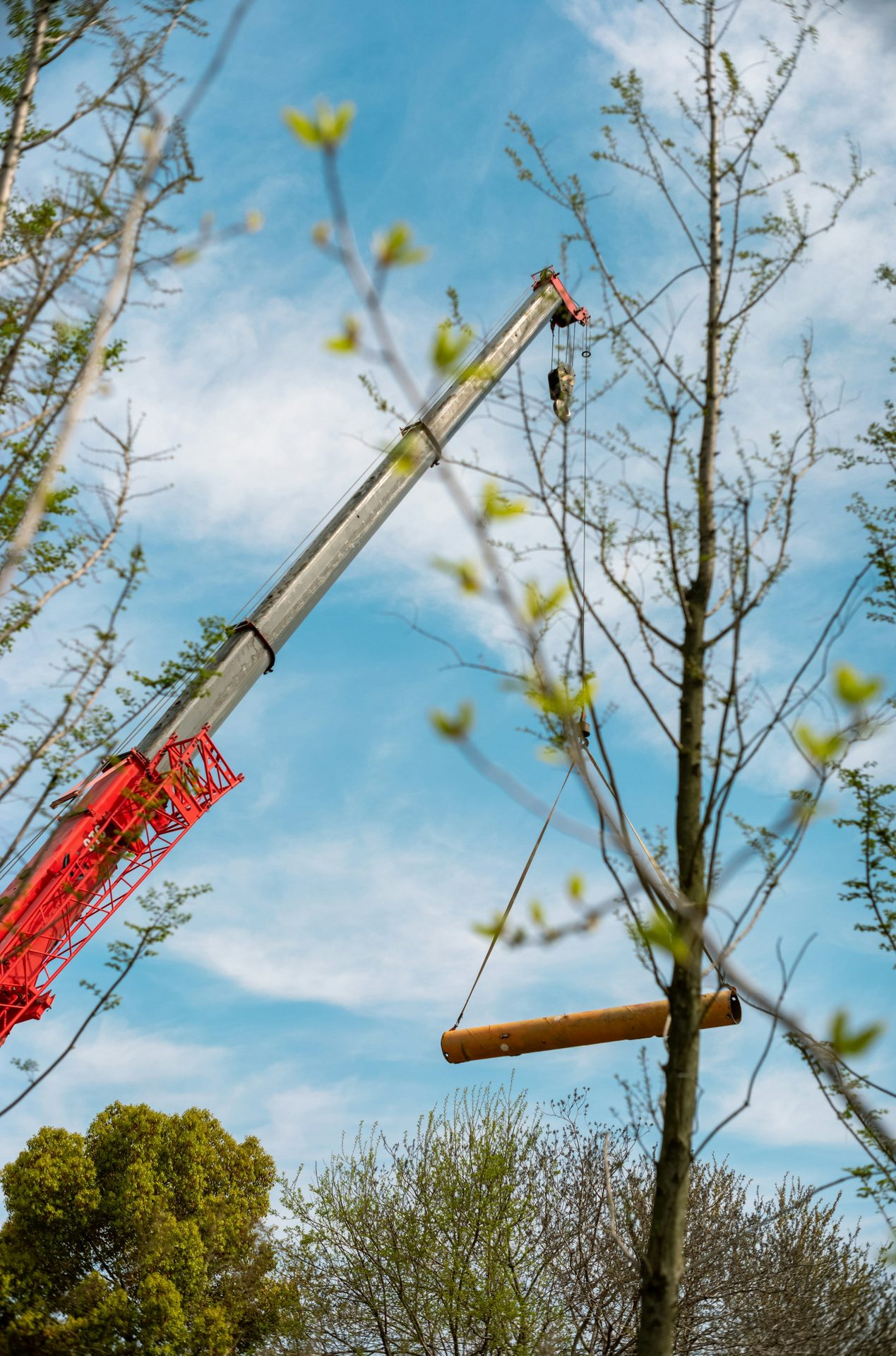
Family-owned since 1987, we work North Georgia ice storms with our own crew and equipment: bucket truck, chipper, stump grinder and our own crane for trees that cannot be climbed safely. Never subcontracted. After an ice storm we answer 24/7 emergency calls and take trees on houses first, then come back to work through the yard: hangers out, broken limbs cut clean, and an honest read on which trees to keep, which to watch until spring and which to take down.
We are a TCIA member, licensed, bonded and insured with general liability and workers' compensation. Every estimate is free, written and itemized, in a form insurers accept. For storm pruning, removal or a second opinion on an ice-damaged tree anywhere from Buford to Gainesville and Cumming, call (678) 482-9994.
Frequently asked questions
Will a tree recover from ice storm damage?
Usually, if it was healthy, its main trunk is intact and it kept at least half of its crown. Trees that lost only twigs and small limbs almost always recover. Trees that lost half or more of the crown, or the top of a pine, rarely do.
Should I knock ice off my trees?
No. Extension guides from SDSU and Clemson both warn that knocking or shaking ice off branches causes more breakage. Let the ice melt and keep people out from under the tree until it does.
Will a bent pine tree straighten after an ice storm?
Young pines often do. UGA Extension's rule of thumb is to give a bent pine the next growing season, and remove it if it has not straightened within a year. Older, taller pines bent far over rarely come back.
Should I seal pruning cuts on ice-damaged trees?
No. SDSU Extension says tree paints and wound dressings do not protect against decay and can make it more likely. A clean cut at the branch collar is the best protection.
How soon should ice-damaged trees be pruned?
Hazards like hanging limbs and broken limbs over the house should come out right away. Clean-up cuts can follow over the next few weeks, and final decisions on borderline trees are best made after spring leaf-out.
Which trees are most likely to break in an ice storm?
Bradford pear, water and laurel oak, red and silver maple, pecan, Leyland cypress and slash pine break most often in the South. River birch, crape myrtle, bald cypress and white oak hold up better.
- N.C. Forest Service — Storm-Damaged Tree Assessment: Best Management Practices (crown loss, FEMA codes, 25% pruning limit, decay resistance)
- NC State Extension — Preventing and Managing Ice and Snow Damage to Landscape Plants
- UGA CAES — Cleanup, Patience Best for Damaged Trees
- USDA Forest Service, Southern Research Station — Bragg, Shelton & Zeide (2003), Impacts and management implications of ice storms on forests in the southern United States
- Hauer, Wang & Dawson (1993), Ice Storm Damage to Urban Trees — Journal of Arboriculture (ISA)
- Clemson Cooperative Extension HGIC 2359 — Storm & Weather Damage
 Call (678) 482-9994