
Dead Tree Removal Cost: What Changes the Price
Quick answer: a standing dead tree usually costs about the same to remove as a live tree of the same size, and often more, because brittle wood cannot be climbed safely and the job moves to a bucket truck or crane. National cost guides put an average tree removal at roughly $750 to $850, with most jobs between about $200 and $2,000. A dead tree that is already on the ground costs far less. Your real number depends on what the tree could hit and how long it has been dead.
- Same chart, different job: height and trunk size set the base price, dead or alive.
- Why it often costs more: decayed wood can make climbing unsafe, so crews switch to a bucket truck or a crane.
- Why it sometimes costs less: a dead tree has no leaves and may be hollow, so it is lighter to lower and haul.
- Time is the hidden driver: the longer a tree stands dead, the more brittle it gets and the fewer safe ways there are to take it down.
- Georgia pines: southern pine beetle spots jumped from 273 in 2023 to more than 1,600 in 2024, and a beetle-killed pine can put the pines around it at risk.
Most people assume a dead tree should be the cheap job: no leaves, half the branches already on the lawn. Then the estimates come back the same as a healthy tree, or higher.
Below is what actually changes the price of a dead tree, the national figures the big cost guides publish (and where they disagree), what is different about dead pines in North Georgia, and how to compare quotes so you are paying for the right method. For the general factors behind any removal estimate, see our tree removal cost guide; this post is only about dead trees.
Does a dead tree cost more to remove than a live one?
Usually about the same, often more, and occasionally less. Every national guide we read starts from the same place: height and trunk diameter set the price whether the tree is alive or dead. Bob Vila, drawing on HomeAdvisor, Angi and Fixr, says a dead tree that is still standing will cost about the same to remove as a living tree of the same size. What moves it from there is how the tree has to come down.
| Factor | Pushes the price | Why |
|---|---|---|
| Brittle or decayed wood | Up | May not be safe to climb; bucket truck or crane instead |
| Dead top or loose limbs | Up | Pieces must be lowered, not dropped, and limbs shed when the trunk is jarred |
| Close to the house, fence or lines | Up | No room to fell it; it comes down in small sections |
| No leaves, lighter wood | Down | Less weight to rig and less debris to chip and haul |
| Hollow trunk | Either way | Lighter, but less predictable to cut and lower |
| Open yard, clear fall zone | Down | Can often be felled in one piece |
| Already on the ground | Down | No climbing or rigging; cut up and haul away |
Bob Vila puts it both ways too: sometimes dead trees are less costly because they are hollow and not as heavy, and sometimes supports are needed to stop the tree falling while it is cut, and ladders or lifts could be required if it cannot be safely climbed. Which way your tree goes is the first thing a crew is judging on the walk-through.
How much does dead tree removal cost? National figures
R & R Tree Service does not publish prices, because no two dead trees are the same job. What we can do is show you what the national cost guides say, so you know the ballpark before anyone walks your yard. These are national, third-party figures, not Georgia quotes and not ours:
| Situation | National figure | Source |
|---|---|---|
| Average tree removal | $750 (typical $200–$2,000) | Bob Vila, citing HomeAdvisor, Angi, Fixr |
| Average tree removal | $850 (typical $385–$1,070) | Lawn Love |
| Dead tree, hollow and lighter | $400–$900 | Bob Vila |
| Tree up to 30 ft | $285–$435 | Lawn Love |
| Tree over 80 ft | $1,160–$2,000 | Lawn Love |
| Pine tree (50–100 ft typical) | $475–$1,450 | Lawn Love |
| Dead tree already fallen | $90–$300 / $300–$500 | Lawn Love / Bob Vila |
| Emergency removal | $450–$3,000; up to $5,000 | Lawn Love; Bob Vila |
Notice that the guides disagree: the "already fallen" figure differs about threefold between two of them. And the figures are for an ordinary tree. A dead 80-foot pine leaning over a roof is not an ordinary tree, and no average covers it. Lawn Love also says a tree in poor condition, diseased or storm damaged, costs more because it is more difficult to remove.
Why can't a crew just climb a dead tree?
Because the tree may not hold them. Climbing is normally the cheapest way to take a tree down in sections near a house: one climber, ropes, a ground crew. A dead tree can take that option away, and every option after it costs more.
This is not just tree-crew caution; it is in the federal rules. OSHA's citation guidance for tree care (Directive CPL 02-01-045), reproduced in the Tree Care Industry Association's guidance on crane practices, tells inspectors to ask whether the tree is safe to climb and states that "climbing decayed or damaged trees could be hazardous." It gives insect damage to the bark as an example of what can make climbing infeasible, and lists the alternatives in order: aerial lifts (bucket trucks) first, cranes in addition when heavy limbs have to be handled.
That is the equipment ladder you are paying for on a dead tree:
- Climb and rope it down. Possible on a recently dead tree that is still sound. Least equipment, usually the lowest cost.
- Bucket truck. The cutter works from the bucket instead of the tree. Needs a place to park the truck within reach, and firm ground under it.
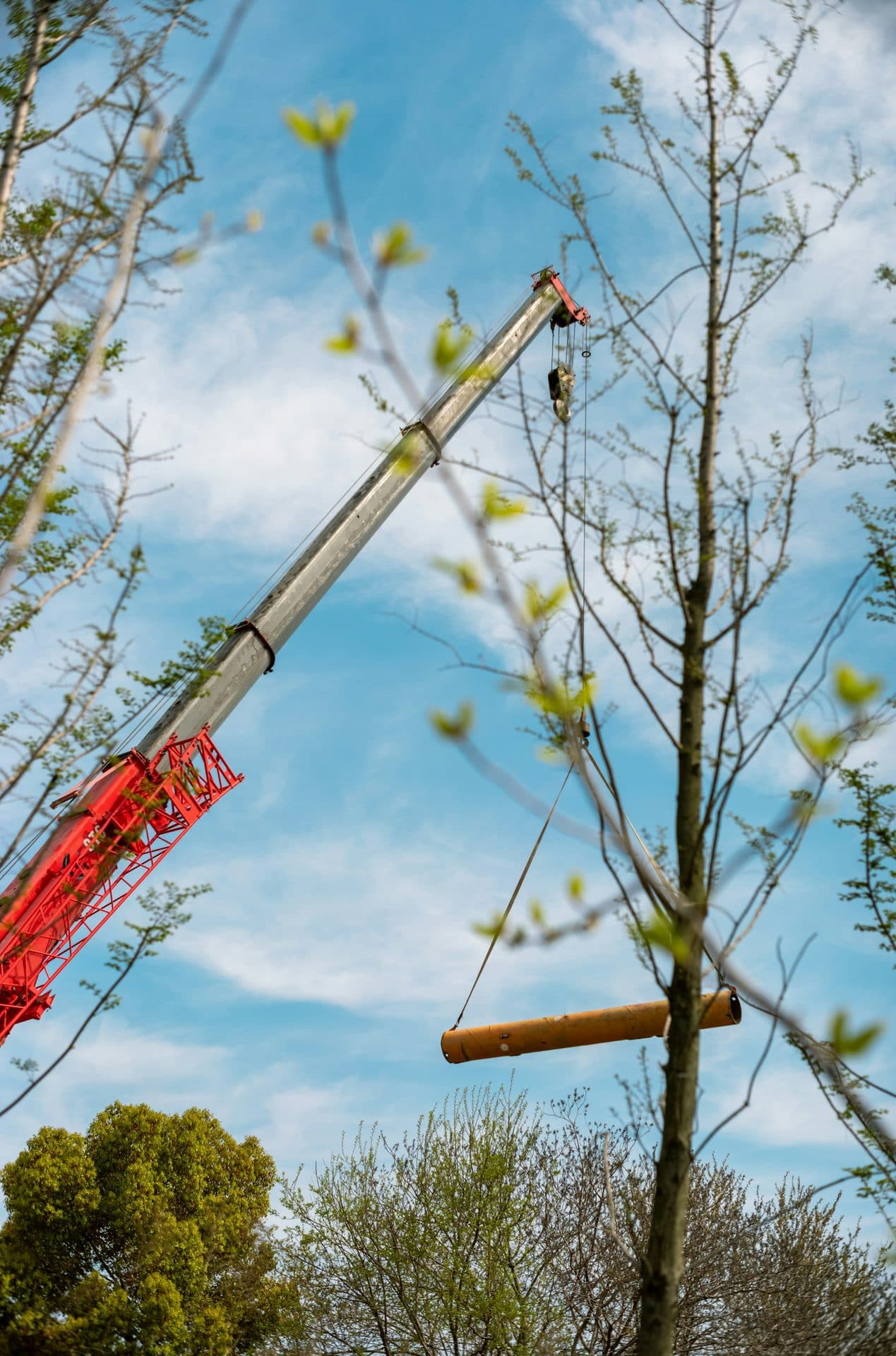
- Crane. The crane holds each section before it is cut and lifts it clear, so nothing is dropped and nobody relies on the dead wood. The most equipment, but often the fewest hours and the least risk on a big dead tree over a house.
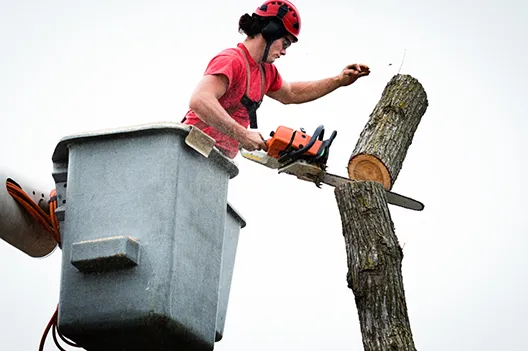
How bad can hidden decay be? In 2022 the TCIA ran a crane demonstration for federal OSHA on a dead 105-foot tulip poplar that it described as "definitely not climb-able." When the first cut went in, several gallons of water gushed out of the trunk. From the ground it was just a tall dead tree.
There is a second reason dead wood changes the method. When a crew cuts a piece, the strip of uncut wood left in the cut, the hinge, is what steers that piece as it falls. Sound wood bends and holds; dead, dry wood can snap, so the piece goes where it wants to. That is why crews take dead trees down in smaller pieces, lowered on ropes or held by the crane, and why this is not a homeowner job.
What else changes the price of removing a dead tree?
- Size. Height and trunk diameter are the base of every estimate, dead or alive.
- What it could hit. A dead tree with a clear fall zone can often be felled whole. The same tree beside the house or over the fence comes down in sections.
- Access. Bob Vila puts the effect of location and access at 25 to 50 percent of the cost. A backyard tree behind a fence, on a slope, or where a bucket truck cannot get close changes everything. On our soft Georgia clay after rain, getting heavy equipment close without rutting the lawn is part of the plan.
- Power lines. A dead tree touching or near a line may need the utility first. Who to call when a tree is on a power line explains which utility and why you should never go near it.
- Urgency. Scheduled work costs less than an emergency call. The national guides above put emergency jobs well above an ordinary removal, and Bob Vila notes that a storm hitting a whole neighborhood drives prices up with demand.
- How many trees. Several dead trees in one visit share one set-up: one trip, one crane or bucket placement, one chipper.
- The stump. Grinding is a separate line item on most estimates. It is cheaper added to the same visit than booked later. See stump grinding.
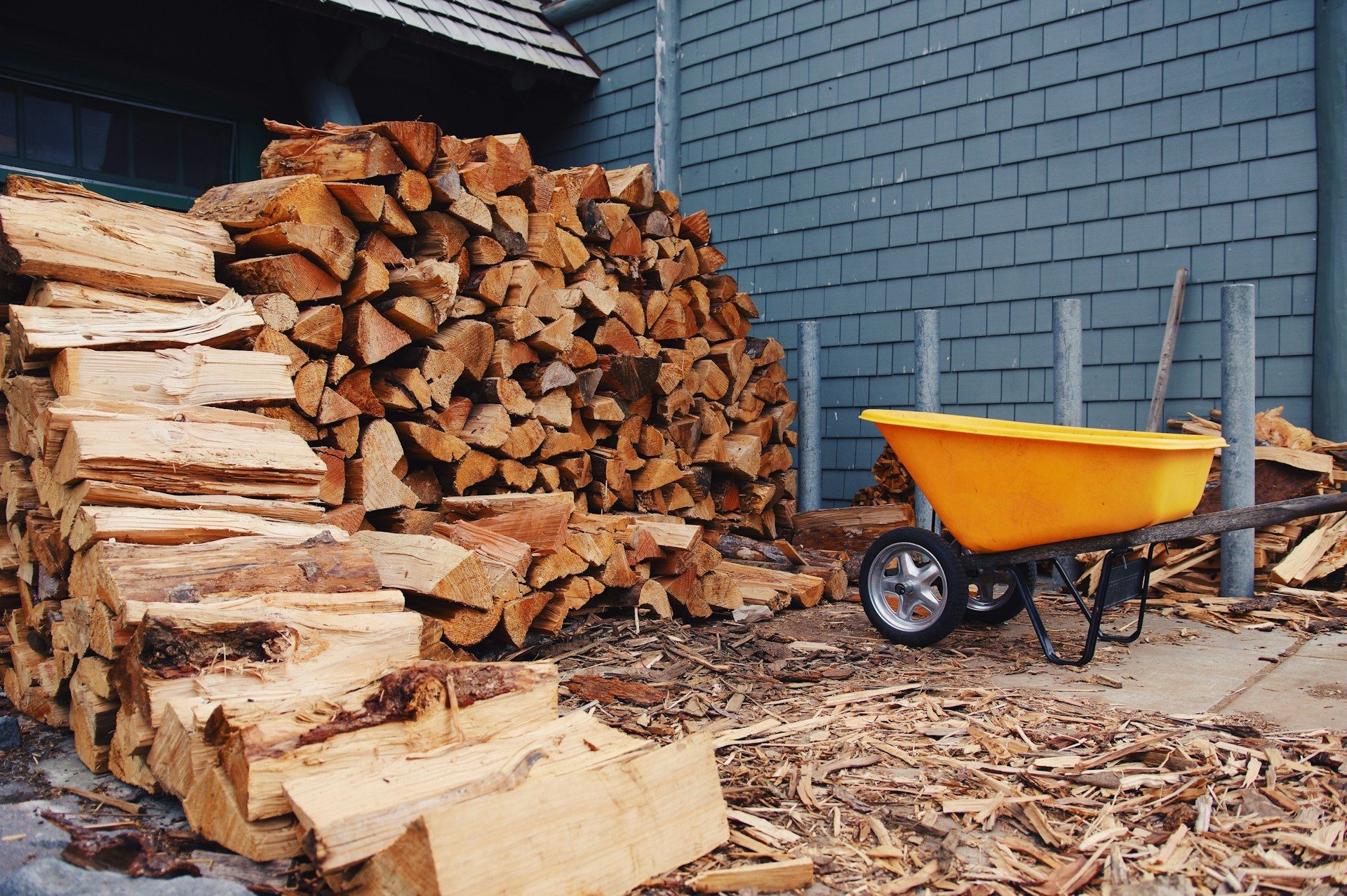
- The wood. Hauling everything away is part of most quotes; leaving the logs, or the chips as mulch, can change the number. Sound dead hardwood can make good firewood; punky, rotten wood is not worth keeping.
- Permits. Rarely needed for a dead tree on a home lot in our area, but see below.
How long has it been dead?
This is the factor homeowners miss, and the one that most often turns a cheap job into an expensive one. A tree does not get safer to remove as it dries out. Here is how it usually plays out on the jobs we see:
| Stage | What you usually see | What it means for the job |
|---|---|---|
| Recently dead (this season) | Bark tight, limbs still flexible, fine twigs hanging on | Often still climbable after inspection; closest to a live-tree price |
| Dead a year or more | Bark slipping, fine branches gone, limbs snapping off in wind | Climbing often ruled out; bucket truck or crane |
| Advanced decay | Fungus at the base, soft or hollow wood, top broken out | Unpredictable to cut; crane, or felled whole only with room to spare |
Not sure whether your tree is dead or just dormant for the winter? How to tell if a tree is dead walks through the scratch test and bud check before you pay anyone. If the dead tree is leaning toward the house, cracking, or dropping limbs over a driveway or play area, do not wait for spring: read when a leaning tree needs a call today and the warning signs we look for.
What does it cost to remove a dead pine tree in Georgia?
Dead pines are priced the same way as any other tree: height, what is under them, and how the crew can reach them. Pines are tall and straight, so a dead pine in an open yard can be one of the simpler removals. A dead pine 70 feet tall beside a house almost always means a bucket truck or crane, because a pine's height is exactly what makes it dangerous to drop.
What makes dead pines different here is why they died and what that means for the trees next to them.
Southern pine beetle is back in Georgia
The Georgia Forestry Commission documented 273 southern pine beetle spots, areas where many pines have died together, in 2023 and more than 1,600 in 2024, according to UGA's Bugwood center. A 2024 publication from UGA's Warnell School of Forestry and the Georgia Forestry Commission, Southern Pine Beetle in Georgia, adds what a homeowner needs to know:
- Which pines: the beetle prefers loblolly, shortleaf, pitch, pond and Virginia pines.
- Why now: pines are more likely to be attacked when stressed by wind damage, lightning, drought or flooding. Historically, Piedmont outbreaks come every six to 10 years.
- The signs: needles fade from green to yellow to red to brown (sometimes dropping while still green), popcorn-sized pitch tubes appear in the crevices of the bark, and fine boring dust gathers at the base.
- The speed: about seven generations a year, and in forest outbreaks spots can spread up to 50 feet a day.
- What does not work: insecticides are not generally recommended for stopping southern pine beetle.
Not every dead pine is a beetle pine. Smaller engraver beetles also attack pines weakened by lightning or drought, and UGA Extension entomologist Keith Douce, in a UGA field report, noted that they usually kill only a weakened tree "and sometimes the trees right around it." His advice was to quickly remove infested trees, which takes away the source of beetles that can attack the others, and to have your county Extension agent, an arborist or a Georgia Forestry Commission forester confirm the species.
Do you need a permit to remove a dead tree?
On most owner-occupied home lots in our service area, no. Dead and hazardous trees are the case local ordinances treat most leniently. The rules change at city limits, in stream buffers, for street trees and on commercial or development property, and an HOA may want to approve any removal. Our North Georgia tree removal permit guide has the town-by-town detail.
Either way, photograph the dead tree before it comes down. It costs nothing and it is your proof of its condition if a city, an HOA or a neighbor ever asks. If a permit is needed, we file the application and pass the fee through at cost.
Will insurance pay to remove a dead tree?
Not before it falls. Removing a dead tree to prevent damage is maintenance, and standard homeowners policies do not pay for it. If a visibly dead tree does fall on the house, the claim may still be paid, but the insurer may argue the loss came from neglect rather than the storm. That is one more reason the cheapest dead tree is the one taken down on your schedule. Does homeowners insurance cover tree removal? goes through the policy wording and the per-tree caps.
If the dead tree is your neighbor's, talk to them, then put your concern in writing with a photo. In Georgia, whether a neighbor is responsible for a tree that falls often turns on whether they knew or should have known it was dangerous; what happens when a neighbor's tree falls on your house explains why that written notice matters.
How do you compare dead tree removal quotes?
Two quotes for the same dead tree can be far apart and both be honest, if they plan different methods. Line them up on the same points:
- The method. Climb, bucket truck or crane? A low quote that plans to climb a tree that should not be climbed is not a saving. Ask why they chose that method.
- The scope. Is the stump ground? Is all the wood hauled away, or left in rounds? Are the chips left or taken? Cleanup of the lawn and gutters?
- Insurance. Ask for certificates for both general liability and workers' compensation, sent from the insurer, not a photo of a card. Dead trees are where accidents happen.
- Who does the work. Is the company quoting the company arriving, with its own crew and equipment, or will it be subcontracted?
- In writing. An itemized, written estimate that names the tree, the method, the cleanup and the price. Ask whether the number on the estimate is the number on the invoice.
- Timing. For a dead tree that is not an emergency, a scheduled date at the normal rate beats waiting for a storm and paying the emergency rate.
For a second opinion on whether a tree is truly dead, or worth saving, look for an ISA Certified Arborist. The tree removal cost page lists the five red flags we see most in tree removal estimates.
How R & R Tree Service prices dead tree removal
We have been taking dead trees down across Buford, Gwinnett, Hall and Forsyth counties since 1987, with our own crew and our own bucket truck, chipper, stump grinder and crane, never a subcontractor. On a dead tree we look at the wood first, then decide whether it can be climbed, needs the bucket, or needs the crane, and we put that method on the estimate so you can compare like with like.
Every estimate is free, written, itemized and done on site, most within 24 hours, and the number on the estimate is the number on the invoice. We are licensed, bonded and insured, with general liability and workers' compensation, and a TCIA member. If a dead tree is already threatening the house, our 24/7 emergency crew is a phone call away. Either way, call (678) 482-9994 or request an estimate online.
Frequently asked questions
Is it cheaper to remove a dead tree than a live one?
Not usually. National guides say a standing dead tree costs about the same as a live tree of the same size, and more if decay rules out climbing and the crew needs a bucket truck or crane. It can cost less when the tree is light, hollow and has room to be felled whole.
Why is dead tree removal so expensive?
Because dead wood is brittle and unpredictable. OSHA's tree-care guidance notes that climbing decayed or damaged trees could be hazardous, so many dead trees have to come down from a bucket truck or with a crane, which means more equipment on the job.
How much does it cost to remove a dead tree that has already fallen?
Much less than a standing one, since there is no climbing or rigging. National guides disagree on the number, from about $90 to $300 (Lawn Love) to $300 to $500 (Bob Vila). A tree that fell on a structure is a different, larger job.
How long can you leave a dead tree standing?
There is no safe date. A dead tree gets more brittle every season, which makes it more likely to drop limbs or fail and harder to remove safely. If it could reach a house, driveway, power line or play area, have it looked at now rather than after the next storm.
Can I cut down a small dead tree myself?
A dead sapling you can cut while standing on the ground, with nothing in reach, is one thing. Anything tall enough to reach a house, fence, line, car or person is a job for an insured crew, because dead wood can break and fall in directions you do not expect.
Should I remove a dead pine right away?
Usually yes, especially if it died from bark beetles. UGA Extension advises removing infested pines quickly to take away the source of beetles that can attack nearby pines, and a freshly dead pine is easier and safer to take down than one that has stood dead for a year.
Does R & R Tree Service charge for dead tree estimates?
No. Every estimate is free, written and done on site, and most are returned within 24 hours. Call (678) 482-9994.
- UGA Warnell School of Forestry & Georgia Forestry Commission — Southern Pine Beetle in Georgia (WSFNR-24-30a, October 2024)
- UGA Bugwood — Southern Pine Beetle Outbreaks in Georgia (November 2024)
- TCIA — Guidance for Crane Practices in Arboriculture, reproducing OSHA Directive CPL 02-01-045 (in NY Department of Labor Crane Operator Board exhibits, pp. 3–4 of the guide)
- TCIA — Crane demonstration for federal OSHA on a dead 105-foot tulip poplar (2022)
- UGA CAES Field Report — Bark Beetles Attacking Georgia Pines (1998)
- Bob Vila — How Much Does It Cost to Remove a Tree? (citing HomeAdvisor, Angi, Fixr)
 Call (678) 482-9994