

Tree Leaning Toward the House: When to Call Today
Quick answer: call today if the lean is new or getting worse after a storm or heavy rain, or if the soil is cracked or lifted on the side away from the lean, roots are snapping, or the trunk is cracking. Those are signs the root plate is giving way; the International Society of Arboriculture calls soil heaving a warning sign of failure, "especially if the tree is leaning." A lean held for years, with firm soil and a healthy crown, is usually not an emergency — but have it checked if it can reach the house.
- New lean = urgent. A tree that shifted after a storm or a week of rain is moving at the roots. Keep people out of its reach and call the same day.
- Look at the back side. Cracked, raised or mounded soil on the side away from the lean means the root plate is lifting out of the ground.
- The angle is not the test. UGA Extension treats a 30-degree lean with a target in the fall path as hazardous, but a fresh 5-degree shift can be more dangerous than an old 30-degree lean.
- Georgia makes it worse when wet. Saturated clay loosens the roots' grip, so the danger peaks during and right after long rains, not just in high wind.
- Big leaners rarely straighten. UGA and Georgia Forestry Commission specialists say large trees leaning to any extent usually will not come back upright; the real choices are reduce, support or remove.
We get a lot of calls about a tree "leaning toward the house." Some of those trees have stood at that angle since before the house was built. Others started moving last night and should not be left standing through the next rain. From the kitchen window they can look exactly the same.
The difference is almost never the angle. It is what is happening at the base, and whether it changed recently. Below: how to tell the two apart from a safe distance, what makes a lean an emergency today, the Georgia conditions that tip trees over, and your options. If a tree is already resting on the house, start here instead.
Is a tree leaning toward your house dangerous?
It can be, but a lean on its own is not a defect. Trees grow toward light: one that came up beside taller trees, a wall or the house itself often bends toward the open side and builds its wood and roots to hold that shape. A tree like that has carried its lean through every storm of its life.
A lean becomes dangerous when it is new or changing, because that means something underneath has moved — roots snapping, soil giving way, or decay at the base. The International Society of Arboriculture's homeowner brochure, Recognizing Tree Risk, puts it plainly: cracks or separations in the soil "may indicate soil heaving from excessive movement of the roots," and that "can be a warning sign for failure, especially if the tree is leaning."
The second half of the question is what the tree would hit. UGA Extension's Forsyth County office defines a hazardous tree as one likely to fall on "a person, pet, livestock, house, car, fence, or other target." A leaning tree in the woods is a curiosity. The same tree over a bedroom is a decision.
How do you tell an old lean from a new one?
Do this from the yard, outside the tree's reach. You are looking at the tree, not touching it. For the wider list of defects worth checking on any tree — dead limbs, cavities, cracks — see the dangerous tree warning signs we look for.
| Clue | Long-standing lean | New or shifting lean |
|---|---|---|
| Trunk shape | Gentle curve; the top often turns back toward upright | Straight trunk tipped from the base |
| Soil on the back side | Flat, grassed over, undisturbed | Cracked, raised, mounded or split open |
| Roots | Root flare even and buried | Roots lifted, snapped or newly exposed |
| Soil on the lean side | Normal | Pushed up or bulging, or the trunk sunk into it |
| Old photos | Same angle against the house corner or a fence post | Angle has changed |
| Recent events | Nothing in particular | Storm, week of rain, digging or grading nearby |
The curved trunk is the best single clue. A tree that leaned when young and kept growing will usually bend its upper trunk back toward vertical. A tree that was straight and has just tipped stays straight — the whole trunk is tilted from the ground up, because the movement happened at the roots.
Old photos help more than people expect: real-estate listing pictures, family photos in the yard, or street-view images. Line the trunk up against something that does not move, like the corner of the house or a fence post. If you have nothing, take a photo today from a spot you can stand on again, and repeat it after the next storm.
What does soil heaving at the base of a leaning tree mean?
It means the root plate — the disc of roots and soil that anchors the tree — is starting to rotate out of the ground like a lid being pried up. The roots on the back side, away from the lean, are the anchor holding the tree upright. When they start to let go, you see it in the soil before you see it in the tree:
- A crack or split in the soil in a curve around the back side of the trunk, sometimes a few feet out.
- A raised mound or ridge on the back side where the roots are lifting the turf.
- Roots pulled up, snapped or newly visible on the back side.
- A gap opening between the trunk and the soil on the back side.
- Soil pushed up on the lean side, or the trunk looking sunk in on that side.
UGA Extension's Forsyth County office lists "cracks in the soil surface around the tree," along with stress cracks or buckling bark on the trunk and decay near the base, as the companion signs of a hazardous leaning tree. In Bartow County, Extension agent Paul Pugliese advises watching storm-stressed trees for "any shifting of the root plate and soil cracks that might indicate impending root failure."

When is a leaning tree an emergency today?
Here is how we sort the calls we get. The right column is what we would tell a family member.
| What you see | Urgency | What to do |
|---|---|---|
| Lean appeared or got worse after a storm or heavy rain | Today | Keep everyone out of reach; call a tree service now |
| Fresh soil cracks, mound or lifted roots on the back side | Today | Same — this is root-plate failure starting |
| Cracking or popping sounds, or a trunk crack opening | Today | Leave that side of the house; call now |
| Tree resting against another tree, or touching the roof | Today | Do not try to push or pull it free |
| Tree leaning into power lines | Today — utility first | Stay back and call the utility; see below |
| Mushrooms or conks at the base of a leaning tree | This week | Book an assessment; decay is advanced |
| Digging, trenching or grading near the roots in recent years | This week | Have the root zone checked before storm season |
| Dieback on one side, or the lean seems slowly greater | This week | Book an assessment |
| Old lean, curved trunk, firm soil, full crown | Monitor | Photo after storms; have it looked at if it can reach the house |
While you wait, keep people, pets and cars out of the area the tree could reach, and stay out of the rooms on that side of the house if the tree is big enough to come through the roof. Do not put a ladder against it, tie it off to a truck or another tree, or start cutting limbs to "lighten" it. A tree on a failing root plate can shift the moment its weight changes.
If the tree is leaning on or into power lines, do not go near it. That is a call to your utility before it is a call to us — what to do when a tree is on a power line walks through who to call in North Georgia.
Can a leaning tree actually reach your house?
This is the quick check that sorts a lot of worry. A tree that falls lands roughly its own height away from the base, and a leaning tree will almost always fall in the direction it leans. So compare two numbers: how tall the tree is, and how far its trunk is from the house.
You can estimate height from a distance. Stand well back, hold a pencil at arm's length with its base on the trunk base and its tip on the treetop, then swing it flat along the ground and note where the tip lands; the distance from that spot to the trunk is roughly the height. It is rough, but it tells you whether a 70-foot pine 40 feet from the house is in reach. (It is.) If the tree is taller than its distance to the house, the house is in reach — plus a margin for the spreading crown. In the yards we work in across Gwinnett, Hall and Forsyth counties, mature pines, tulip poplars and oaks are often taller than the distance to the nearest roofline, which is why so many leaning-tree calls turn out to be genuine.
Why do trees suddenly start leaning in Georgia?
A tree that was standing straight for decades does not lean for no reason. In North Georgia, it is usually one of these:
- Saturated soil. UGA climate specialists note that some trees are snapped by high wind while "others are uprooted when saturated soils weakens the grip that the tree roots have." In our experience North Georgia clay stays wet for days after a soaking, so a tree that held firm through a dry summer can lose its grip in a wet spring or after the remnants of a tropical storm.
- Wind after rain. UGA Extension in Bartow County explains that wind-throw — a tree blown over roots and all — "is also common when high winds are accompanied or preceded by heavy rains." The storm that tips the tree often arrives a day or two after the rain that loosened it.
- Drought, then deluge. After Georgia's four-year drought ended in heavy rain in 2003, UGA horticulturist Marco Fonseca explained that trees were toppling because root systems "that became shallow during the drought are now being drowned by the excess rain." Shallow roots plus soft soil is the worst combination for a tall tree.
- Root damage from construction. Bartow County Extension lists "soil excavation, the use of heavy equipment over the tree's critical root zone, or trenching for utilities" as causes of trees blowing over, and the ISA lists root loss from construction, grade changes and soil compaction. A new driveway, septic line or pool can show up as a lean years later.
- Shallow-rooted or weak species. Bartow Extension saw "many Leyland cypress trees" wind-thrown in north Georgia storms, and names willow, silver maple and Bradford pear as soft-wooded trees with the most failures. Leylands planted in tight rows along a property line are a common leaning-tree call for us.
- Decay at the base. By the time you see conks or mushrooms on the trunk or root flare, UGA Extension says, "the tree is in advanced stages of decay." Rotting roots cannot anchor a lean the tree used to carry easily.
Can a leaning tree be saved?
Sometimes, but not by pulling it upright. A young tree that leaned after planting can often be staked and straightened in a season. A mature tree is a different matter: in a 2018 guide to storm-damaged forest stands written by UGA Warnell School of Forestry professors and the Georgia Forestry Commission's forest health coordinator, the authors note that older, larger pines and hardwoods — over 12 to 14 inches in diameter and 60 to 80 feet tall — "that are leaning to any extent will usually not straighten back up." They also note that trees with severe root damage "rarely survive the growing season."
For a big tree with a stable, long-standing lean, the realistic options are the ones the ISA lists: prune to take weight off the lean side, add cables or braces to support weak stems (which the ISA is careful to say "are not guarantees against failure"), keep up routine care, or remove it. Cabling helps a tree with a weak fork; it does not hold up a tree whose roots are letting go.
For a tree whose lean is new and whose roots are moving, there is rarely a saving option. It needs to come down before it comes down on its own.
How is a tree leaning toward a house taken down?
Carefully, and never by simply cutting it at the base. A leaning tree wants to fall the way it leans, and its weight is already loaded toward the house. Felling it "away" from the lean is not something a saw cut alone can do safely when the house is underneath. How a crew handles it depends on the tree, the ground and the access:
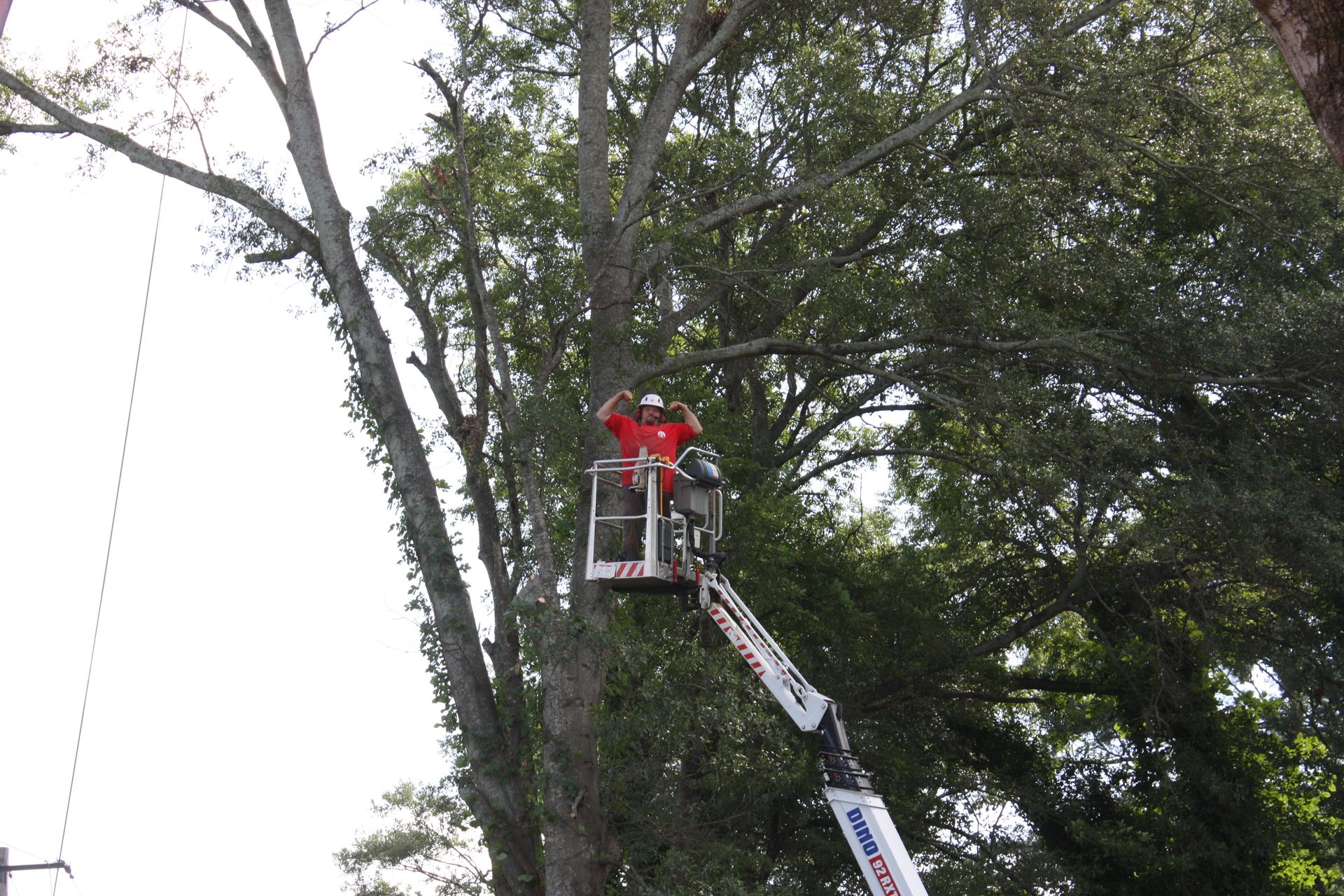
- Sectioning from the top down. A climber or a bucket truck removes the tree in pieces, lowering each one on ropes so nothing lands on the roof. The weight comes off the lean side first.
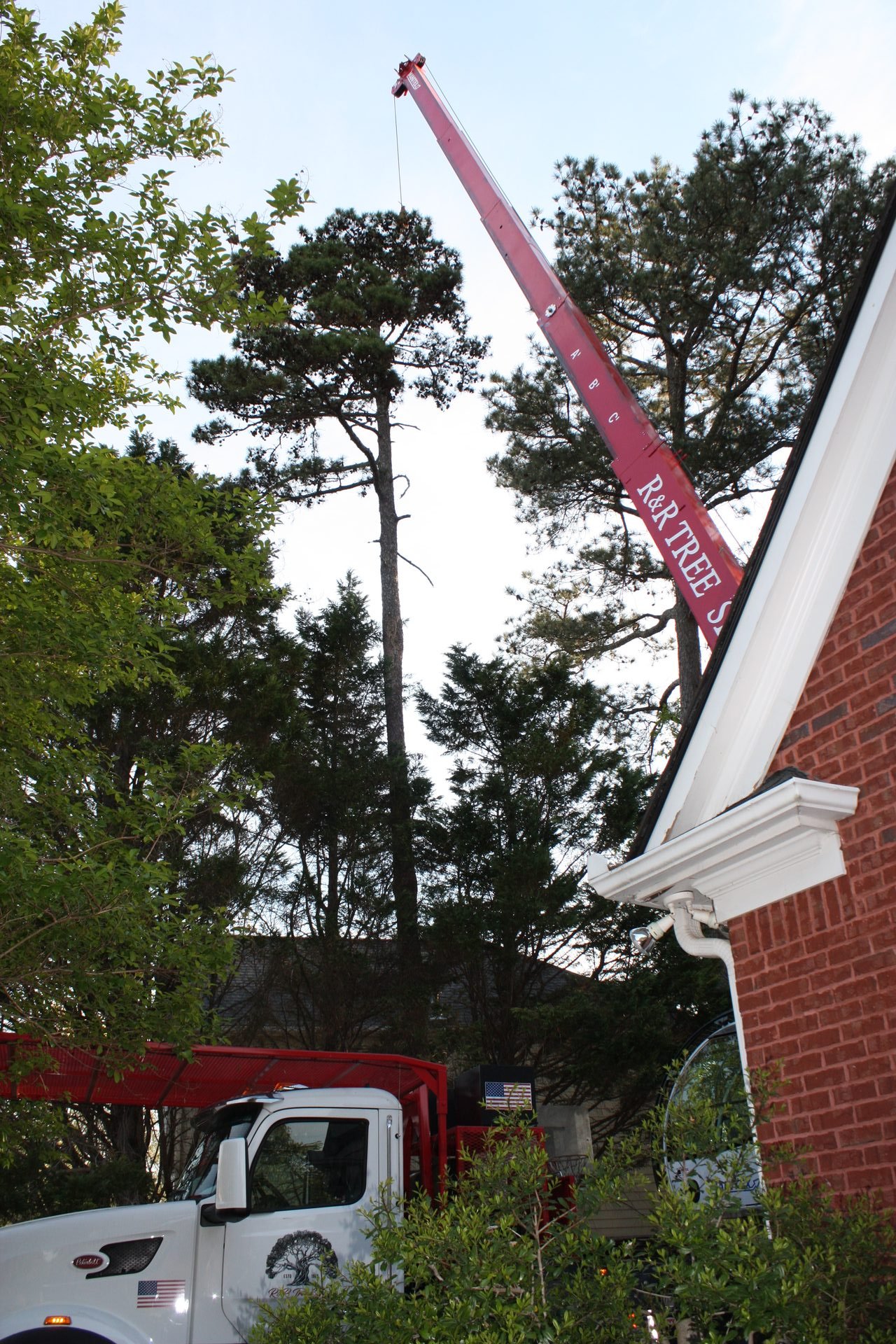
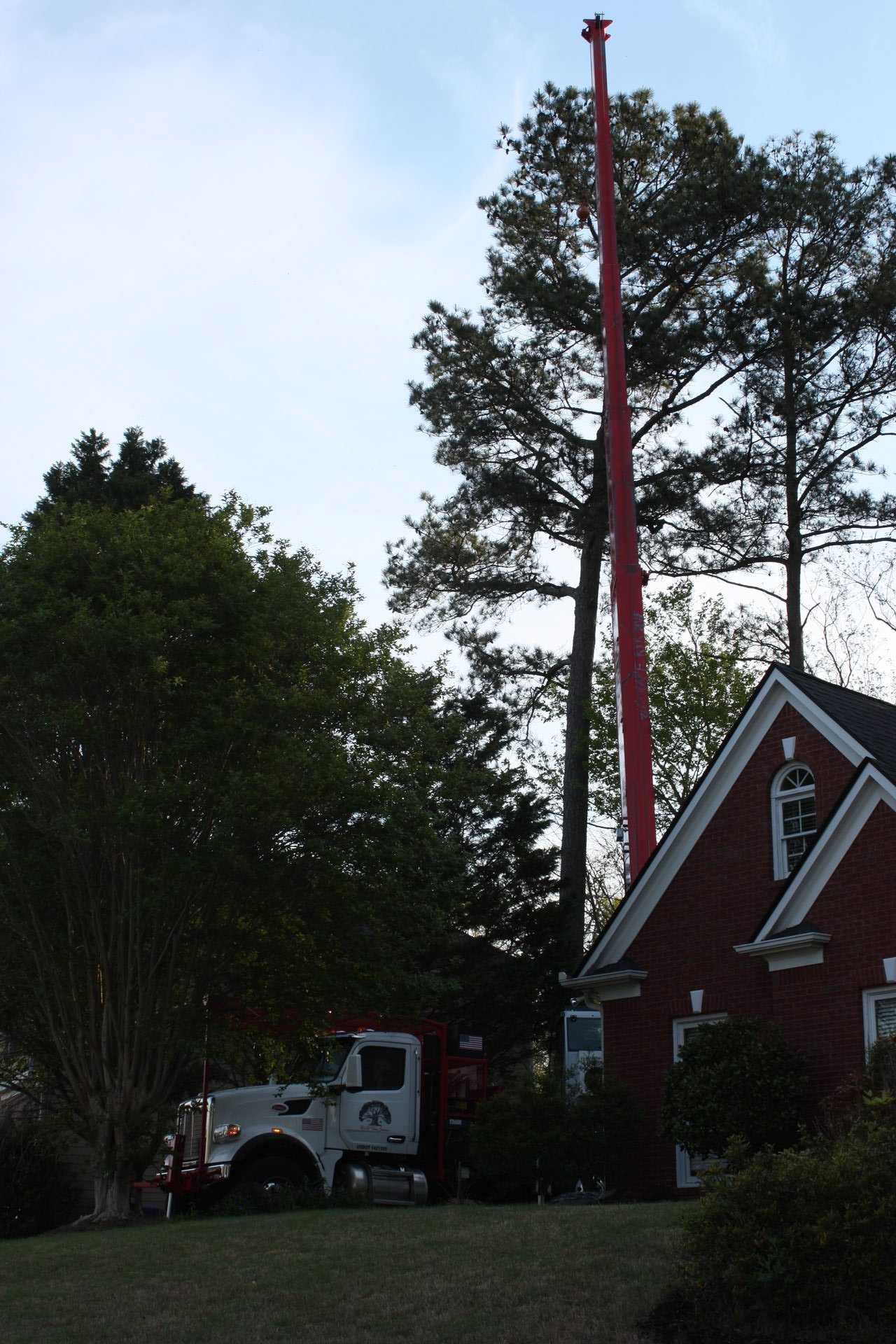
- A crane pick. For big leaners over a house, a crane holds each section before it is cut and swings it clear. Nothing drops, and no one has to climb a tree whose roots are suspect. On soft, saturated ground the crane sets up on the street or driveway, which is also where it does the least damage to the yard.
- Stump and roots. Once the tree is down, the stump can be ground. A lifted root plate is often half out of the ground already and may need to be dealt with before the soil is regraded.
A tree whose root plate is moving is not a tree anyone should be climbing. That is the job a crane exists for. More on the method: crane tree removal.
Do you need a permit to remove a leaning tree?
Possibly. It depends on your city or county, the size of the tree and the reason it is coming down, and the rules vary from one jurisdiction to the next. If a permit is needed, we handle the application.
Will insurance pay to remove a leaning tree?
Generally not before it falls. A standard homeowners policy covers sudden damage, and removing a tree that is leaning but still standing is treated as maintenance — our insurance guide explains what the policy does and does not pay. The uncomfortable math: removing it now is on you; after it falls, it is a claim, a deductible and a damaged house.
If the leaning tree is your neighbor's, talk to them first, and put your concern in writing. In Georgia, whether a neighbor is responsible for a tree that falls often turns on whether they knew or should have known it was dangerous — what happens when a neighbor's tree falls on your house covers how written notice works. For a tree that is also dead, dead tree removal cost explains why those jobs are priced differently.
How R & R Tree Service handles a leaning tree
When you call about a tree leaning toward your house, we come out, look at the base and the back-side soil, and tell you straight whether it is a today problem, a this-season problem or a tree that has been fine for thirty years and will be fine for thirty more. The estimate is free, written and itemized, usually within 24 hours, and the number on the estimate is the number on the invoice.
If it has to come down, our own crew does the work with our own bucket truck and our own crane — never a subcontractor. We are a family business in Buford since 1987, a TCIA member, licensed and insured with general liability and workers' compensation. If the lean is new and the ground is moving, call our 24/7 emergency line at (678) 482-9994. For anything else, call the same number for a free estimate.
Frequently asked questions
How much lean is too much for a tree?
There is no single safe angle. UGA Extension in Forsyth County treats a lean of 30 degrees or more with a target in the fall path as hazardous, but a small lean that is new, or that comes with cracked or lifted soil, is more urgent than an old, steeper one.
My tree started leaning after a storm. What should I do right now?
Keep people, pets and cars out of the area it could reach, stay out of the rooms on that side if it is large, and call a tree service the same day. Do not cut, climb, push or tie off the tree yourself. If it touches power lines, call the utility first.
Can you straighten a large leaning tree?
Usually not. UGA and Georgia Forestry Commission specialists note that older, larger trees leaning to any extent will usually not straighten back up. Young trees can sometimes be staked; for mature trees the options are pruning, cabling, monitoring or removal.
Why are trees falling over in my neighborhood after it rains?
Saturated soil weakens the grip of the roots, and UGA Extension notes that wind-throw is common when strong winds follow heavy rain. Trees with shallow or construction-damaged roots, and shallow-rooted species such as Leyland cypress, go first.
Will homeowners insurance pay to remove a tree before it falls?
Generally not. Removing a leaning tree that is still standing is usually treated as maintenance. Check your own policy, and see our insurance guide for what is covered after a tree falls.
Who should inspect a leaning tree?
The ISA recommends having trees with warning signs examined by an ISA Certified Arborist; you can search for one at TreesAreGood.org. For a tree that may need to come down, a licensed and insured tree service with the right equipment can assess and remove it.
- International Society of Arboriculture (TreesAreGood.org) — Recognizing Tree Risk (2021)
- UGA Extension Forsyth County — Hazardous Trees (H. N. Kolich, 2021)
- UGA Extension Bartow County — Hazardous Trees (P. Pugliese)
- UGA Warnell School of Forestry & Georgia Forestry Commission — Assessing Hurricane and Tornado Storm Damaged Forest Stands (draft, 2018)
- UGA Climate and Agriculture blog — Summer storms result in downed trees across Georgia (2017)
- UGA CAES Newswire — Rainy weather toppling trees (2003)
 Call (678) 482-9994