

A Tree Fell on My House: What to Do in the First Hour
Quick answer: get everyone out of the house and away from the tree, call 911 if anyone is hurt, a line is down or you smell gas, and do not touch the tree or anything it is touching. Once people are safe, photograph the damage from the ground, call your insurer, and call a tree service that handles trees on structures. The tree should be lifted off from the top down, often by crane, before the roof is tarped — never cut free at the stump or dragged off.
- People first: get everyone out by the safest exit and keep them well away from the tree and any wires.
- Right call, right order: 911 for injuries, fire, gas or a line on the house; the utility for lines; then your insurer and a tree crew.
- Treat every wire as live: Georgia law keeps tree crews more than 10 feet from high-voltage lines until the utility makes them safe.
- Leave the tree where it is: it is holding weight and stored energy; cutting it at the stump can drop it further into the house.
- Tarp after the lift: the roof gets covered once the weight is off, from a bucket or crane, not by someone walking on a damaged roof.
The sound is unmistakable, and the next few minutes decide whether a bad night becomes a dangerous one. A tree on the house is rarely just a tree: it can bring a power line with it, crack a gas meter, or leave a roof that will not hold a person's weight.
This is the order we would follow if it were our own family. We are a tree crew that has been lifting trees off North Georgia houses since 1987, not firefighters or insurance agents, so where the job belongs to 911, the utility or your insurer, we say so.
What should you do first when a tree falls on your house?
In order, with nothing skipped:
- Get everyone out. Leave by the exit farthest from the tree, take pets, phones, keys and medicines, and do not go back for anything else. A roof or wall that looks fine from inside can still be carrying the tree's weight.
- Move well away from the tree and every wire. Stand somewhere that is out of reach if the tree shifts or a line comes down. Keep children and pets with you.
- Call 911 if anyone is hurt, you smell gas, you see fire or sparks, or a line is on the house or the tree. Otherwise, call the power company if any line is involved.
- Do not touch the tree, the wires, or anything metal they are touching — gutters, fences, a ladder, a car.
- Photograph from where you are standing. Wide shots of the whole tree and the house are enough for now. The full list can wait (here is our documentation checklist).
- Call your insurer or agent to open the claim, and ask for a claim number.
- Call a tree service that handles trees on structures, 24/7. Send them the wide photos; it tells them which equipment to bring.
Everything after that — tarping, the roofer, the adjuster — comes once the tree is off and the house is stable.
Who do I call first: 911, the power company, or a tree service?
Most people call the tree service first. Usually that is the third call, not the first. Use what you can see and smell to decide:
| What you see or smell | Call first | Then |
|---|---|---|
| Anyone hurt or trapped | 911 | Insurer, tree service |
| Gas smell or hissing, or the tree hit the gas meter | 911 from a safe distance, or Atlanta Gas Light 1-877-427-4321 | Tree service once cleared |
| Smoke, sparks or fire | 911 | Utility, insurer |
| A line on the house, the tree, or the ground | 911 or your power company | Tree service after the utility makes it safe |
| Lights flickering or power out, no line visible | Power company | Tree service |
| No lines, no gas, nobody hurt | Tree service and insurer | Roofer after the tree is off |
In Georgia Power territory, outages and downed lines can be reported 24 hours a day at 888-891-0938, the number Georgia Power gives in its storm safety releases. If your power comes from an electric membership cooperative instead, the outage number is on your bill. For gas, Atlanta Gas Light's emergency line is 1-877-427-4321, and its advice is simple: if you smell gas, leave the area and call for help, as the utility told Atlanta News First.
Is it safe to stay in the house after a tree falls on it?
Assume not until someone qualified has looked. The tree may be resting on a rafter it has already cracked, and Bob Vila's guide makes the same point we would: unless the damage is clearly limited — a few top branches against the siding, or a tree on a detached garage — plan to stay elsewhere until a contractor or structural engineer has assessed it.
Three things make staying in the house actively dangerous:
- Gas. If the tree struck the meter or you smell gas, leave and call from a distance. Do not flip light switches or start a car near the house.
- Electricity. A tree can pull the service line off the house or drag a line across the roof. If water is coming in near wiring or the panel, stay out.
- Carbon monoxide from a generator. Trees on houses usually come with an outage. The CDC says to run portable generators and any gas-powered equipment outside, at least 20 feet from doors, windows and vents — never in the garage, even with the door up.
What if the tree is touching a power line?
Then nobody touches the tree until the utility says so — not you, not a neighbor with a saw, and not a tree crew. Georgia Power's storm advice is to never touch a downed wire or try to remove branches from power lines, to stay off wet or saturated ground where a line may be down, and to avoid chain-link fences, which can carry current from a line out of sight.
There is also a legal reason a tree crew waits. Georgia's High-Voltage Safety Act, O.C.G.A. § 46-3-33, says no one working in their trade may bring a person or equipment within 10 feet of a line over 750 volts until the utility has been notified and has de-energized, moved or covered the line. A first offense is a $1,000 fine under § 46-3-40, and a contractor who breaks the rule is strictly liable for any resulting injury or damage. A tree service that offers to "just cut it off the wire" is telling you something about how it works.
Usually the utility clears or de-energizes the line, then the tree crew takes the tree. The details — whose line it is, and who fixes the wire to your house — are in what to do when a tree falls on a power line.
Should you put a tarp on the roof yourself?
No — not while the tree is on it, and not by walking a damaged roof. Bob Vila's guide calls roof tarping dangerous work best left to professionals, because parts of the roof may not hold you. From the field we would add one thing: a tarp under a tree does very little, because the tree has to come off before the roof can be closed.
What you can safely do from the ground:
- Move furniture, electronics and valuables away from leaks, and put buckets and towels down.
- Board or cover broken ground-floor windows, carefully, if you can reach them without going near the tree.
- Shut off the water if a pipe has broken, and the power at the panel if water is reaching wiring and you can get to the panel safely.
- Keep every receipt for anything you buy or pay for.
That last one matters. Most homeowners policies require you to protect the property from further damage by making "reasonable and necessary repairs" and keeping a record of what they cost; insurance attorney Corey Harris of Merlin Law Group explains the clause and gives tarping a damaged roof as the classic example. Temporary is enough. Permanent repairs come after the adjuster.
How is a tree safely removed from a house?
A tree on a roof is doing two jobs at once: it is loading the framing, and it is often holding the damage closed. Take it off the wrong way and it drops further in. UGA Extension's Fannin-Gilmer office puts the risk plainly: in storm-damaged trees, energy stored in compressed limbs and trunks "can release suddenly, explosively, and fatally."
On a tree-on-house job, a professional crew's sequence generally looks like this:
- Read the tree before anyone cuts. Where is the weight bearing — ridge, eave, a wall? Is the root plate still attached and pulling? Which parts are in tension and which in compression? Is anything still touching a line?
- Secure what is still standing. If the tree snapped, the stub or the neighbor tree it is hung up on can be as dangerous as what is on the roof.
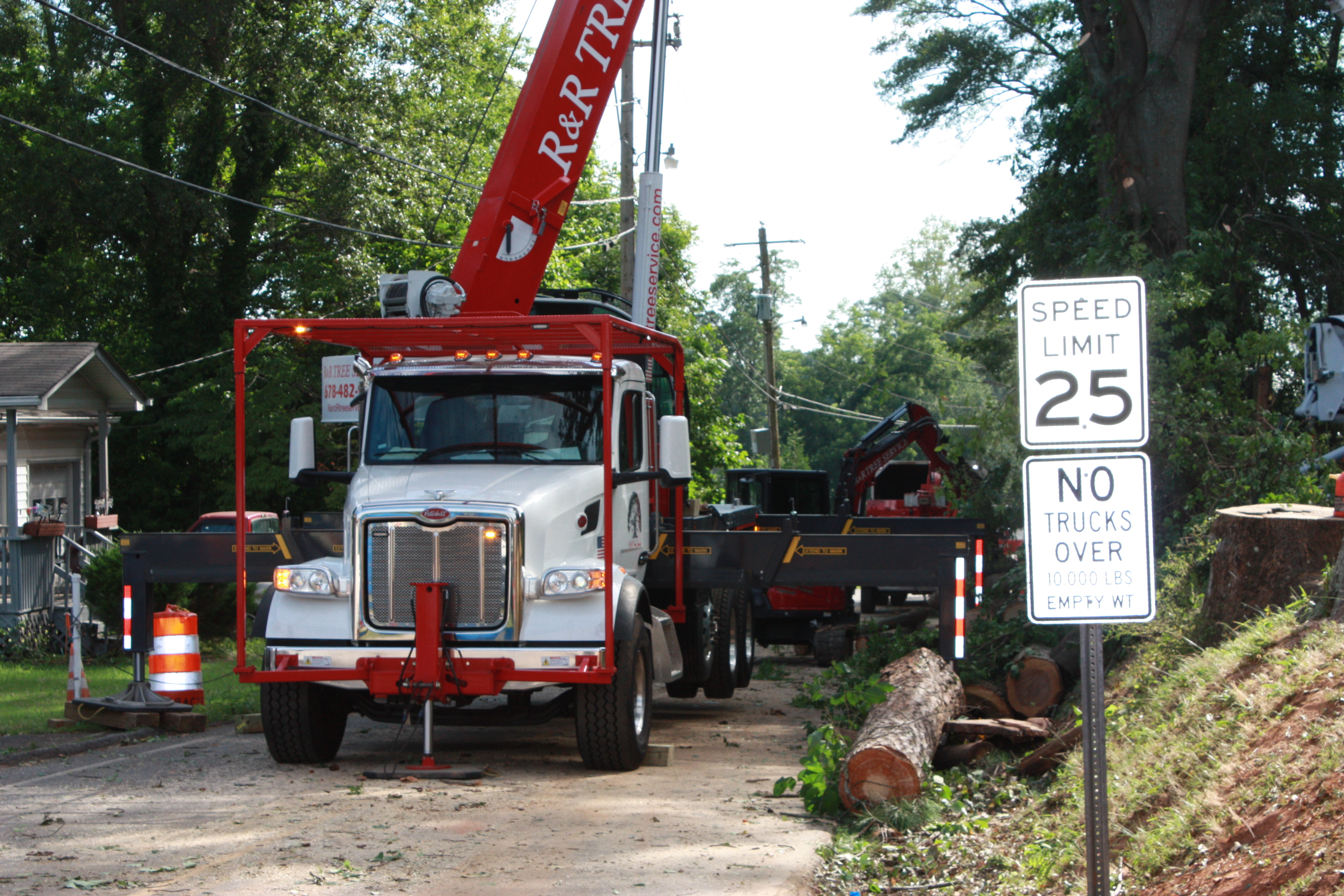
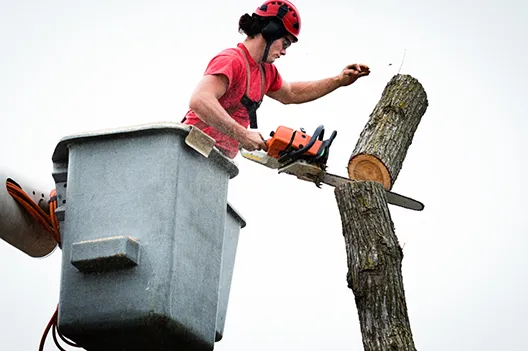
- Take the weight from the top down. Limbs and top sections come off first. With a crane, each piece is rigged and held before it is cut, then lifted straight up and set down in the yard — nothing is dropped or dragged across the shingles.
- The trunk comes off last, lifted rather than rolled. The trunk is not cut free at the stump while it is on the house; that is how a tree slides or rolls into the next room.
- Then the roof can be tarped, usually from the bucket or the crane rather than by walking on damaged decking.
A crane is not required on every job, but on a large tree on a roof it is often the method that adds no new damage, because nothing is lowered onto or dragged across the house. That point matters for the claim too. Under the standard policy form, getting a tree off the house is paid as part of repairing the house, with "no internal limit" according to the Florida Association of Insurance Agents; the $500-per-tree cap is for hauling the wood away afterward. A cheap removal that cracks more rafters is not a saving. Our insurance post explains how the two parts are paid.
What should you not do after a tree falls on your house?
- Do not climb onto the roof or into the attic under the impact point.
- Do not cut the tree yourself. UGA Extension Gwinnett's advice is that homeowners should clear only minor debris; large broken or hanging sections, ladder work or overhead chainsaw work belong to a professional.
- Do not pull on limbs or climb on the tree. Partly fallen trees can shift quickly because the weight is uneven, UGA Extension warns.
- Do not let anyone drag the tree off with a truck and chain. It drags the trunk across the roof and pulls the framing with it.
- Do not go near or under a line or anything it touches, even if the power seems to be out.
- Do not throw the wood away before the adjuster sees it if there is any question about rot or what brought it down.
- Do not sign the first contract from a door-knocker without checking insurance and references (below).
How do you choose a tree service when a tree is on your house?
After a big North Georgia storm, the trucks that show up first are not always the ones you want on your roof. UGA Extension Gwinnett's guide to managing storm-damaged trees gives a checklist we agree with, and it fits on a phone screen:
- Proof of insurance, including the insurance company's name and contact details so you can check it. On a house, ask specifically for liability and workers' compensation, and how you can confirm both policies are current.
- The licenses and permits the job needs.
- References you actually call, and past jobs you can look at.
- A detailed written contract that says when the work starts and ends, who cleans up, and the total cost — and asks about extras such as stump grinding.
- Not automatically the lowest bid. Compare what each estimate actually includes.
The same guide recommends having the trees assessed by an ISA Certified Arborist, and UGA Extension's Fannin-Gilmer office points to the ISA's find-an-arborist directory for that. For the removal itself, ask one more question: what equipment will they bring, and how will they take the weight off the roof?
What happens after the first hour?
Once the tree is off and the roof is covered, the job becomes paperwork and repairs:
- The claim. What a standard Georgia policy pays for, including the tree-removal cap, is in does homeowners insurance cover tree removal.
- The evidence. Photos, video, receipts, weather records and the adjuster visit: documenting tree damage for an insurance claim.
- If it was the neighbor's tree, you still claim on your own policy first: a neighbor's tree fell on my house — who pays in Georgia.
- The rest of the yard. A storm that drops one tree often weakens others. These warning signs tell you which ones need a look before the next storm.
UGA Extension Gwinnett notes that trees are at higher risk in high winds when heavy rain has saturated the soil, and after years of drought, construction and pest stress. That describes a lot of North Georgia yards, which is why one fallen tree is worth a walk around the rest.
How R & R Tree Service handles a tree on a house
Trees on structures go to the front of our line, day or night. We bring our own crew and our own equipment — bucket truck, chipper and our own crane — and we never subcontract the work. We take the weight off the roof first, and handle the complete cleanup and haul-off when the tree is down.
We are a TCIA member, licensed, bonded and insured with general liability and workers' compensation. You get a written, itemized estimate in a format insurers accept, and we will talk with your adjuster if you ask us to. We work across Gwinnett, Hall and Forsyth counties and the Atlanta metro — see the areas we serve. For a tree on your house right now, call our 24/7 emergency line at (678) 482-9994.
Frequently asked questions
Who do I call when a tree falls on my house?
Call 911 first if anyone is hurt, you smell gas, there is fire, or a line is down. Then the power company if any line is involved, then your insurer and a tree service that handles trees on structures.
Should I call my insurance company or a tree service first?
If nobody is in danger, you can call both within minutes of each other. Photograph the damage first, open the claim to get a claim number, and have the tree service make the house safe; your policy expects you to prevent further damage.
Can I stay in my house if a tree fell on it?
Only if the damage is clearly minor, such as a few branches against the siding. If the tree is on the roof, cracked framing, hit the gas meter or involves a power line, stay elsewhere until a contractor or structural engineer has checked the house.
Can I remove a tree from my roof myself?
No. A tree on a roof stores energy and can shift or roll when cut, and UGA Extension advises homeowners to clear only minor debris. Leave the lift to a crew with rigging or a crane.
How long does it take to get a tree off a house?
It depends on the tree, the access and whether a power line is involved; the utility has to make any line safe before a tree crew can work near it. Ask the tree service for its plan and timing when it sees the photos.
Will a tree crew tarp my roof?
Many will once the tree is off, because the roof cannot be closed with the tree still on it. Keep the receipt; tarping is a classic temporary repair that policies expect you to make.
Does R & R Tree Service handle trees on houses at night?
Yes. We answer 24/7 and trees on structures are our first priority. Call (678) 482-9994.
- UGA Extension Gwinnett (Timothy Daly) — Managing Storm Damaged Trees (via City of Peachtree Corners)
- UGA Extension Fannin-Gilmer — Assessing storm-damaged trees
- Georgia High-Voltage Safety Act, O.C.G.A. §§ 46-3-30 to 46-3-40 (text published by Georgia 811)
- Georgia Power — after-the-storm safety tips and outage line
- CDC — Prevent carbon monoxide poisoning after a disaster
- Florida Association of Insurance Agents — Debris Removal Primer (ISO homeowners form)
 Call (678) 482-9994