
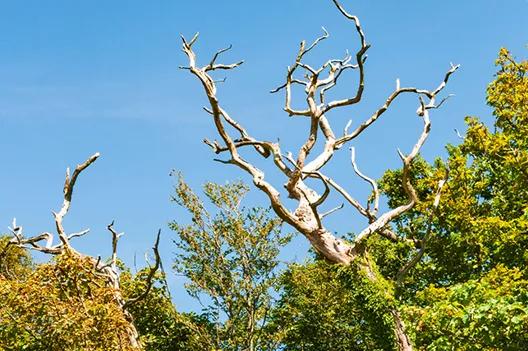
Hollow Tree: Is It Dangerous, and Will It Fall?
Quick answer: not necessarily — many hollow trees stand for decades, because a trunk gets most of its strength from the outer ring of wood, not the center. What matters is the sound wood left around the hollow, the size of the opening, the species and the wind load. A common rule of thumb flags a trunk when the sound shell is under about 30% of its radius, or the opening spans more than a third of its circumference. Conks, cracks, carpenter ants or a hollow at the base mean get it assessed.
- Hollow is not the same as hazardous: a trunk is like a pipe — the outer wood carries most of the load, so a sound shell can hold a tree up for years.
- The rule of thumb: arborists start to worry when the sound shell is under about 30% of the radius (t/R below 0.3), or the opening is more than a third of the way around.
- The rule has limits: research found it flags some safe trees, and it assumes decay is the only defect — cracks, lean and a big crown all change the answer.
- Warning signs: mushrooms or conks, carpenter ants, cracks or bulges at the cavity, dieback in the crown, a hollow at the root flare, or a new lean.
- Never fill it: concrete and foam add no strength, trap moisture, and can hide a hazard from the crew who later cuts the tree.
- Testing is for professionals: sounding, resistance drilling and sonic tomography each see part of the picture; no single test sees all of it.
A hollow in a big oak or maple is one of the most common reasons homeowners call us, and one of the most misunderstood. Some people assume a hollow tree is about to fall. Others assume that because it has looked the same for twenty years, it always will. Both can be wrong.
Below: how hollows form, why many stand for decades, the shell-thickness rule and where it breaks down, the signs of failure, and how decay is tested. We are a tree crew, not a lab, so every figure here comes from extension services and published research, linked as we go.
Why do trees become hollow?
Almost every hollow starts with a wound. A broken limb, a mower strike at the base, a bad pruning cut, a lightning scar or a severed root opens the wood to decay fungi, and the fungi slowly digest it.
A tree cannot heal that wound the way skin does. Instead it walls the damage off. Penn State Extension's guide to the spread of decay in trees explains the model forester Alex Shigo developed in the 1970s, called CODIT (compartmentalization of decay in trees): the tree builds chemical and physical walls around the infected wood, the strongest of them in the new wood it grows after the injury. The decayed core is given up, and if the decay keeps spreading inside those walls, the center can rot away and leave a hollow.
The type of fungus changes what you see. Penn State describes white rots, which leave soft, spongy or stringy wood, and brown rots, which leave dry, brown wood that crumbles into cubes and weakens quickly. Either way, the wood that is gone does not grow back.
Why do some hollow trees stand for decades?
Because a trunk works like a pipe. When wind bends a tree, the wood at the outside of the trunk does most of the work and the wood at the center does very little. Arborists Brian Kane and Dennis Ryan, writing in the International Society of Arboriculture's journal, note that the outer fibers of a trunk cross-section contribute "exponentially more" to its resistance to bending than the core does (Kane & Ryan, 2004). Losing the middle costs less strength than most people expect.
The tree is also still alive where it counts. The living layer that moves water and sugar is just under the bark, so a tree can keep a full green crown for years with its heartwood gone. That is why a hollow tree often looks perfectly healthy from the yard.
Load matters as much as wood. In Kane and Ryan's study, several woodlot trees had lost a large share of their strength on paper, yet none appeared to be in immediate danger of failure. The authors point to their forest-grown shape and the shelter of neighboring trees, and conclude that the load a tree carries is critical to judging its risk. A hollow tree in a sheltered grove and the same tree standing alone in a cleared lot are not the same risk.
How much sound wood does a hollow tree need?
The best-known rule of thumb comes from German biomechanics researchers Claus Mattheck and Helge Breloer. It compares the thickness of the sound wood shell (t) with the radius of the trunk (R). As Kane and Ryan summarize it, a cross-section with t/R below 0.3 is considered a hazard, and a cavity opening wider than one-third of the trunk's circumference counts as a hazard on its own. At t/R = 0.3, the trunk has lost roughly a third of its resistance to bending.
Put simply: the thinnest part of the sound wall should be at least about 30% of the radius, which is the same as 15% of the trunk diameter. A U.S. Forest Products Laboratory team using sonic tomography described the same line as generally accepted: more than 40% of the cross-section decayed, or a remaining shell under 15% of trunk diameter, marks critical risk (Allison, Wang & Ross).
| Trunk diameter | Radius | Sound shell needed |
|---|---|---|
| 12 inches | 6 inches | about 1.8 inches |
| 20 inches | 10 inches | about 3 inches |
| 30 inches | 15 inches | about 4.5 inches |
| 40 inches | 20 inches | about 6 inches |
Two details trip people up. The radius is measured from the outside of the whole trunk, not from the edge of the hollow; the forest pathology guide at ForestPathology.org says to take the diameter and halve it, and puts the minimum at one-third of the radius left sound. And t is the thinnest point of the wall, not the average — decay rarely sits neatly in the middle.
Is the shell-thickness rule reliable?
It is a useful screen, not a verdict. Kane and Ryan tested the four formulas U.S. arborists commonly use against the real cross-sections of 19 trees with decay. Their findings, in plain terms:
- The t/R rule erred on the cautious side. It flagged 3 of the 19 trees as hazards when their actual strength loss was under the threshold, and it never called a weak tree safe.
- The older "strength loss" formulas did worse. They treat the hollow as a neat circle in the middle of the trunk. Real decay was irregular and off-center, and one formula missed weak trees in 8 of 19 cases at its caution level.
- Big openings with thick walls are a blind spot. The authors warn the t/R rule might underestimate trees whose cavity opening approaches a third of the circumference while the wall stays thick.
- It assumes decay is the only problem. Every formula's threshold assumes no other defect. A crack, a lean, a heavy limb over the hollow, or root decay changes the math.
Researchers have kept testing the rule since. A 2017 study in Royal Society Open Science confirms that t/R 0.3 is used worldwide as an approximate criterion, but finds a discrepancy between field observations and the critical wall thickness that classic bending theory predicts, and notes the exact thresholds vary within and among species. The honest summary: the number tells an arborist where to look harder. It does not tell anyone the day a tree will fail.
What are the signs a hollow tree is failing?
You can look without touching. These are the signs that move a hollow tree from "keep an eye on it" to "get it assessed":
- Mushrooms or conks (shelf-like brackets) on the trunk, the root flare or the ground over the roots. UGA Extension's Is My Tree Dying? (C1100) calls them signs of severe or advanced rot, and root decay cannot be reversed.
- Carpenter ants going in and out of the cavity. Penn State notes they nest in decayed wood rather than eating sound wood, so they are a sign the decay is there.
- Cracks, seams or bulges at or beside the cavity. The Forest Products Laboratory team screened trunks for exactly these — cavities, cracks, bulging and seams — before testing.
- A hollow at the base or root flare, or a flare that looks swollen or oddly shaped. Decay low on the trunk or in the root plate is the most dangerous kind, because the whole tree rides on it.
- Dieback in the crown: dead tops, bare limbs, twigs poking out of thin foliage. UGA says dieback can point to internal decay even with no other symptoms.
- A cavity that is getting bigger, wood crumbling out of it, or a new lean. A tree that has started to lean is a different conversation — here is when a lean is an emergency.
Please do not probe, drill or chip at the cavity to see how deep it goes. Every new hole is a fresh wound for fungi, and climbing into or onto a hollow tree is how people get hurt. If the trunk has split open rather than rotted, our post on split trunks covers what can and cannot be braced. For the broader checklist, see the warning signs of a dangerous tree.
Which trees in Georgia go hollow most often?
Species matters a great deal. Penn State groups oaks, hickory and sugar maple among the strong compartmentalizers that resist the spread of decay, and silver maple, cottonwood and willow among the weak ones that try to outgrow a column of decay while their centers go hollow.
Two native southeastern oaks deserve special mention, because they are fast-growing shade trees with a short life:
- Water oak. The University of Florida's water oak fact sheet (ST553) calls it a poor compartmentalizer of decay — "many are hollow at 40 years old" — with a life span of only 30 to 50 years on good sites, and says it often begins to break apart just as it reaches a desirable size.
- Laurel oak. UF's laurel oak fact sheet (ST549) gives a 50- to 70-year life span and says the smallest trunk injury or bad pruning cut can start a column of decay 10, 20 or more feet long.
Both sheets point to live and shumard oaks, among others, as more durable choices. So a hollow in a 60-year-old water oak and a hollow in a 60-year-old white oak are very different findings, and an arborist will read them differently.
How do arborists test a hollow tree?
Testing is a sequence, cheapest and least invasive first. Researchers working on century-old red oaks in Madison, Wisconsin compared the main methods against the real wood after the trees were cut down (Wang & Allison, 2008):
| Method | What it does | Limits |
|---|---|---|
| Visual inspection | Reads cavities, conks, cracks, bulges, taper and the crown | Spots a problem, not its size |
| Sounding | Strikes the trunk with a mallet; a big void sounds like a drum | Misses decay with no large void; varies by species |
| Single-path stress wave | Times a sound wave across the trunk; decay slows it | Flags trouble without showing where |
| Sonic tomography | Sensors around the trunk map wave speed into a cross-section image | Cannot tell a crack from decay on its own |
| Resistance drilling | A thin needle drill graphs wood resistance along its path | Shows one line per hole; small wound |
Sounding notes are from the ForestPathology.org inspection guide, which calls it an art: a very hollow tree gives a bass-drum sound, but decay without a large void is much harder to hear.
The Madison study found the combination worked: the tomograph showed the general location and size of the defect, and resistance drilling pinned it down and told decay apart from cracks. It also cites an earlier study in which sonic tomography matched the decay actually present with 89% average accuracy in white oak and hickory.
Even then, the Forest Products Laboratory team is candid that these methods sample the tree: you cannot assume decay is absent where you did not test, and precise measurement of decay is beyond the tools. That is why a good assessment pairs the readings with judgment about the species, the site, the crown and what the tree would hit.
Can a hollow tree be saved or filled?
Saved, often. Filled, no. Filling cavities with concrete was standard practice for decades, and it does not work. Tree Care Industry Association staff arborist Tchukki Andersen explained to Farm and Dairy that a rigid fill does not move while the tree sways constantly, and the rubbing can create new wounds for the decay fungi to exploit. Penn State adds that concrete and foam add no structural benefit, can trap water and block airflow that favor decay, and can be a dangerous surprise for the crew when the tree is eventually cut.
What actually helps a hollow tree that is worth keeping:
- Reduce the load. Careful crown reduction and trimming cuts how much wind the crown catches. Kane and Ryan cite crown reduction as a remedy at the t/R threshold.
- Support, where it fits. TCIA notes that when a tree needs structural support, an arborist will recommend cabling, bracing, propping or guying — or removal — not cavity filling.
- Stop making new wounds. Penn State's list: keep mowers and string trimmers off the trunk, do not cut large roots, prune at the branch collar instead of flush cuts, and skip wound paint, which slows wound closure.
- Re-inspect on a schedule. Decay keeps moving. A hollow tree near the house deserves a fresh look every year or two and after any major storm.
Do hollow trees help wildlife?
A great deal. UGA Extension in Fannin and Gilmer counties describes cavity trees as live trees with holes big enough to shelter animals, notes that limb cavities matter more to some species than big hollow trunks, and estimates that about 20% of forest wildlife relies on dead and dying wood. NC State Extension's guide to snags and downed logs counts more than 45 bird species and more than 20 mammal species using snags in the Southeast, from barred and screech owls to woodpeckers, flying squirrels and evening bats.
A cavity may be occupied, so look for animals before any removal. Hollow trees also offer a middle option when a hollow tree is too risky to keep whole but stands well away from the house, the driveway and anywhere people gather: take the crown down and leave a tall trunk standing as a wildlife snag. NC State lists cutting the tops off large trees as one way to create snags. Near a home, play set or road, safety comes first.
When should a hollow tree come down?
Put the pieces together and the decision usually looks like this:
| What you see | What it usually means | Next step |
|---|---|---|
| Small cavity at an old limb, sound bark around it, full crown | Decay walled off | Keep; recheck every year or two |
| Large hollow, thick walls, durable species, nothing to hit | Often stable for years | Assess; consider a crown reduction |
| Opening more than a third of the way around the trunk | Rule-of-thumb hazard on its own | Get it assessed soon |
| Conks, carpenter ants or a hollow at the root flare | Advanced or root decay | Assess now; removal likely |
| Cracks or bulges at the cavity, or a new lean | Shell may be failing | Treat as urgent if it can reach a target |
| Hollow water oak or laurel oak near the house | Short-lived, weak compartmentalizer | Assess; plan removal or replacement |
The target matters as much as the tree. The same hollow trunk is a low priority at the back of five wooded acres and a high one over a bedroom. If a hollow tree is dead, not just hollow, it is more brittle and costs more to take down safely — here is why. And if you are not sure whether the tree is dead or only dormant, start with this winter check.
For a full risk assessment, look for an ISA Certified Arborist; UGA Extension recommends one for any tree near a home or business that you are unsure about.
How R & R Tree Service handles hollow trees
We have been working on North Georgia trees since 1987, with our own crew and our own equipment, never a subcontractor. When we look at a hollow tree, we tell you what we see — the cavity, the wall, the species, the crown and what it could hit — and whether we think it can stay with trimming, needs watching, or should come down. If it should stay, we will say so.
Hollow trees are also harder to take down than solid ones. A hollow trunk may not have the solid wood a normal felling cut relies on, so we often take them down in sections from the bucket truck or lift them out with our own crane, especially near houses. We are a TCIA member, licensed and insured with general liability and workers' compensation. Tree removal and trimming estimates are free, written and on-site: (678) 482-9994 or contact us online.
Frequently asked questions
How long can a hollow tree live?
Often for decades. The living tissue that moves water and sugar is just under the bark, so a tree can keep a full crown with its heartwood rotted away. How long it stays standing depends on the sound wood left, the species and the wind load.
What is the t/R ratio for hollow trees?
It is the thickness of the sound wood shell (t) divided by the trunk radius (R). A t/R below 0.3, from Mattheck and Breloer's research, is the common rule of thumb for a hazardous cross-section. Research shows it is a cautious screen, not a precise prediction.
Should I fill a hollow in my tree with concrete or foam?
No. Fill adds no strength, can trap moisture that favors decay, and rubs against the swaying tree to create new wounds. It can also hide a hazard from the crew that eventually cuts the tree.
Can I tell how hollow my tree is by knocking on it?
Not reliably. Sounding with a mallet is a professional screening step, and even then it misses decay that has not formed a large void and varies by species. Leave testing to an arborist, and do not drill or chip at the cavity yourself.
Is a hollow tree with leaves still dangerous?
It can be. A green crown only shows the outer living layer is working; it says nothing about how thick the sound wall is. Conks, cracks, carpenter ants or a hollow at the base are the signs that matter.
Are animals living in my hollow tree a problem?
Usually not for the tree, but check before any removal. Owls, woodpeckers, squirrels and bats all use cavities. If the tree is safe to keep as a tall trunk away from the house, it can stay as a wildlife snag.
- Kane & Ryan (2004), The Accuracy of Formulas Used to Assess Strength Loss Due to Decay in Trees, Arboriculture & Urban Forestry 30(6)
- Wang & Allison (2008), Decay Detection in Red Oak Trees Using Visual Inspection, Acoustic Testing and Resistance Microdrilling, Arboriculture & Urban Forestry 34(1)
- Allison, Wang & Ross, Visual and Nondestructive Evaluation of Red Pines (USDA Forest Products Laboratory, NDT of Wood symposium)
- Penn State Extension — Understanding the Spread of Decay in Trees
- UGA Extension — Is My Tree Dying? (C1100)
- UF/IFAS — Quercus nigra: Water Oak (ST553)
 Call (678) 482-9994