
Is My Tree Dead? How to Tell in a Georgia Winter
Quick answer: scratch a few small twigs with your fingernail: moist green tissue under the bark means that part of the tree is alive and dormant, while brown, dry tissue all over the tree, with no plump buds and twigs that snap, points to a dead tree. Check the base too: bark falling away from bare wood or mushrooms at the root flare mean serious decline. Pines never go brown for winter, so a fading pine is not dormant. If the signs are mixed and the tree is not over anything, wait for spring leaf-out.
- Scratch from the tips back: test twigs on several sides of the tree, then work toward the trunk to see how far any death goes.
- Buds tell you the plan: a dormant tree carries firm, plump buds all winter; missing or shriveled buds mean that branch is dead.
- Some trees look dead and are not: oaks and beech hold brown leaves all winter, and pecan, hickory and sycamore leaf out late.
- Pines do not go dormant brown: brown inner needles with green tips is normal; a crown fading yellow to red is not.
- Mushrooms at the base change everything: UGA Extension calls them a sign of advanced rot, and a dead or decaying tree near a house should not wait for spring.
Every winter we get the same call: a tree in the yard has been bare since November, the neighbor's looks the same, but this one just looks wrong. Is it dormant, or is it dead? In a Georgia winter, with every hardwood leafless at once, the honest answer is that you often cannot tell from the kitchen window.
You can tell up close, though, with a fingernail and ten minutes. Below is how we check on a walk-through, the Georgia species that fool people, when it is fine to wait for spring, and when a dead tree should not wait at all.
Is my tree dead, or just dormant for the winter?
In dormancy, growth slows, leaf production stops, and the tree puts its energy into the roots and trunk. Deciduous trees drop every leaf; evergreens keep theirs but slow down too. That is why, as SavATree puts it, a dormant tree is easy to mistake for a dead one in the off-season.
The difference is that a dormant tree is still alive under the bark and has already set next year's buds. A dead tree has neither. Three checks, done together, settle most cases:
- The scratch test — is the thin layer just under the bark green and moist, or brown and dry?
- The bud check — are there firm, plump buds at the twig tips?
- The twig test — do small twigs bend, or snap?
One failed check proves little; even a healthy tree carries a few dead twigs. You are looking for a pattern: dead everywhere, or dead in one part.
How do you do the scratch test on a tree?
Under the bark is a thin living layer (the cambium) that carries the tree's growth. On a dormant tree it stays green and slightly moist all winter. Davey Tree and the Iowa State Extension describe the same test; here is how we run it so it tells you more than yes or no:
- Pick a twig you can reach from the ground, pencil-thick or smaller, near the tip of a branch. Never climb or use a ladder for this.
- Scrape a spot the size of a fingernail with your nail or a pocketknife — just through the outer bark, not into the wood.
- Read the color. Bright or pale green and moist: alive. Brown and dry: that twig is dead.
- If it is brown, move back toward the trunk a foot or so and scratch again. Keep going until you hit green or run out of reach. That tells you whether only the tips died or the whole limb.
- Repeat on three or four branches on different sides of the tree. Death on one side only often points to a root or trunk problem on that side.
A scratch test only tells you about the twig you scratched. A big oak with dead twigs low and live ones high is a tree with dieback, not a dead tree, and that is a different conversation (see whether a dying tree can be saved, below).
What should the buds look like on a dormant tree?
Even in January, a living deciduous tree has its buds set at the ends of its twigs: small, firm, often scaly, and symmetrical. TreePeople likens the end bud to a little scaly cone.
- Alive: firm, plump buds.
- Dead branch: no buds at all, or buds that are dry, shriveled, flat or flaking. Davey's rule is to check a few branches before you decide about the tree as a whole.
The twig snap test
Bend a thin twig gently. A living twig flexes and springs back; a dead one is stiff and snaps cleanly. Davey puts it simply: if they break, they are dead.
What do the bark, trunk and root flare tell you?
Twigs tell you whether a tree is alive; the trunk and base tell you whether it is safe. UGA Extension's circular Is My Tree Dying? (C1100) starts its evaluation at the base and works up, and so do we.
Bark
Some trees shed bark as part of normal growth; Davey names maples and shagbark hickories. Shed bark should have fresh bark underneath. Bark that falls away and leaves bare wood behind, or comes off in large sheets, is a sign of decline. Look for long vertical cracks and cankers (sunken or discolored patches); UGA notes that wherever bark has been knocked off, dieback often follows.
The root flare
A healthy tree widens where the trunk meets the ground. UGA says that flare is the part of a tree most often damaged by cars, mowers and string trimmers, and that it is often buried or damaged during construction, which can trigger a death spiral. This matters more here than people expect: UGA notes that most tree roots in Georgia clay soils grow in the top 12 to 18 inches. A new driveway, septic line, patio or a few inches of fill inside the drip line can kill a tree slowly, over several years.
Oak bark falling off with a tan or black crust underneath
Hypoxylon canker (now called Biscogniauxia) lives harmlessly in many hardwoods and turns on them after drought, injury or root damage, according to NC State Extension. Oaks are hit most, and red oaks more than white oaks. The tell is patches of bark sloughing off to expose a fungal mat that starts reddish-brown or tan and powdery, later hardening black, then gray. NC State cites a South Carolina survey in which oaks did not survive more than a few weeks once those mats were visible. If you see it, treat the tree as dead or dying.
Do mushrooms on a tree mean it is dying?
Usually, yes, and they are the sign homeowners most often ignore. UGA Extension's C1100 is direct: mushrooms or conks (shelf-like brackets) on the ground around the roots or on the trunk are signs of severe or advanced rot. Root decay cannot be reversed, makes the tree less stable, and means the tree is well into its death spiral.
The UGA Extension office in Forsyth County calls mushrooms on or around a tree a sure sign of decay inside, and says trees in advanced decline, such as those with mushrooms, should be removed immediately.
A tree can be alive at the twigs and still be rotten at the base, so a green scratch test does not clear a tree with conks at the flare. Decay inside the trunk is its own subject; our post on hollow trees covers cavities, how much sound wood a trunk needs, and how decay is tested.
How can you tell if a pine or evergreen is dead in winter?
A pine, cedar, cypress or magnolia keeps its foliage through dormancy, so in December through February it should look green. A pine that is brown across the crown in winter is not dormant. What confuses people is that healthy evergreens shed old foliage every year.
Normal: seasonal needle drop
Evergreen needles last two to five years depending on the species, according to UGA Extension in Fannin and Gilmer counties. Each fall the oldest needles, on the inside of the canopy, turn straw-yellow, then brown, and drop — white pines can shed up to half their needles in early fall. On our loblolly and shortleaf pines, UGA forest specialist Dr. David Moorhead describes the same thing: normal browning of 18-month-old needles as they shed. His test is the one to use: you should have green tufts of needles at the branch tips. If the needles at the ends of the branches are turning brown, there is a problem.
Broadleaf evergreens follow their own calendar: UGA notes that American holly and southern magnolia drop their oldest leaves in spring, as new growth starts.
Not normal: a pine that is fading from the top or all over
When a pine is dying, the whole crown changes, tips included. A 2024 Warnell School of Forestry and Georgia Forestry Commission guide, Southern Pine Beetle in Georgia, describes needles fading from green to yellow to red to brown, popcorn-sized blobs of pitch on the bark, and fine boring dust gathering at the base. Pines stressed by wind, lightning, drought or flooding are the ones beetles attack. That pine will not green up in spring, and its neighbors may be next; dead tree removal covers why to act promptly, and Georgia pines in snow and ice covers after-storm checks.
Leyland cypress with brown sections
Leyland cypress is one of the most planted screens in Georgia, and UGA Extension's bulletin Diseases of Leyland Cypress in the Landscape (B1229) names Seiridium canker as probably the most destructive disease it gets here. Look for browning top or side branches, most often in early spring, with cracked bark and oozing resin. Cankers grow up to three times faster on drought-stressed trees. UGA says to cut out cankered branches and remove trees cankered on the main trunk; fungicides do not cure it.
Which Georgia trees look dead in winter but are not?
Plenty of "is it dead?" worries in late winter and early spring turn out to be a normal tree doing a normal thing. Compare your tree with the same species nearby before you decide, and know what your species does:
| Tree | Normal in winter | Worth a closer look |
|---|---|---|
| Oaks (especially young), beech | Holding dry brown leaves until spring growth pushes them off (UGA Extension) | Bark sloughing off over a tan or black crust; mushrooms at the base |
| Loblolly, shortleaf, Virginia pine | Older inner needles browned and dropped in fall; green tufts at the tips | Brown or red tips, whole crown fading, pitch blobs, boring dust |
| Eastern white pine | Shed up to half its needles in early fall | Brown at the branch tips |
| Leyland cypress | Green and dense | Brown top or side sections, resin oozing from cracked bark |
| Southern magnolia, American holly | Green; oldest leaves drop in spring | Leaves browning through winter, dieback in the crown |
| Pecan, hickory, black walnut, sycamore | Bare until late spring — they leaf out late (Iowa State) | No bud swell long after the same species nearby has leafed out |
| Maple, shagbark hickory | Bark flaking, with fresh bark underneath | Bark falling away from bare wood |
| Dogwood | Bare with flower buds set | Dieback, especially on dogwoods planted in full sun, which UGA says are more prone to drought stress |
Holding dead leaves deserves its own word. UGA Extension in Forsyth County explains that some oaks and beeches never form the separation layer that drops a leaf in fall, so the dry leaves hang on through winter (marcescence). Still run the bud check: a tree that died suddenly in summer can hold dead leaves too.
Should you wait until spring to decide if a tree is dead?
Often, yes. Spring leaf-out is the most reliable test there is; Iowa State Extension says not to remove a tree too quickly, because some species are naturally slow and may look dead well into spring; its cutoff for a tree that has not leafed out is June 1 in Iowa. Georgia's spring comes weeks earlier, so the practical version here is to compare with the same species on your street. If they are in full leaf and yours shows no bud swell, you have your answer.
After a hard freeze, UGA Extension agent Michael Wheeler advises waiting for new growth before pruning back to a live bud: the dead tissue insulates against another cold snap.
But waiting is only for trees that cannot hurt anyone. Use what you found to decide:
| What you found | Probably | What to do |
|---|---|---|
| Green under the bark, plump buds | Dormant | Nothing; enjoy spring |
| Dead twig tips, green further back | Tip dieback (cold, drought) | Wait for leaf-out, then prune dead wood |
| One or two dead limbs, rest alive | Branch death, maybe root or trunk injury on that side | Have it looked at; remove the dead limbs if they hang over anything |
| Brown and brittle everywhere, no buds | Dead | Plan removal; sooner if it can hit something |
| Mushrooms or conks at the base | Advanced root or trunk rot | Do not wait for spring — get it assessed now |
| Pine crown fading yellow to red | Dying pine, often beetles | Act promptly to protect the pines next to it |
| Bare, dead and leaning, cracked or over the house | Hazard | Call now; keep people and cars out from under it |
When does a dead tree become dangerous?
The moment it dies, if something is underneath it. The Forsyth County Extension office says standing dead trees are decomposing and subject to sudden collapse, and that a failing tree becomes a hazard when it is likely to fall on a person, pet, house, car or fence. The International Society of Arboriculture's homeowner guide, Recognizing Tree Risk, calls dead branches probably the most obvious hazard in a tree, with the risk depending on the size of the branch and how far it is from a target.
- Do not climb a dead tree or lean a ladder against it to test it. Dead wood gets brittle quickly.
- Do not pull on dead limbs or try to shake loose a broken branch caught in the canopy — hanging branches are what hurt people.
- Do not wait for spring if the tree is dead, decaying at the base, or leaning toward the house.
Dead trees get harder to take down safely the longer they stand; what a dead tree costs to remove explains why. Some cities and counties regulate tree removal even for dead trees, so check the North Georgia permit guide before you plan the job.
My tree is dying, not dead. Can it be saved?
Sometimes. UGA Extension's C1100 lists the signs of a stressed or declining tree: tip dieback, yellowing or browning leaves or needles, early leaf drop, undersized leaves and a thin crown. Trees rarely die overnight; they decline over several years, and once a tree is in that death spiral, UGA says little can be done. Catch it early.
UGA gives a red maple about 100 years under forest conditions and a white oak about 300; yard trees often live shorter lives. What helps a stressed tree is mostly what you stop doing to it: protect the root zone from traffic and digging, water deeply in drought (UGA's Leyland and NC State's oak guidance both put drought at the root of the diseases above), mulch the root zone, and have dead wood pruned out once the tree leafs out — the best time to prune in Georgia is its own question. For pests and leaf spots, your county Extension agent can help, and our overview of common tree diseases is a starting point.
For a large tree near the house, both UGA and the ISA recommend an ISA Certified Arborist for a full health and risk assessment.
How R & R Tree Service handles a tree that might be dead
We are a family-owned tree service working across Gwinnett, Hall and Forsyth counties since 1987. If you are not sure whether a tree is dead, we will look at it on-site with you and give you a free, written estimate, most within 24 hours.
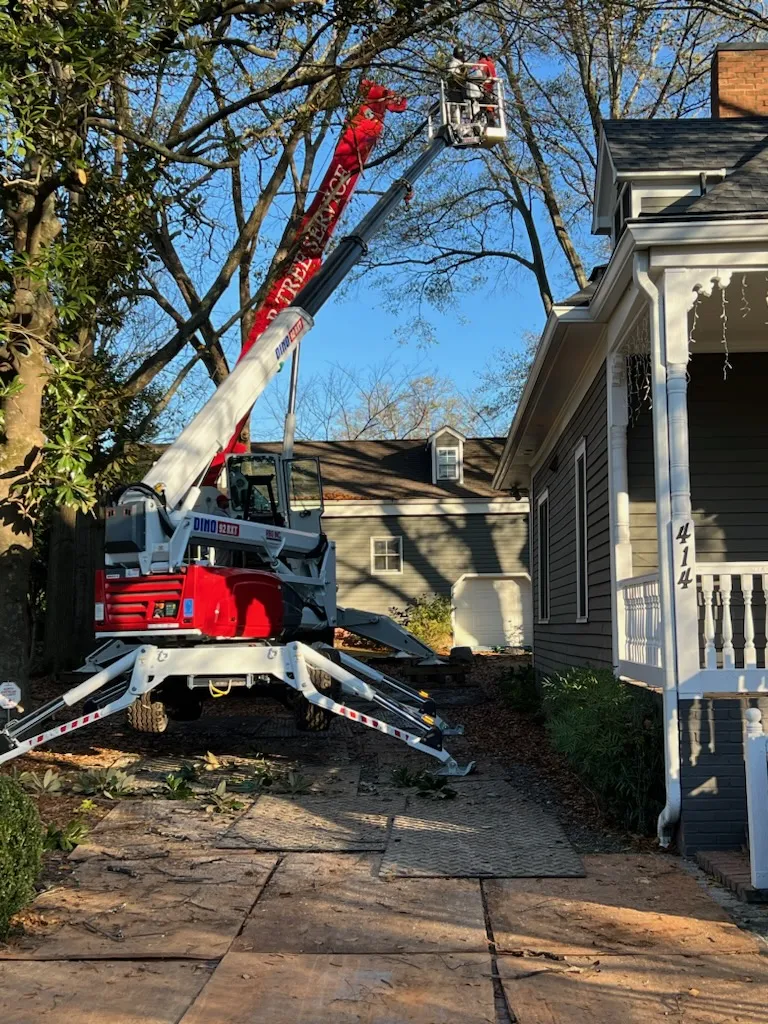
When a dead tree does need to come down, our own crew does it with our own bucket truck, stump grinder and crane, never a subcontractor. We are a TCIA member, licensed and insured with general liability and workers' compensation. For a dead tree removal or dead-wood pruning, call (678) 482-9994, 24/7 if it is already cracking or leaning.
Frequently asked questions
How can I tell if my tree is dead without waiting for spring?
Scratch several small twigs on different sides of the tree, check the twig tips for firm buds, and bend a few twigs. Brown, dry tissue, no buds and twigs that snap all over the tree mean it is dead; green tissue anywhere means at least part of it is alive.
Can a tree look dead in winter and come back in spring?
Yes. Dormant deciduous trees are bare all winter, and some species, such as pecan, hickory, black walnut and sycamore, leaf out late. If the scratch test shows green and the buds are plump, give it until the same species nearby is in full leaf.
Why is my oak tree still holding brown leaves in winter?
Many oaks, especially young ones, and beeches hold their dead leaves until new growth pushes them off in spring, which UGA Extension calls marcescence. It is normal, but check for live buds to rule out a tree that died suddenly in summer.
Is a pine tree with brown needles dead?
Not if the brown needles are on the inside of the branches and the tips are still green; that is normal fall needle drop. Brown needles at the branch tips, or a whole crown fading yellow to red, mean the pine is dying.
Are mushrooms at the base of a tree a bad sign?
Yes. UGA Extension treats mushrooms or conks around the roots or on the trunk as a sign of severe or advanced rot that cannot be reversed. Have the tree assessed promptly, especially if it can reach a house, driveway or play area.
Can a dying tree be saved?
Sometimes, if the cause is caught early: drought, root damage from construction, or a treatable pest or disease. Once a tree has advanced root decay or is dead throughout, it cannot be saved.
Will R & R Tree Service tell me if my tree is dead?
Yes. We walk the tree with you, show you what we find, and give a free written estimate if it needs work. Call (678) 482-9994.
- UGA Extension — Is My Tree Dying? (Circular 1100, reviewed 2024)
- UGA Extension Fannin & Gilmer counties — Evergreens shed needles in the fall
- UGA Extension — Diseases of Leyland Cypress in the Landscape (Bulletin 1229)
- UGA Extension Forsyth County — Hazardous Trees
- NC State Extension — Biscogniauxia (Hypoxylon) Canker
- International Society of Arboriculture — Recognizing Tree Risk
 Call (678) 482-9994