
A Tree Branch Fell on My Car: Insurance and Removal
Quick answer: if you carry comprehensive coverage, your own auto policy pays to repair or replace the car, minus your deductible, no matter whose tree it was. Liability-only policies pay nothing for your own car. Someone else — a neighbor, a landlord, a city — owes you only if they knew or should have known the tree was dangerous. Removing the tree is a separate bill: car insurance does not pay it, but your homeowners policy may if the tree also blocks your driveway or hits the house.
- Comprehensive, not collision: the standard auto policy lists "missiles or falling objects" as other-than-collision loss.
- Whose tree rarely matters at first: you claim on your own policy; your insurer can chase a negligent owner later.
- Government trees have short deadlines: in Georgia, six months to give a city written notice, twelve months for a county or the state.
- Removal is a separate bill: a homeowners policy may pay it when the tree blocks your driveway or damages the house.
- Don't drive it out: a car pinned under a limb can shift, and wires can hide in the canopy.
- Georgia protections: two or fewer comprehensive claims in 36 months can't be the reason an insurer refuses to renew you.
You walk out after a storm and a limb is lying across the hood, or the whole top of a tree has folded the roof of the car in the driveway. After a North Georgia thunderstorm, the questions come in the same order: is it safe to touch, who pays for the car, and who gets the tree off it?
Below is what the standard auto policy says, the first steps, when someone else may owe you, Georgia's deadlines for government trees, and how the tree comes off without more damage. We are a tree service, not an insurance agent or a law firm: your policy, your adjuster and, in a dispute, a Georgia attorney have the final word.
Does car insurance cover a tree branch falling on your car?
Yes, if you carry comprehensive coverage. Most auto policies are built on the same industry form, the ISO Personal Auto Policy (a 1998 edition is posted by the Nevada Division of Insurance). Its physical damage part pays for "direct and accidental loss" to your car, and it splits losses into two kinds: collision, and everything else. The first item on the "other than collision" list is "missiles or falling objects", followed by windstorm, hail and breakage of glass. Your declarations page may call that coverage "comprehensive" or "other than collision"; it is the same thing.
The Insurance Information Institute (Triple-I) lists "fallen objects such as trees, branches, ice or projectiles" among the things comprehensive covers, and notes that every state except New Hampshire requires liability insurance, while collision and comprehensive are optional. If your loan or lease company required "full coverage", you almost certainly have it.
- Comprehensive pays to repair the car, or its actual cash value if it is totaled, minus your comprehensive deductible.
- Liability-only pays nothing for your own car. Liability pays for damage you do to other people.
- Driving matters only a little. A branch that drops onto a moving car is still a falling object. Driving into a tree already lying in the road is a collision — Policygenius, Experian and Chase all draw the same line.
- Your homeowners policy does not cover the car. The standard ISO HO-3 homeowners form lists "motor vehicles" as property not covered, so the car is an auto claim whether you own or rent your home.
Policygenius says comprehensive will not pay if a dead or rotting tree on your own property falls on your car. We could not find that exclusion in the standard auto form, whose exclusions are about the car (wear and tear, breakdown), not the tree. Insurers write their own versions, so if your tree was visibly dead, ask your adjuster rather than assume either way.
What should you do first when a tree falls on your car?
In order, from the moment you find it:
- Stay out of the car and look up. If anyone is hurt, or a line is down or touching the tree, call 911 and keep everyone well back. Treat every wire as live. Our power-line guide covers which utility to call.
- Check what is still overhead. A broken limb hung up in the canopy can drop later. Hanging branches are what injure people after the storm has passed.
- Photograph everything before anything moves: the car from all four sides, the branch where it lies, where it broke from the tree, and the tree itself. Chase's guidance is the same — document the scene before moving debris.
- Call your auto insurer with your policy number. The standard form requires prompt notice of "how, when and where" the loss happened.
- Stop the damage getting worse. The policy says you must take reasonable steps to protect the car from further loss, and "we will pay reasonable expenses incurred to do this" — a tarp over a smashed sunroof, for example. Keep receipts.
- Don't junk or repair it before the insurer looks. The same section requires you to let the insurer inspect and appraise the damage "before its repair or disposal".
- Get the tree off by someone insured. If the tree also blocks your driveway or hit the house, call your homeowners insurer too. Keep a piece of the break if anyone may argue the tree was rotten.
If the car is not drivable, ask about towing and rental cover. The 1998 standard form pays transportation of up to $20 a day and $600 in total, with no deductible, once the car is out of use for more than 24 hours; newer forms and many insurers pay differently.
Who pays if a tree falls on your car: you, the neighbor or the city?
Your own comprehensive coverage, first, in nearly every case. Experian, Chase and Policygenius all agree you claim on your own policy even when the tree came from next door. Whether anyone else owes you turns on the same question Georgia asks about any fallen tree: did the tree's owner know, or should they have known, it was dangerous? A healthy tree brought down by a storm is nobody's fault. Who is responsible under Georgia law explains that test and the cases behind it.
| Whose tree | Who pays for the car | When someone else may owe you |
|---|---|---|
| Your own tree | Your comprehensive coverage | No one else |
| Neighbor's tree, healthy, storm | Your comprehensive coverage | Usually no one — nobody's fault |
| Neighbor's tree, visibly dead, or you warned them in writing | Your comprehensive, at first | The neighbor, if they knew or should have known |
| Street tree (city, county or GDOT) | Your comprehensive, at first | The government, if it had notice — written claim deadlines apply |
| Apartment, HOA or business parking lot | Your comprehensive, at first | The property owner, if it failed to use ordinary care |
| Tree service or contractor dropped it | Their liability insurance | Claim against them directly |
When someone else is at fault, you have two routes: let your own insurer pay and then recover from them (the standard form gives your insurer that right, called subrogation, and you must do "nothing after loss to prejudice" it), or claim against the other party directly. Either way, tell your insurer before you accept money from anyone or sign a release. Our neighbor-tree guide covers how a written warning before the fall changes the outcome.
A contractor is the one clean case: Experian notes that a contractor's general liability insurance usually covers it if their work drops a tree or branch on your car — one more reason to ask for proof of insurance before work starts.
What if a city, county or GDOT tree falls on your parked car?
Street trees are where people expect the strongest claim and often get the weakest one. A city or county is not liable just because it owns the tree. It has to have been negligent, which in practice means it knew or should have known the tree was a hazard.
A 2025 metro-Atlanta case shows how hard that can be. Atlanta News First reported that a branch from a city tree fell on a family's SUV on Roswell Road in Sandy Springs in July 2025, causing about $6,000 in damage. The city denied the claim, citing no prior notice and "environmental elements of nature", although the station found red ties on the trees that day — which the city's own arborist said marked trees needing maintenance for dead branches. A claim against a government is a negligence argument, and it needs evidence.
If you think a government owes you, Georgia's written-notice deadlines are short and strict:
- A city: six months. Under O.C.G.A. § 36-33-5, a written claim must reach the city within six months of the event, stating the time, place, extent of the damage, the negligence and a specific dollar amount. It is served on the mayor or council chair, in person, by certified mail or by statutory overnight delivery.
- A county: twelve months. Under O.C.G.A. § 36-11-1, all claims against counties must be presented within 12 months or they are barred.
- The state, including GDOT: twelve months. Under O.C.G.A. § 50-21-26, written notice goes to the Risk Management Division of the Department of Administrative Services, with a copy to the agency, by certified mail or statutory overnight delivery, return receipt requested, within 12 months of when the loss was discovered.
First you need to know whose road it is. Gwinnett County's homeowner tree guide says to find out whether a fallen right-of-way tree is on a county road or a state highway, then call Gwinnett DOT (770-822-7400) or GDOT (404-656-5267); inside a city, start with the city. Meanwhile, claim on your own comprehensive coverage and give your adjuster everything you have — earlier complaints, work orders, photos of markings — so your insurer can decide whether to pursue the government. For anything beyond a small claim, talk to a Georgia attorney before a deadline passes.
What about apartment complexes, HOA lots and parking at work?
The same rule applies wherever you park: your comprehensive coverage pays first, and the property owner owes you only if it was negligent. Georgia's premises-liability statute, O.C.G.A. § 51-3-1, makes an owner or occupier who invites people onto the property liable for "failure to exercise ordinary care in keeping the premises and approaches safe."
For a tenant, a guest or an employee, that usually means the question is whether the owner knew about a dead or failing tree over the lot and left it. What helps:
- Report it to management in writing right away, with photos, and ask for the owner's insurance details.
- Look for a prior warning. A maintenance request, an email to the leasing office, or an HOA meeting note about that tree is the evidence that matters most.
- Read the covenants if it is an HOA. Gwinnett County sends dead or dying trees in subdivision buffers, open space and designated street-tree areas to the HOA, and says the county "cannot enforce Protective Covenants" — so a dispute over an HOA tree is between you and the association.
- Don't expect your renters policy to pay. Home and renters policies exclude motor vehicles; the car is still an auto claim.
Who pays to remove a tree that fell on your car?
Not your car insurance — it pays for the car, not the tree. Policygenius says you will probably pay out of pocket for removal. Not always, though: your homeowners policy has its own tree-removal coverage.
The debris-removal section of the standard ISO HO-3 homeowners form (the sample policy is published by Triple-I) pays to remove a tree felled by windstorm, hail or the weight of ice, snow or sleet — yours, or a neighbor's brought down by a covered peril — when it damages a covered structure, or when it blocks a driveway on your property and prevents a "motor vehicle, that is registered for use on public roads or property, from entering or leaving." That is up to $1,000 per loss and $500 per tree.
- Tree on the car in your driveway, blocking it: the homeowners policy may pay the removal, subject to that cap and your deductible.
- Tree on the car and the house, garage or fence: the house is a homeowners claim, and getting the tree off it is part of that repair. Our homeowners insurance guide explains the split.
- Tree on the car parked on the street: if it came from the right-of-way, the city, county or GDOT handles the tree; the car is still your claim.
- Tree on the car somewhere else: the property owner deals with its tree; you deal with your car.
Whatever the case, ask for an itemized written estimate that separates lifting the tree off the car, cutting it up and hauling it away. Each piece may go to a different policy, and adjusters handle a clean breakdown far faster.
How do you get a car out from under a fallen tree safely?
Slowly, and usually not by yourself. A limb lying on a car is often still attached to the tree, or wedged against the ground and the car at once, and that wood is under load. Cut it in the wrong place and it can spring sideways or drop harder onto the roof. What we tell people on the phone:
- Don't start the car and drive out from under it. The branch can roll or drop as the car moves, and it will scrape the paint and glass all the way off.
- Don't pull it off with a rope, a truck or a jack. Loaded wood moves in ways you can't predict.
- Don't climb onto the car or the trunk to reach the branch.
- Don't cut anything touching or near a wire. Lines can be hidden in the leaves; that work belongs to the utility.
- Don't cut the tree up before it is photographed if anyone may claim it was dead or decayed.
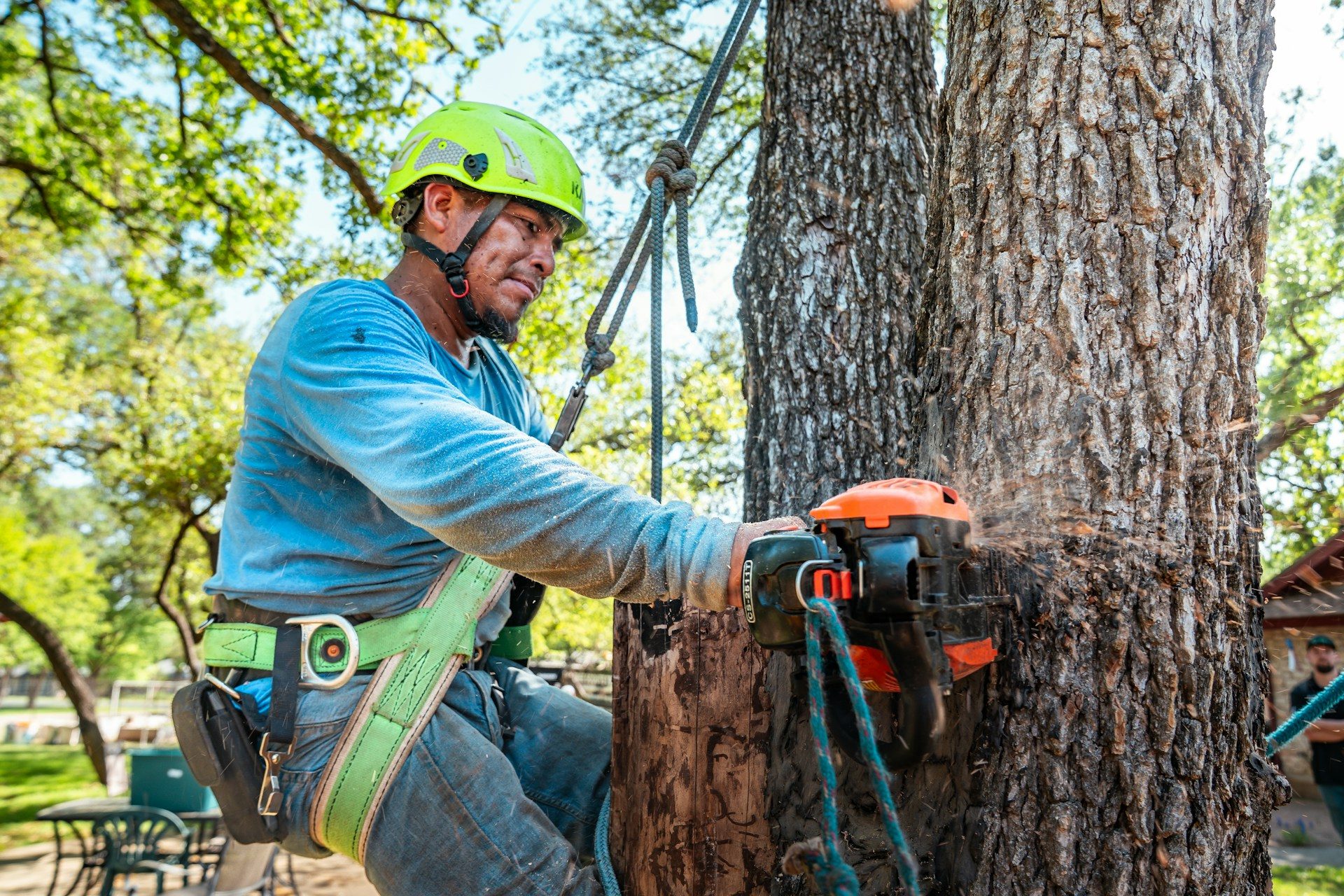
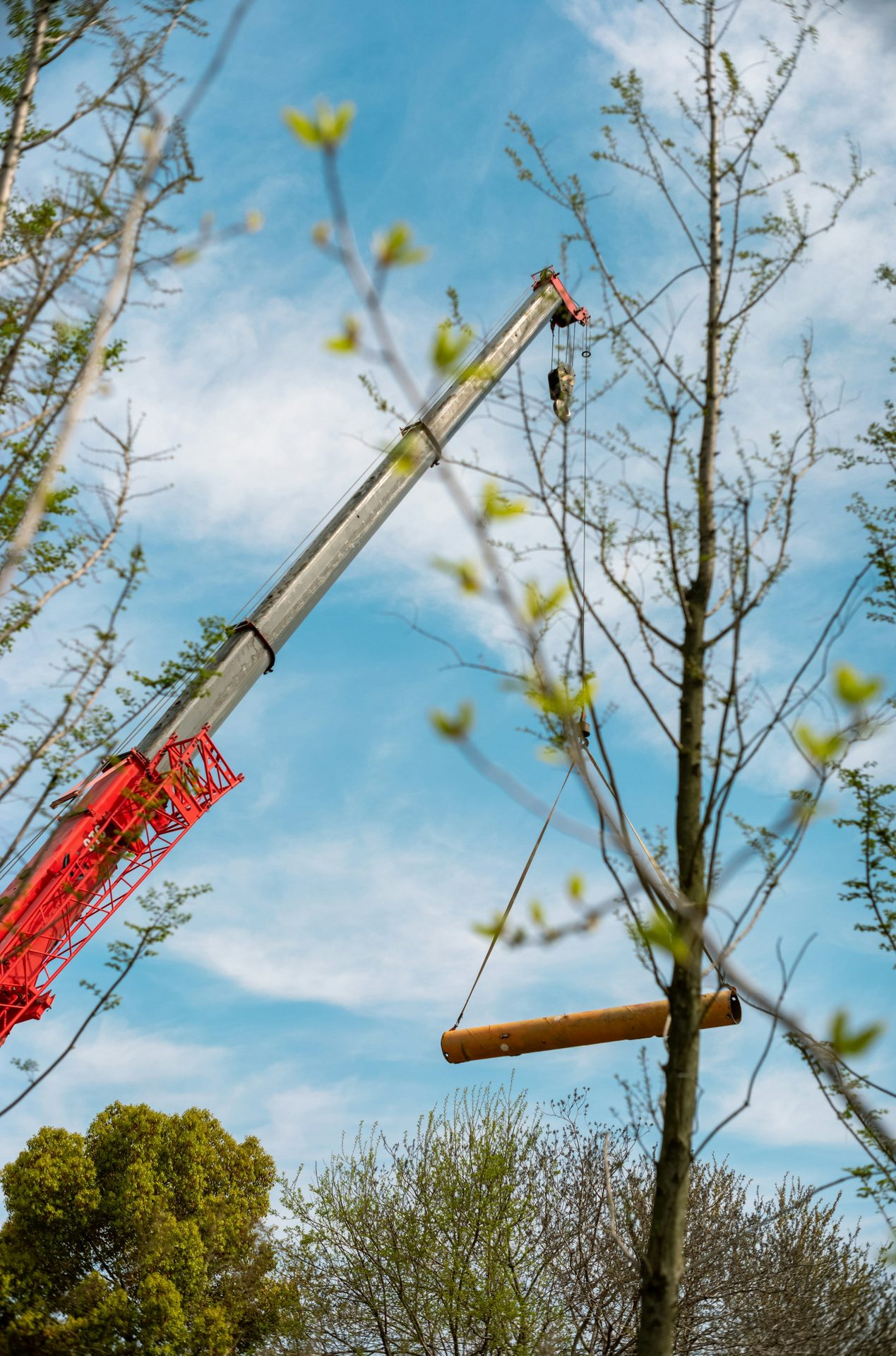
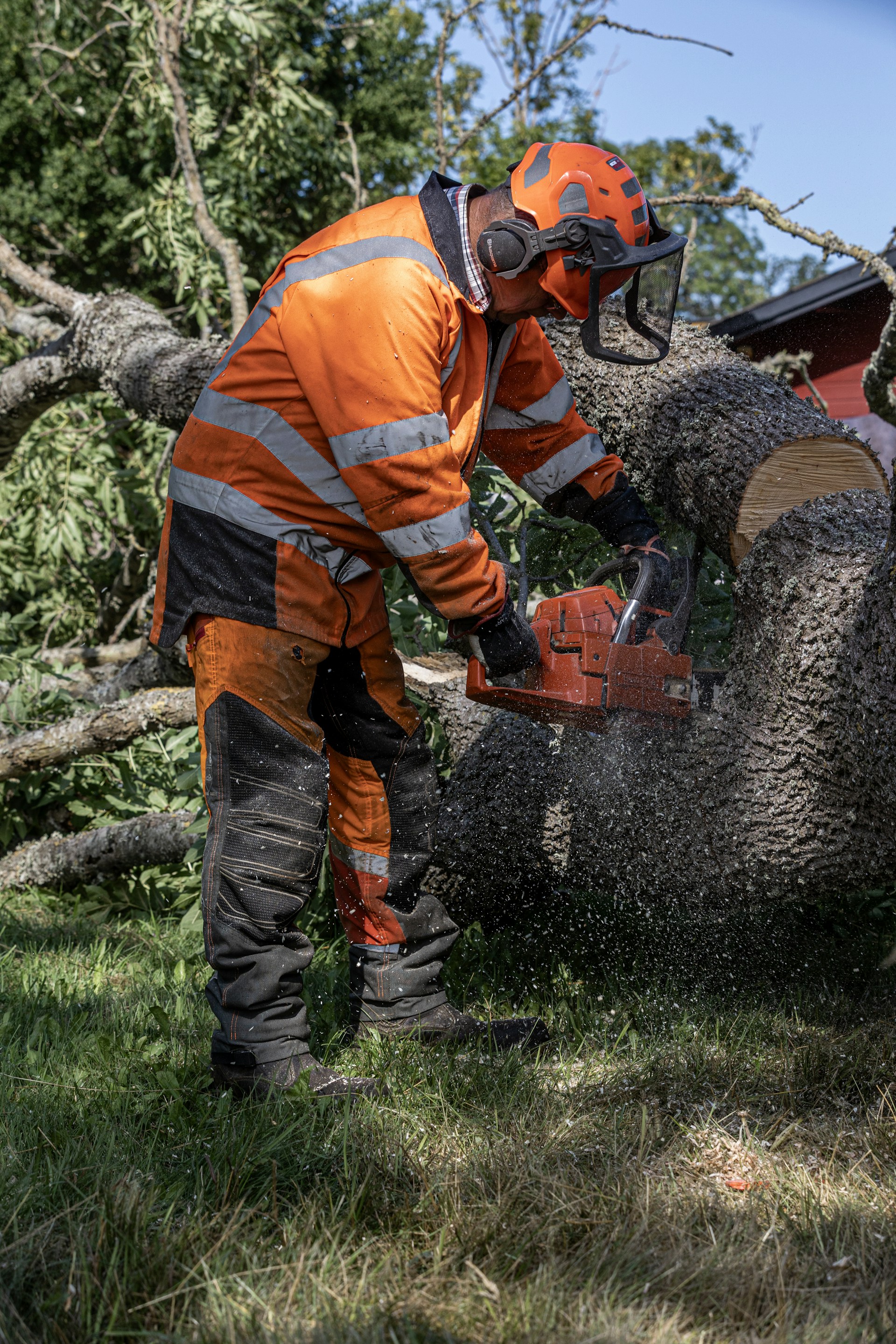
A professional crew works the other way round. We take the canopy off from the top first so the weight comes off gradually, rig the pieces resting on the car so they lift up and away rather than slide, and on a big tree use a crane to pick the last section straight up. If the tree is on the car now, call our 24/7 emergency crew; if it also hit the house, start with this guide.
Will a comprehensive claim raise your rates in Georgia?
It can affect your premium, depending on the insurer, but Georgia limits what an insurer can do at renewal. Under O.C.G.A. § 33-24-45(e)(3), an insurer may not refuse to renew a personal auto policy because of two or fewer comprehensive coverage claims in the preceding 36 months. That protects your policy, not your price, so ask your agent how a claim would affect your rate before you file a small one.
Two more numbers decide whether to claim at all:
- Your deductible. Policygenius gives the arithmetic: a $2,500 repair with a $1,000 deductible means the insurer pays $1,500. If the damage is near your deductible, get a repair estimate first.
- Diminished value. A car that has been damaged and repaired is often worth less. In Georgia, the Supreme Court held in State Farm v. Mabry (2001) that a policy promising to "pay for loss to" a car covers both the repair and the car's loss in value from the damage, as the federal Eleventh Circuit summarized it in Royal Capital Development v. Maryland Casualty (2011). Policy wording varies, so ask your adjuster whether diminished value is part of your claim, and talk to an attorney if you disagree.
How R & R Tree Service handles a tree on a car
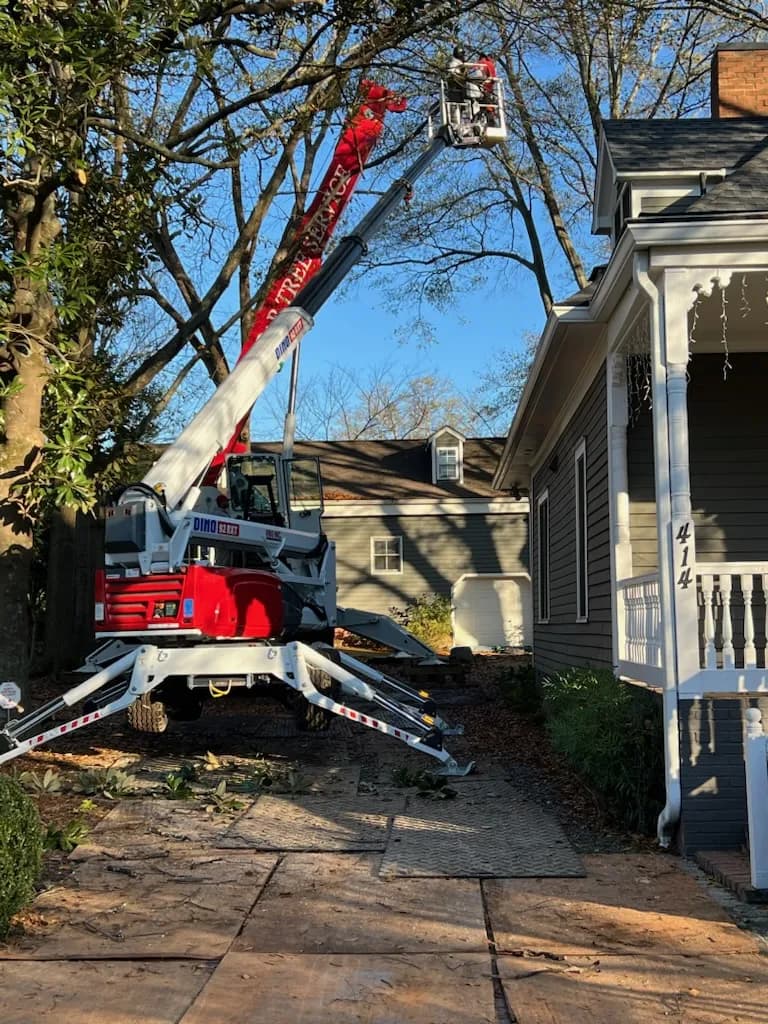
We have been taking trees off cars, driveways and houses across Gwinnett, Hall and Forsyth since 1987, with our own crew, bucket truck and our own crane — never a subcontractor. We answer emergency calls 24/7 and put trees on structures first. We photograph the tree before we cut, lift it off the car rather than drag it, and give you a free, written, itemized estimate in a format insurers accept, separating removal from the car, cleanup and haul-off. When asked, we will talk with your adjuster.
We are a family-owned TCIA member, licensed and insured with general liability and workers' compensation, which is the first thing an adjuster or property manager will ask about whoever does the work. Call (678) 482-9994.
Frequently asked questions
Is a tree falling on my car covered by comprehensive or collision?
Comprehensive. The standard auto policy counts "missiles or falling objects" as other-than-collision loss, even if the car is moving. Driving into a tree already lying in the road is a collision.
My neighbor's tree fell on my car. Does their insurance pay?
Usually not at first. You claim on your own comprehensive coverage. Your neighbor, or their insurer, owes you only if they knew or should have known the tree was dead or dangerous, so a written warning sent before the fall is the key evidence.
How long do I have to file a claim against a Georgia city for a tree that hit my car?
Six months from the event, in writing, under O.C.G.A. § 36-33-5. Counties allow 12 months (§ 36-11-1), and claims against the state, including GDOT, need written notice to the Department of Administrative Services within 12 months (§ 50-21-26). Talk to an attorney early.
Does car insurance pay to remove the tree from my car?
No, auto insurance pays for the car. Your homeowners policy may pay to remove a storm-felled tree that damages a covered structure or blocks your driveway, typically up to $500 per tree and $1,000 per loss on the standard form.
What if I only have liability insurance?
Then your own policy pays nothing for your car, and you pay for the repair unless someone else was negligent. That could be a neighbor, a landlord or a government that knew the tree was a hazard.
Can I move my car out from under the branch myself?
Only if the branch is small, loose and nowhere near a wire. A limb still attached to the tree or wedged against the car is under load and can shift or drop as the car moves. Photograph it first and call a tree service for anything larger.
Will my insurer drop me for a tree-on-car claim in Georgia?
Georgia law bars an insurer from refusing to renew a personal auto policy because of two or fewer comprehensive claims in the preceding 36 months. It does not limit premium changes, so ask your agent.
- ISO Personal Auto Policy PP 00 01 06 98 — Part D Coverage for Damage to Your Auto, Duties After an Accident or Loss, Our Right to Recover Payment (Nevada Division of Insurance copy, archived)
- Triple-I — What is covered by collision and comprehensive auto insurance?
- Insurance Information Institute — sample ISO Homeowners 3 policy: Property Not Covered, Debris Removal
- Atlanta News First — Sandy Springs denies claim after large tree branch damages car (Sept. 2025)
- U.S. Court of Appeals, 11th Circuit — Royal Capital Development v. Maryland Casualty (2011), on State Farm v. Mabry and diminished value in Georgia
- Experian — Who is responsible if a tree falls on my car?
 Call (678) 482-9994