

How to Store Firewood So It Stays Dry (and Bug-Free)
Quick answer: store firewood outdoors on a rack, pallets or rails a few inches off the ground, cover only the top so rain runs off while wind dries the sides, and keep the stack away from the house — not against walls, fences or the deck. Bring in only a day or two of wood at a time. In Georgia, also burn wood where you buy it: emerald ash borer and other tree pests travel in firewood, and the Georgia Forestry Commission asks you not to move it out of its county.
- Off the ground: wood on bare soil soaks up moisture, rots from the bottom and invites termites.
- Top covered, sides open: the EPA says covering the sides traps moisture in. A tarp belongs on top only.
- Away from the house: never stacked against walls. Five feet is the bare minimum for pests; 30 feet if wildfire is a concern.
- A day or two indoors: warm wood wakes up the insects inside it. Never spray firewood with insecticide.
- Don't move it: buy and burn firewood in the same county — invasive pests ride in it, and clean-looking wood can still carry them.
Good firewood can be ruined in one wet Georgia month. We see the same mistakes every winter: a delivery dumped on the grass, a blue tarp pulled tight over the whole pile, or a neat stack leaned against the back wall of the house. By January the bottom rows are soft, the top smells of mildew, and something has moved in.
This is how we tell our own firewood customers to store wood around Buford and the rest of North Georgia: where to put it, how to stack it so it stays up, how much to bring inside, and the pest rules most storage guides skip. If you are still deciding between seasoned and green wood, start with this guide — it covers drying times and moisture. This one is about keeping wood dry once you have it.
What is the best way to store firewood outside?
Every serious guide agrees on the same four rules, and the EPA puts the core of it in one line: store wood "outdoors, off the ground, with only the top covered — covering the sides traps in moisture." Here is the whole checklist and why each rule matters:
| Rule | How | Why it matters |
|---|---|---|
| Off the ground | Rack, pallets, rails, blocks — a few inches up | Ground moisture wicks up; the bottom rows rot; termites feed from below |
| Top covered | Roof, lean-to or tarp over the top only | Keeps rain off without trapping moisture |
| Sides open | Bare sides facing the wind | Moving air is what keeps wood dry |
| Sun and breeze | Open, sunny spot; not under trees | Dries the wood after every rain |
| Gap from walls | Never touching the house, fence or deck | Damp wood against siding invites termites and mold |
| Split, not rounds | Split before stacking | Rounds dry very slowly |
Firewood For Life adds a spacing rule we agree with: if you stack more than one row, leave about 12 inches between rows so air reaches every side. Air is the whole game in Georgia. Our problem is not snow load; it is humidity and summer downpours, and wood that cannot dry out between storms goes punky fast.
How far from the house should firewood be stored?
This is where most guides contradict each other — Orkin says at least five feet from the foundation, others say 20 or 30 — and none of them explain why. The answer depends on what you are protecting against:
| Concern | Distance | Source |
|---|---|---|
| Termites, ants, rodents (bare minimum) | At least 5 ft from the foundation, on a rack | Orkin |
| Pests, for a stack that stays all season | 20 ft or more from the nearest door | Firewood For Life |
| Wildfire (wooded lots, dry spells) | At least 30 ft from the home | Utah State University Extension |
| A day or two of wood by the door | On a raised rack, off the siding | Our practice |
Termites. Here the honest answer is calmer than pest-control marketing. University of Georgia entomologist Brian Forschler told UGA's news service that wood stored on the ground can attract termites, but it is "very unlikely" those termites will start a new nest in your house unless the woodpile sits in place for several years. Iowa State Extension says the same thing from the other side: termites carried indoors in firewood cannot start a colony, but "a woodpile stacked against a house can serve as an avenue for termites to infest the structure." The risk is the pile touching the house, not the wood itself.
Mice and snakes. Forschler called these the bigger, more immediate worry: an outdoor woodpile quickly becomes home to mice, and snakes follow the mice. UGA Extension in Towns and Union counties notes that copperheads "like spots with logs, leaf, and rocks for cover" and live comfortably in suburbs, and it lists wood piles among the habitats to remove from around the house. A stack 20 feet out in the open, on a rack, with no ivy or tall grass around it, is a much less attractive den than one tucked behind the azaleas.
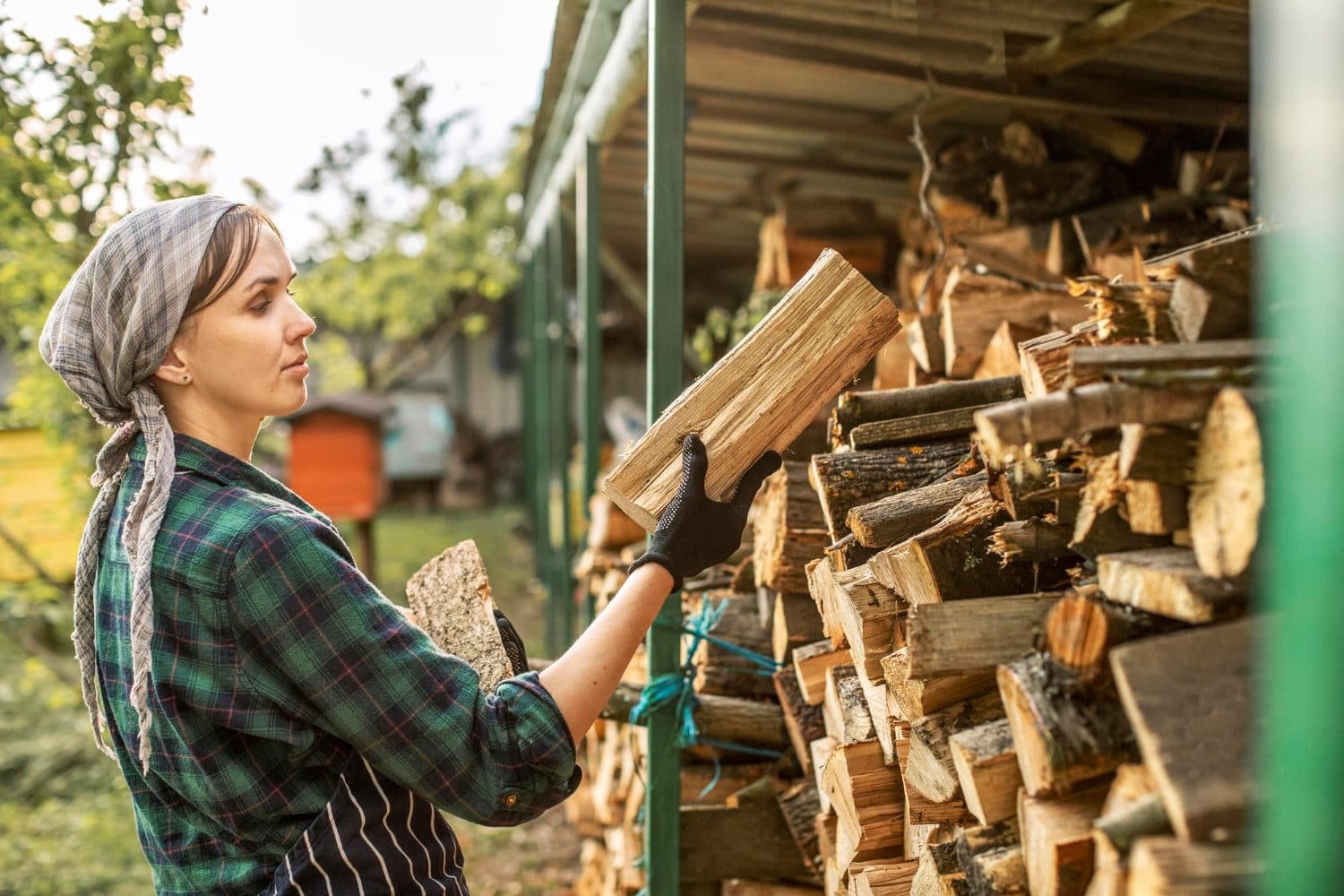
Spiders. Georgia has three widow spiders — southern black, northern black and brown — and UGA Extension says gardeners should wear gloves near "piles of wood or debris." Widow bites are rare, but they happen when someone grabs a log the spider is on. Gloves every time you pull wood off the stack.
How do you keep firewood off the ground?
You only need a few inches of clearance, but it has to be solid and open underneath so air can move. Firewood For Life says wood "can soak up a lot of moisture directly from the ground" without a barrier, and Hansen Pole Buildings notes that the bottom of a ground-level stack rots first and passes moisture up into the wood above.
- A steel log rack — the cleanest option, with end supports that keep the stack square.
- Wooden pallets — free from many businesses. Lay them slats-up and level; a wobbly pallet makes a wobbly stack.
- Two rails — pressure-treated 2x4s or landscape timbers laid parallel on blocks. Never burn the treated rails; the EPA lists pressure-treated wood among things you should not burn.
- Concrete blocks or pavers under rails, on a gravel pad if the spot holds water.
North Georgia red clay deserves a special word. In our experience it stays wet for days after a hard rain, and a pallet set straight on clay in a low spot sits in a puddle. Pick a spot that drains, or put down a few inches of gravel first.
Should firewood be covered with a tarp?
Yes — on top. No — on the sides. Wrapping a pile in plastic is the most common way we see good wood ruined: the tarp traps the moisture already in the wood, the sun cooks it, and mold grows on the underside. Firewood For Life's rule is a sensible limit: cover the top and no more than a foot or two down the sides.
- Best: a roof. A firewood shed, a lean-to roof or a rack with a metal top keeps rain off with no tarp to manage. The ideal shed is roofed with open or slatted sides.
- Good: a tarp on top only, weighted at the corners with a split or two so wind cannot strip it off in a thunderstorm.
- Give it a slope so water runs off instead of pooling in the middle of the stack.
- Freshly delivered green wood: leave it uncovered in dry weather so sun and wind can work on it. Hansen Pole Buildings advises tarping only once wood has dried, or when heavy rain is coming.
Seasoned wood that is already dry needs the cover more than green wood does — it is ready to burn and you want it to stay that way.
How do you stack firewood so it won't fall over?
A collapsed stack is a mess, and around children it is a hazard: the University of Illinois Extension puts a full cord at about 2 tons. A stable stack comes down to a level base, solid ends and a sensible height.
- Keep it to about 4 feet high. That is the height firewood.co.uk recommends for safety, and it is the standard height of a measured cord.
- Build the ends first. Without a rack, crisscross pieces at each end like a log-cabin column — two one way, two the other — and fill the row between them.
- Stack bark side up on the top layer so it sheds rain like shingles.
- Lean the row slightly inward, never outward. A row that leans out will come down.
- Mix sizes as you go, filling gaps with smaller splits so the courses stay level.
- One row, or rows 12 inches apart. Two rows jammed back to back dry poorly and topple together.
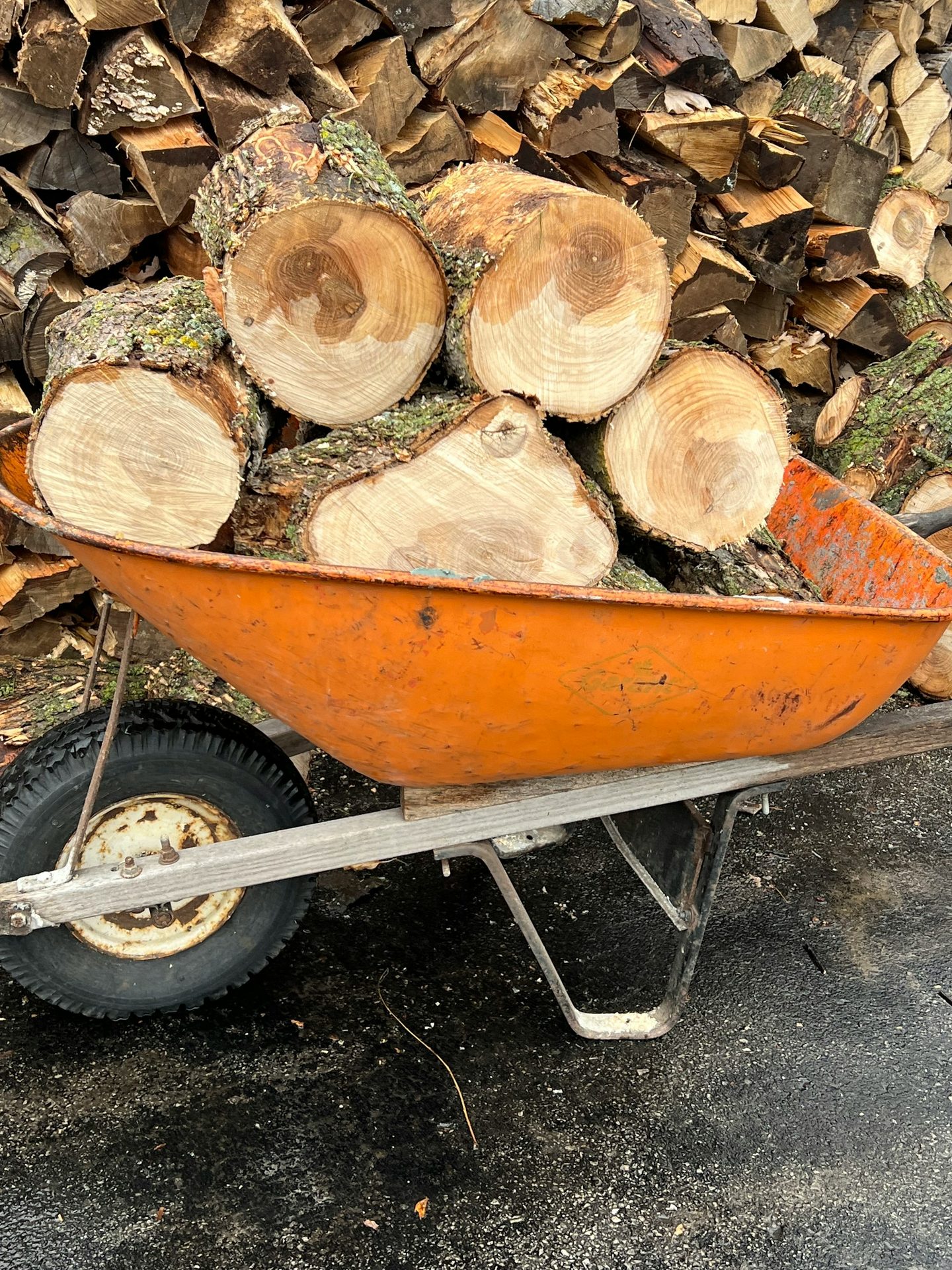
Not against a fence, either. A wood privacy fence gets the same moisture and termite problem as the house, and the stack's weight pushes on the fence. On a deck or porch, keep only a small rack — a full stack holds water against the deck boards and puts a lot of weight on the structure.
How much room does a firewood delivery need?
Plan the spot before the truck arrives. A delivery is usually dumped in one place, and moving it twice is twice the work. The University of Illinois Extension gives the standard sizes:
| Amount | Stacked size | What it means for you |
|---|---|---|
| Full cord | 4 ft high × 4 ft deep × 8 ft long (128 cu ft) | About 2 tons; usually three rows of 16-inch splits |
| Half cord | 4 ft high × 2 ft deep × 8 ft long | A good season for occasional fires |
| Face cord / rick | 4 ft high × 8 ft long, one row deep | Depth varies — ask how long the pieces are |
If you have one 8-foot rack, a full cord will not fit on it. Three rows of 16-inch splits, with a foot between rows, need a footprint roughly 8 feet long and 6 to 7 feet deep, or one long row of about 24 feet. Our price guide explains how to check you received a full measure.
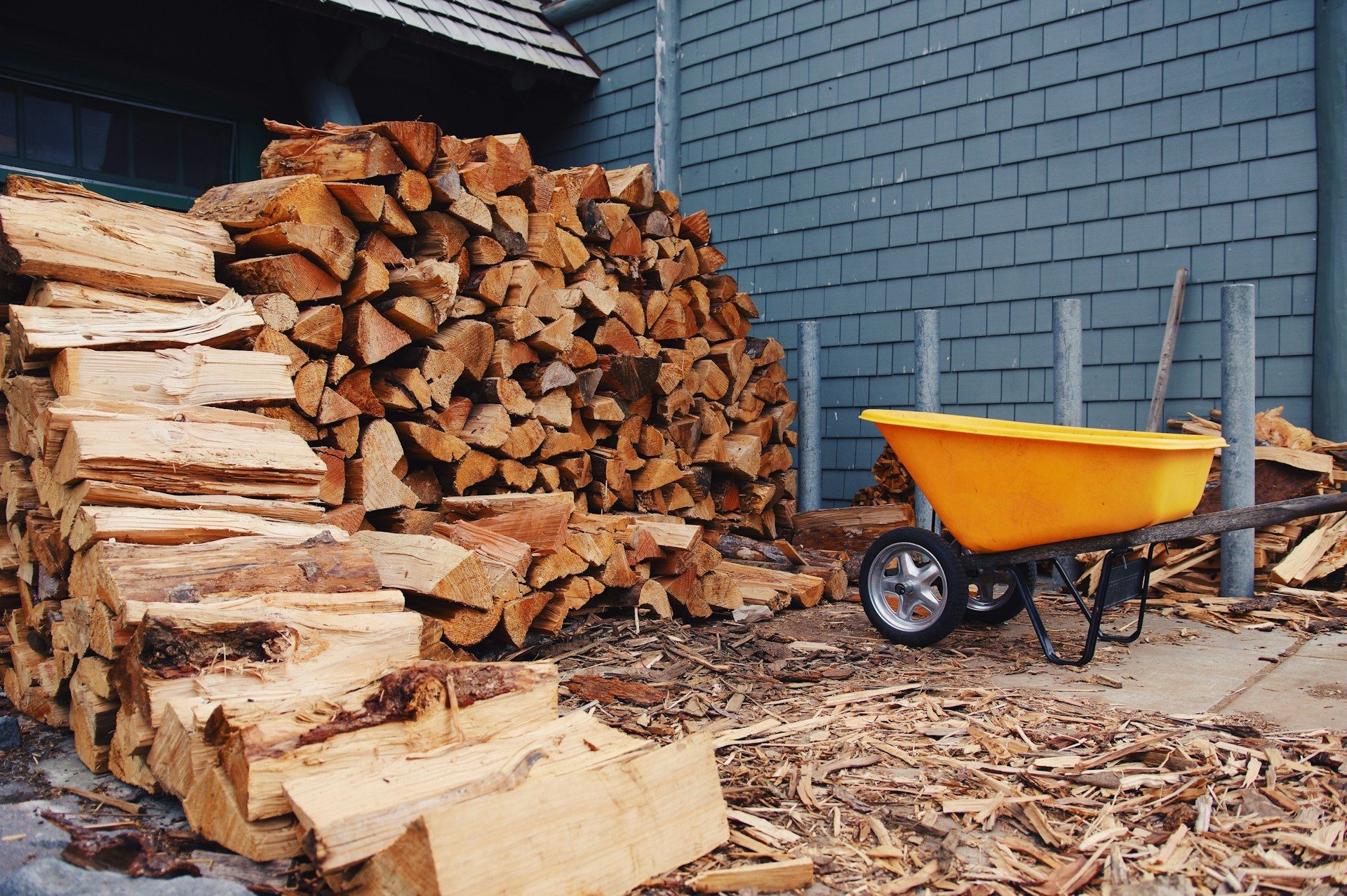
- Pick the spot — level, drained, sunny, at least 20 feet from the house, reachable from the driveway.
- Set the base — rack, pallets or rails — before delivery day.
- Tell the driver where. A loaded truck on a soft lawn leaves ruts; the driveway edge is often better.
- Stack within a day or two if rain is coming. A loose pile sheds water poorly and the bottom stays wet.
- Oldest wood in front. Put this year's green wood at the back so you burn the dry wood first.
Or skip the work: we offer optional stacking with every firewood delivery — tell us where you want the stack and we build it there.
Can you store firewood in the garage, basement or house?
Only a small amount, and only for a short time. The reason is bugs, not fire codes. Firewood is full of overwintering insects that stay cold and still outside. Iowa State Extension says it generally takes a couple of days indoors for them to warm up and start moving, so it advises leaving wood outside until a day or two before you burn it. University of Illinois Extension stretches that to a week at most.
UGA's Forschler is reassuring about what comes out: ants, spiders, roaches and millipedes from firewood do not mean your house is infested — "you probably just need to leave your wood outside until its time to use it." Most firewood insects, including the beetles that sometimes emerge from logs, will not harm your home or furniture, according to Iowa State.
- Don't spray firewood with insecticide. Iowa State strongly advises against it: the spray does not reach insects inside the wood, and burning treated wood indoors can vaporize the insecticide into your living room.
- Don't stack a winter's supply in the basement. It is the dampest room in most Georgia houses, and you bring every pest in the woodpile inside with it.
- Don't keep wood close to the fireplace or stove. The EPA says to keep flammable items away from the appliance.
- Don't leave a pile on the hearth for weeks. That, Forschler says, is how firewood insects get a chance to settle in.
A garage is a reasonable middle step for a week or so of wood on a rack off the concrete — handy in a cold snap. In an attached garage, treat it like the house: a small supply, not the season's stack.
How long can you store firewood?
Well-stored hardwood keeps for years. Firewood For Life estimates 3 to 4 years outside for properly stored wood. In our experience the clock runs faster in Georgia's heat and humidity, and faster for pine than for oak or hickory, so we tell customers to plan on burning wood within a couple of winters of buying it.
What ends a stack's life is moisture, not age. Old dry wood still burns, just with less heat. Wood that has gone soft, crumbles in your hand, or is coated in mold or fungus is past saving; the EPA lists "wet, rotted, diseased, or moldy wood" among the things not to burn. Use the oldest wood first and you rarely reach that point.
Why shouldn't you move firewood in Georgia?
Because insects and diseases that kill trees travel in it. Don't Move Firewood, the national campaign, sums up Georgia's position: firewood brought in from other states threatens Georgia's trees with pests such as emerald ash borer, spongy moth, Asian longhorned beetle and laurel wilt disease, and the Georgia Department of Agriculture, Department of Natural Resources and State Parks all urge people to use local firewood. Its summary of the Georgia Forestry Commission's guidelines:
- Avoid moving firewood out of the county where it originated.
- When visiting campgrounds, leave your firewood at home and get it at or near the campsite.
- If you brought firewood with you, burn all of it on-site before leaving.
Emerald ash borer is already here. UGA reported the beetle's first confirmed Georgia infestation in July 2013, in DeKalb and Fulton counties. The larvae tunnel under the bark and kill ash trees, and although the adult flies, UGA scientists said its primary spread is "hitching a ride on infested ash firewood, logs and nursery stock." Georgia has an estimated 2.9 million ash trees planted around homes, businesses and parks.
Spotted lanternfly arrived in 2024. The Georgia Department of Agriculture announced the state's first confirmed detection, in Fulton County, in November 2024, as reported by UGA. It lays eggs from September to November, and the egg masses "look like smears of mud." If you see one, the state asks you to photograph it, kill it and report it at gainvasives.org.
Termites move in wood too. A University of Florida Extension review notes that the spread of the Formosan subterranean termite is tied to moving large chunks of infested wood, citing case histories from Atlanta.
You cannot inspect your way out of the risk. UGA Extension in DeKalb County points out that microscopic fungal spores and pin-sized insect eggs are easily missed — "never assume that the wood is free from invasive species." In practice: do not bring wood home from the mountain cabin or a relative's place out of state, do not take leftover campfire wood home, and buy firewood that was cut near where you live.
How R & R Tree Service handles firewood
Our firewood comes from our own tree removals and land clearing in North Georgia, so it was cut close to where it will burn. We sell oak, hickory and maple hardwoods plus pine, seasoned (air-dried and ready to burn) or green (cheaper, if you have room and time to dry it), by the half cord, full cord or smaller amounts. See the types and what each burns like.
Delivery usually happens within 48 hours, and we will stack it for you where you want it. You can also pick up at our yard at 1381 Buford Hwy, Monday through Saturday — call ahead. We have been a family-owned business since 1987. Order on our firewood delivery page or call (678) 482-9994.
Frequently asked questions
Should firewood be stacked bark side up or down?
Bark side up on the top layer, so it sheds rain like a roof. Lower in the stack it matters less than keeping gaps for air and the whole stack off the ground.
Is it OK to stack firewood against the house?
No. Iowa State Extension warns that a woodpile against a house can give termites a path into the structure, and wood against siding stays damp. Keep the main stack at least 5 feet away, and ideally 20 feet or more.
Can I store firewood on my deck or porch?
Only a small rack holding a day or two of wood. A full stack holds moisture against the deck boards, gives pests a bridge to the house and is heavy — a full cord weighs about 2 tons.
Should I spray my firewood for bugs?
No. Iowa State Extension strongly advises against it: insecticide does not reach the insects inside the wood, and burning treated wood indoors can release the chemical into your home. Store wood outside and bring it in only a day or two before you burn it.
Can I bring firewood home from my cabin or campsite?
Georgia asks you not to. The Georgia Forestry Commission's guidelines are to avoid moving firewood out of the county where it was cut and to burn campfire wood on-site before you leave, because pests like emerald ash borer travel in it.
Is it safe to burn moldy firewood?
The EPA says not to burn wet, rotted, diseased or moldy wood. A little surface mildew on otherwise sound, dry wood is common in Georgia, but wood that is soft, crumbly or heavily molded should not go in the fireplace.
Does R & R Tree Service stack firewood?
Yes. Stacking is an option with every delivery, and most deliveries arrive within 48 hours. Call (678) 482-9994 to order.
- UGA College of Agricultural & Environmental Sciences — Uninvited guests can hitch a ride inside on firewood (Brian Forschler)
- Don't Move Firewood — Georgia firewood guidance (Georgia Forestry Commission guidelines)
- University of Georgia — Tree-killing insect emerald ash borer found in Georgia (2013)
- UGA Extension DeKalb County — Don't move that firewood: burn where you buy
- Iowa State University Extension — Firewood insects
- U.S. EPA Burn Wise — Best wood-burning practices
 Call (678) 482-9994