

Price of Firewood in North Georgia: Cord, Face Cord, Rick
Quick answer: the price of firewood only means something per cord: a legal cord is 128 cubic feet of tightly stacked wood (4 feet high, 4 feet deep, 8 feet long), and Georgia requires firewood to be sold by the cord or a fraction of one. A "face cord" or "rick" is usually one row of 16-inch pieces, about a third of a cord, and is not a legal sales unit in Georgia. National quotes run wide (Yelp: $80 to $575 a cord), so convert every quote to a per-cord price first.
- A cord is a legal measure: 128 cubic feet of wood stacked parallel, touching and compact — under NIST Handbook 130 and Georgia's own rule.
- Georgia bans the vague units: "face cord," "rack," "pile," "truckload" and terms like them may not be used to advertise or sell firewood.
- Convert before you compare: a face cord of 16-inch pieces is one third of a cord, so multiply its price by three.
- You are owed a ticket: Georgia requires a delivery ticket naming the seller, buyer, date, quantity and what the wood is.
- Short load? Stack it, measure it, photograph it, call the seller before you burn any — then the Georgia Department of Agriculture.
Most firewood questions we get in the fall are really price questions in disguise: is this a good deal, and how much wood is actually in it? Both answers depend on the unit. A cord is a defined, legal amount of wood. A "face cord," a "rick" or a "truckload" is whatever the seller decides it is that day.
Below is what a cord is under federal model law and Georgia's own regulations, how the common shorthand units compare, what legitimately moves the price of firewood, and how to check a delivery so you are not paying for air. We sell firewood ourselves, but we do not publish prices — every load is quoted to the order — so the price ranges here are national third-party figures, labelled as such.
How much wood is in a cord?
A cord is 128 cubic feet of wood, "ranked and well stowed." That is the definition in NIST Handbook 130, the national model law most states adopt, and Georgia uses the same words in its own rule, Ga. Comp. R. & Regs. 40-15-4-.02. "Ranked and well stowed" means the pieces are laid in a row, touching and parallel to each other, and stacked in a compact way — not tossed.
The classic shape is a stack 4 feet high, 4 feet deep and 8 feet long. But any stack that multiplies out to 128 cubic feet is a cord: the National Conference on Weights and Measures' consumer sheet also shows one 2 feet deep, 4 feet high and 16 feet long. Since almost nobody burns 4-foot logs, a real delivered cord is usually three rows of 16-inch pieces, or two rows of 24-inch pieces, standing side by side.
Even a perfect cord is not 128 cubic feet of solid wood. The University of Arkansas Extension's heating-with-firewood fact sheet puts the solid wood in a stacked cord at about 85 cubic feet on average; the rest is air between the pieces. That is normal, and it is why tight stacking matters.
Face cord vs cord vs rick: what is the difference?
A face cord and a rick are the same idea: one row of firewood 4 feet high and 8 feet long, as deep as the pieces are long. That last part is the catch. With 16-inch pieces a face cord is a third of a cord; with 12-inch pieces it is a quarter; with 24-inch pieces it is half. Family Handyman notes that some sellers even call a 12-inch row a face cord. As a long-time firewood seller quoted by Fire & Saw puts it, a rick is "whatever someone says it is."
| Unit | Size | Share of a full cord |
|---|---|---|
| Full cord | 4 ft x 4 ft x 8 ft = 128 cu ft | 1 |
| Half cord | 64 cu ft (e.g. 2 ft deep x 8 ft long) | 1/2 |
| Quarter cord | 32 cu ft (e.g. 1 ft deep x 8 ft long) | 1/4 |
| Face cord / rick, 16-in pieces | about 42.7 cu ft | about 1/3 |
| Face cord / rick, 12-in pieces | 32 cu ft | 1/4 |
| Face cord / rick, 24-in pieces | 64 cu ft | 1/2 |
| Truckload, pile, load | Undefined | Unknown until stacked |
Half cords, quarter cords and other fractions of a cord are legal and useful — not everyone has room for, or burns, a full cord. What matters is that the fraction is stated against a real cord, so you can check it.
Is it legal to sell firewood by the face cord or truckload in Georgia?
No. Georgia's Department of Agriculture rule on fireplace and stove wood says fuel wood "shall be advertised, offered for sale and sold only by measure, using the term 'cord' and fractional parts of a cord, or the cubic meter." It then bans the shorthand outright: the terms "face cord," "rack," "pile," "truckload," "or terms of similar import shall not be used when advertising, offering for sale, or selling wood for use as fuel." "Rick" is not named, but it is the same thing as a face cord.
The rule covers more than the cord itself. Under the same section (40-15-4-.02):
- Species claims have to be accurate. A seller does not have to name the species, but if an ad or invoice says, for example, "50% hickory, 50% softwood," the percentages must be within 10%.
- Packaged wood shows cubic feet. Bundles and bags must state the quantity in cubic feet or cubic meters, so you can compare a gas-station bundle with a cord.
- Single logs and small packs of logs are sold by weight or by weight plus count.
When you see firewood for sale by the "truckload" on a roadside sign or an online listing, that is not a reason to call anyone — it is a reason to ask one question before you pay: "How many cubic feet, or what fraction of a cord, is that?" A seller who knows the answer will tell you.
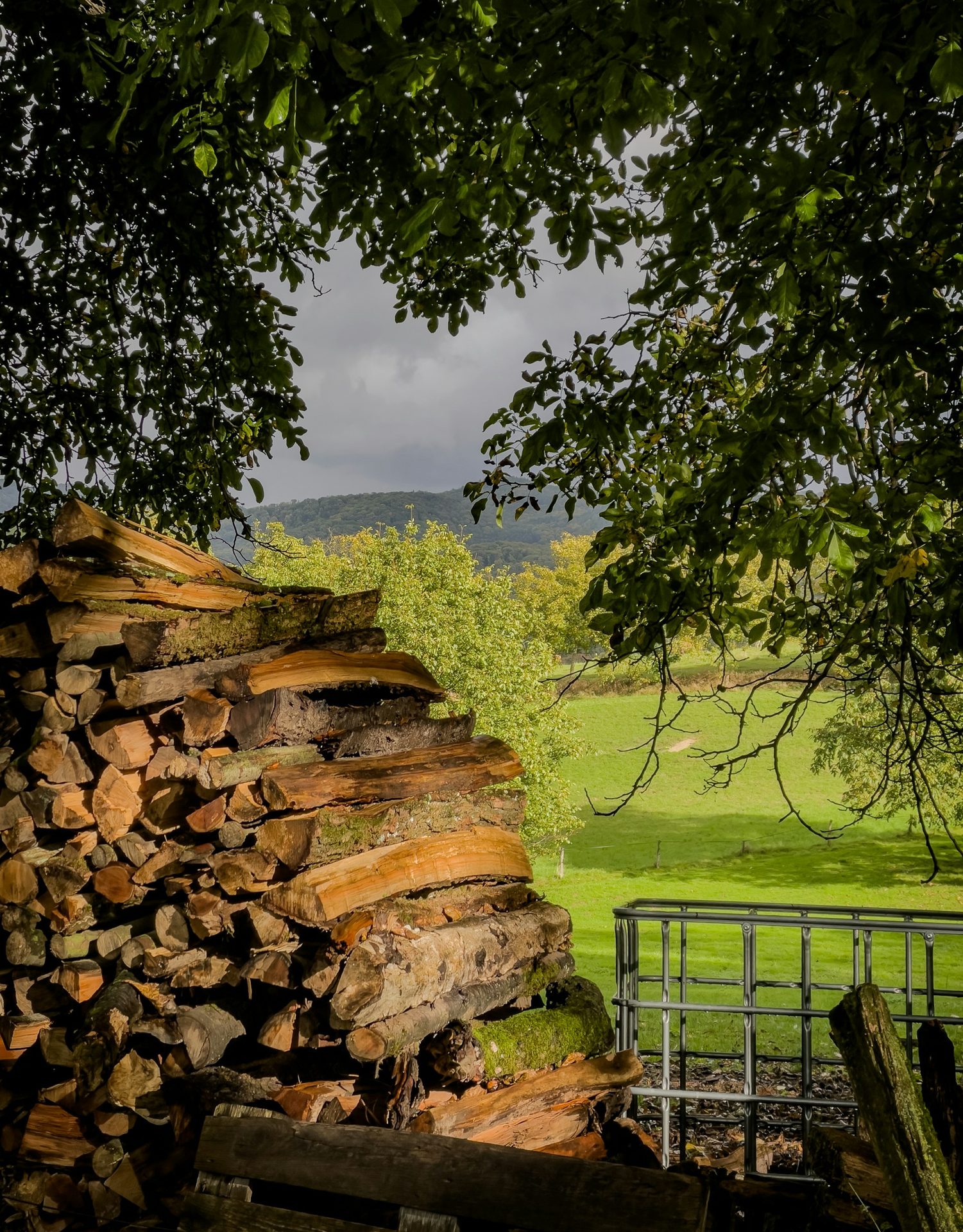
How much does a cord of firewood cost?
It depends heavily on where you live, the species and how dry the wood is, and the published ranges are wide. These are national figures from third-party guides — Yelp's firewood cost data and Family Handyman — not North Georgia prices and not ours:
| Unit | Range quoted | Source |
|---|---|---|
| Full cord | $80 to $575 | Yelp, from quotes on its platform (Oct 2026) |
| Full cord, from a supplier | $200 to $400 | Family Handyman (2023) |
| Half cord | $40 to $300 | Yelp (Oct 2026) |
| Face cord / rick | $20 to $190 | Yelp (Oct 2026) |
| Delivery | $20 to $80 | Yelp (Oct 2026) |
| Store bundle (about 3/4 cu ft) | $5 to $7 each | Family Handyman (2023) |
Two things jump out. First, the face-cord range is not a third of the cord range, because nobody agrees what a face cord is. Second, bundles are by far the most expensive way to buy wood: Family Handyman works out that bundles at $5 to $7 can add up to as much as $670 per cord. For anything beyond an occasional fire, buying by the fraction of a cord is the better deal.
For a real number in your area, get quotes — and make every quote say how much wood it is in cords or cubic feet, whether delivery is included, and whether stacking is.
How do you compare a face cord price with a cord price?
Convert everything to a full cord. The University of Arkansas Extension method is simple: divide 48 inches (the depth of a full cord) by the length of the pieces, then multiply by the price of one 4-by-8-foot row.
- Measure the pieces. Take a tape measure to several pieces and use the average length — 16 inches is common.
- Divide 48 by that length. 48 / 16 = 3 rows to a cord. 48 / 12 = 4. 48 / 18 = about 2.7.
- Multiply by the row price. In the Extension's own illustration, a $75 face cord of 16-inch wood works out to 3 x $75 = $225 a cord, and a $60 "stove cord" of 12-inch wood to $240 — so the cheaper-sounding unit was the more expensive wood.
- For any other stack, use volume. Length x height x depth in feet, divided by 128, gives the fraction of a cord. Divide the price by that fraction.
What makes firewood cost more or less?
Once quotes are on the same per-cord basis, the remaining differences usually have a reason. The ones that matter:
- Species. Denser wood holds more heat per cord. In the University of Arkansas Extension's heat table, a cord of shagbark hickory yields about 16% more usable heat than red oak, and red oak about 23% more than sweetgum. Its ratings put hickories and the oaks at "excellent" overall and pine at "fair", because pine smokes heavily and coals poorly. Paying more per cord for hickory or oak can be cheaper per hour of heat.
- Seasoned vs green. Green wood is cheaper because the seller has not had to store it. Arkansas Extension notes that drier wood costs more "because it has been stored longer and under better conditions." Green wood is only a bargain if you have the room and the months to dry it — seasoned vs green firewood explains how long that takes in Georgia.
- Piece length and split size. Shorter pieces and finely split wood take more cutting and handling, so they usually cost more per cord, according to the same fact sheet. Consistent lengths cost more too — and stack better.
- Cleanliness. Wood dragged through mud or sand is worth less. Clean bark is easier on your hearth and your hands.
- Delivery. Often a separate line on the quote — Yelp's national data puts it at $20 to $80. Picking up at the seller's yard avoids it.
- Stacking. Having the crew stack it is usually an add-on. It is also the easiest way to see what you got — the NCWM sheet suggests asking the seller to stack it, even if it costs extra.
- Season. Several of the guides we checked report higher prices once cold weather arrives and lower prices in summer, when demand is low. Buying early also gives seasoned wood more time under cover.
- Quantity. Fire & Saw lists buying in larger volumes, alongside buying green and picking up yourself, among the ways to pay less.
Our own guide to the types of firewood covers how each species burns, if you are choosing between them.
How do you measure a firewood delivery?
Stack it before you burn any of it. The NCWM's advice is simple: get a receipt, stack the wood neatly, measure, and contact the seller about any shortage before you use a single piece. Once it is in the fireplace, nobody can prove anything.
- Stack tight. Pieces parallel, touching, few gaps — the "ranked and well stowed" standard the law uses. Crisscross the ends for stability if you like, but keep the rows compact.
- Measure in feet. Length, height and depth of each row. Depth is the average piece length.
- Multiply and divide by 128. A row 8 ft long, 4 ft high and 1.33 ft deep is 42.6 cu ft — a third of a cord. Three of those is a cord.
- Photograph the stack with the tape measure in the shot.
If your wood was dumped in a pile, you cannot measure it as it lies — loose wood takes much more room than stacked wood. As a rough check, Northern Woodlands reports that many firewood dealers treat about 200 cubic feet of thrown wood, or two thrown loads in a full-size pickup bed, as one stacked cord. That makes a single thrown pickup load roughly half a cord, not a cord.
Expect a little shrink with green wood. Northern Woodlands notes that wood shrinks between 2% and 10% across the grain as it dries, so a stack of green wood measured in October will be slightly smaller by spring. That is not a short cord. A row that is a foot short on the day it arrives is.
How do you avoid getting shorted on firewood?
Most short cords are not fraud; they are vague units and loose piles. Here is how to read what a seller tells you:
| The seller says | What it means | Ask or do this |
|---|---|---|
| "A cord" or "half cord" | A legal measure: 128 or 64 cu ft stacked | Ask if delivery and stacking are included |
| "A face cord" or "a rick" | One row; depth = piece length; not a legal sales unit in Georgia | Ask the piece length and cubic feet |
| "A truckload" | Undefined; depends on the truck and how it was loaded | Ask what fraction of a cord it equals |
| "Seasoned" | Should be dry enough to burn | Ask how long it has been split and stacked |
| "Mixed hardwood" | A species claim; if percentages are given they must be within 10% | Ask which species, roughly |
| A price with no unit | You cannot compare it | Get the quantity in writing |
Then get the paperwork. Under Georgia's rule on sales from bulk, which applies to firewood sales over $25, a cord of wood sold to a consumer must come with a delivery ticket showing:
- the name and address of the seller and of the buyer;
- the date delivered;
- the quantity delivered, and the quantity the price is based on if different;
- what the wood is, in the most descriptive terms practical, including any quantity claim made in the sale;
- the truck's tag number, if the truck is not otherwise identifiable.
The NCWM adds two habits worth keeping: get the seller's phone number, and write down the delivery truck's license plate.
What should you do if a firewood delivery is short?
- Do not burn any of it. The stack is your evidence.
- Stack, measure and photograph it as above.
- Call the seller first. Many shortfalls are honest mistakes and get topped up.
- If the seller will not fix it, contact the state. The firewood rules above are Georgia Department of Agriculture rules, and the department's Fuel & Measures Division handles weights and measures. Its main line, as listed by the National Association of State Departments of Agriculture, is 404-656-3600 — ask for Fuel & Measures. Have your ticket, photos and measurements ready.
We are a tree service, not a regulator: this is how the rules read, and the department has the final word on how it handles a complaint.
How R & R Tree Service sells firewood
Our firewood comes from our own tree removals and land clearing around Gwinnett, Hall and Forsyth counties: oak, hickory and maple hardwoods, plus pine. Every species is available seasoned (air-dried, ready to burn) or green (lower priced, if you will dry it yourself),. We sell by the half cord, the full cord or smaller amounts.
Firewood delivery is usually within 48 hours, with optional stacking so you can see exactly what you received; or pick up at our yard at 1381 Buford Hwy in Buford, Monday through Saturday (call ahead). We serve homes and businesses across our service area, from Buford, Sugar Hill and Suwanee to Cumming, Gainesville and the Atlanta metro. We take cash, ACH or card (cards carry a 3.5% fee). For a quote on what you need, call (678) 482-9994. Before winter, how to store firewood keeps it dry once it is stacked.
Frequently asked questions
How many face cords are in a cord of wood?
Three, if the pieces are 16 inches long. A face cord is one row 4 feet high and 8 feet long, so with 12-inch pieces it takes four to make a cord, and with 24-inch pieces it takes two.
Is a rick of wood the same as a face cord?
Usually, yes: both mean a single row 4 feet high and 8 feet long, as deep as the pieces are long. Neither is a defined measure, and Georgia does not allow "face cord" or similar terms in firewood sales, so ask for the cubic feet.
How much firewood fits in a pickup truck?
It depends on the truck and how the wood is loaded. Northern Woodlands reports a dealer rule of thumb that two thrown loads in a full-size pickup bed make about one stacked cord, so one thrown load is roughly half a cord.
What should a firewood receipt show in Georgia?
Georgia's rule requires a delivery ticket with the seller's and buyer's names and addresses, the delivery date, the quantity delivered, and a description of the wood. Ask for the price and the species on it too.
Is green firewood cheaper than seasoned?
Usually, because the seller has not stored and dried it. It is only a saving if you have the space and several months to let it dry before you burn it.
How much wood is a half cord?
64 cubic feet stacked — for example, a row 8 feet long, 4 feet high and 2 feet deep, or a 4-by-4-by-4-foot stack.
Does R & R Tree Service sell firewood by the cord?
Yes. We sell oak, hickory, maple and pine, seasoned or green, by the half cord, full cord or smaller amounts, with delivery usually within 48 hours and optional stacking. Call (678) 482-9994 for a quote.
- Georgia Dept. of Agriculture rule — Ga. Comp. R. & Regs. 40-15-4-.02 (Nonfood Products: fireplace and stove wood)
- Georgia Dept. of Agriculture rule — Ga. Comp. R. & Regs. 40-15-4-.06 (Sale from Bulk: delivery tickets)
- NIST Handbook 130 (2026), Uniform Regulation for the Method of Sale of Commodities, section 2.4 Fireplace and Stove Wood
- National Conference on Weights and Measures — Avoid Getting Burned When Buying Firewood
- University of Arkansas Extension, FSA1091 — Basics of Heating with Firewood
- Northern Woodlands — A Cord is a Cord is a Cord
 Call (678) 482-9994