


Emergency Tree Removal in Gainesville, GA: What to Do First
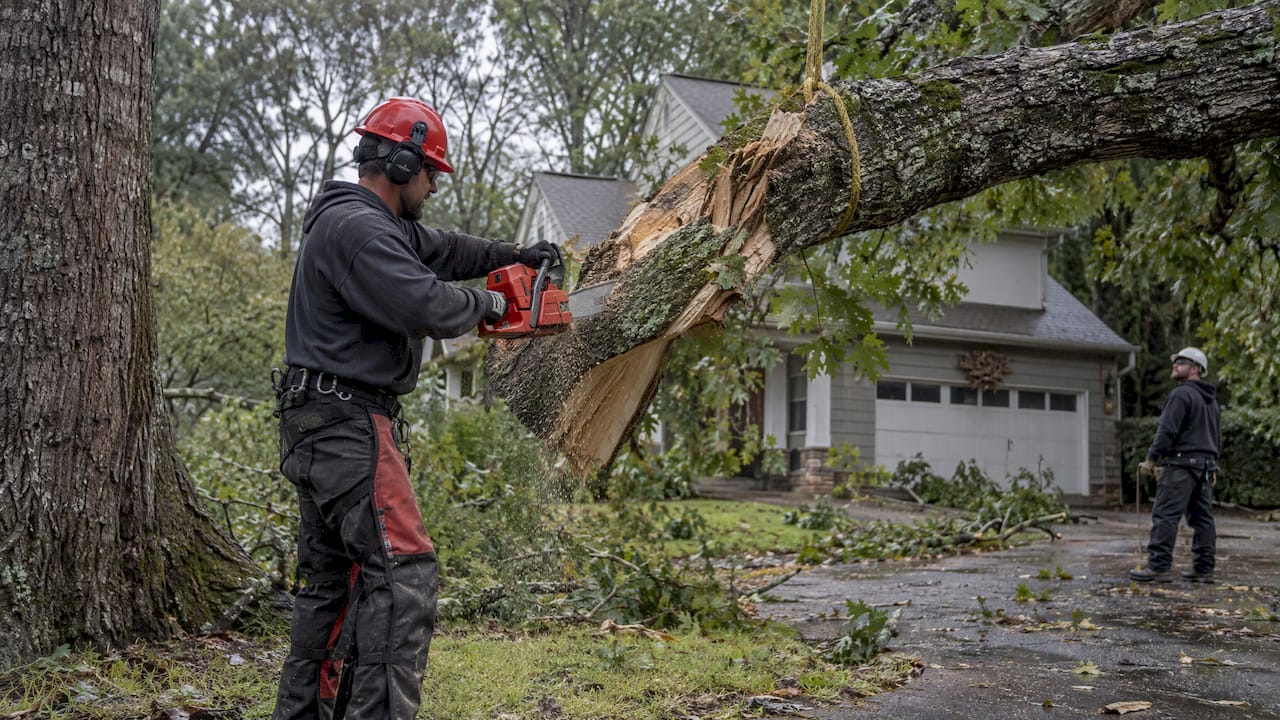
If a tree has fallen on your house, blocked your driveway or is leaning hard toward your home in Gainesville, Georgia, the first moves are simple: get everyone clear, keep away from any wire, photograph the damage, and call a crew that does the work with its own people and its own equipment. R & R Tree Service is a family owned company in Buford, GA, serving North Georgia since 1987, with 24/7 emergency tree removal handled by our own crew, no subcontractors, from the first call to the final cleanup. Below is how to tell a true emergency from a tree that can wait, who pays, and what happens when the crew arrives.
TL;DR
- A tree on a house, on a road or driveway, or touching a power line is an emergency. Stay away from the wire and call the utility first, then a tree crew.
- A tree leaning toward a house or leaning 30 degrees or more, especially with lifted roots after heavy rain, needs a professional look right away.
- In Georgia, a neighbor is generally liable only if the tree was visibly dead or diseased before it fell. Otherwise your own homeowners policy is usually where you turn.
- Photograph everything before anything is moved, and call your insurer. Price depends on size, access, and what the tree is touching.
- We are licensed, bonded and insured, own our machinery, and do not subcontract. Call us for a free assessment of a storm-damaged tree.
Table of Contents
- What counts as an emergency
- A leaning tree after heavy rain
- What to do in the first hour
- Who removes the tree when it is on a power line
- Who pays when a neighbor’s tree falls on your property
- Can a storm-damaged tree be saved
- What emergency tree removal costs
- When the tree is too big or too hard to reach
- Choosing an emergency crew
- Our service area: Gainesville and beyond
- After the tree is down
- Our perspective
- Need a crew in Gainesville?
- FAQ
- Sources
What counts as an emergency
Not every damaged tree needs a crew at 2 a.m. Some do. The difference is what the tree can hit.
University of Georgia and Florida extension guidance treats a tree as urgent when it leans on or hangs over power lines, blocks a road or driveway, or sits in a heavily used area. The same guide says a tree leaning toward something it can hit, with major roots broken or lifted, should come down promptly after the storm and that the work belongs with a certified arborist or trained professional.
Treat it as an emergency when:
- A trunk or large limb is on your roof, a bedroom wall, a garage, or a vehicle.
- A tree or limb is touching or tangled in a power, cable or phone line.
- The tree blocks your only way in or out, or a public road.
- The tree has newly shifted, and soil is heaved up on one side or roots are visibly torn.
- Large limbs are hanging broken over a house, play area or driveway.
It is usually an urgent-but-not-midnight call when the tree is down in an open part of the yard and touches nothing. You still want it cleared, but there is time to document it and schedule a visit.
A leaning tree after heavy rain
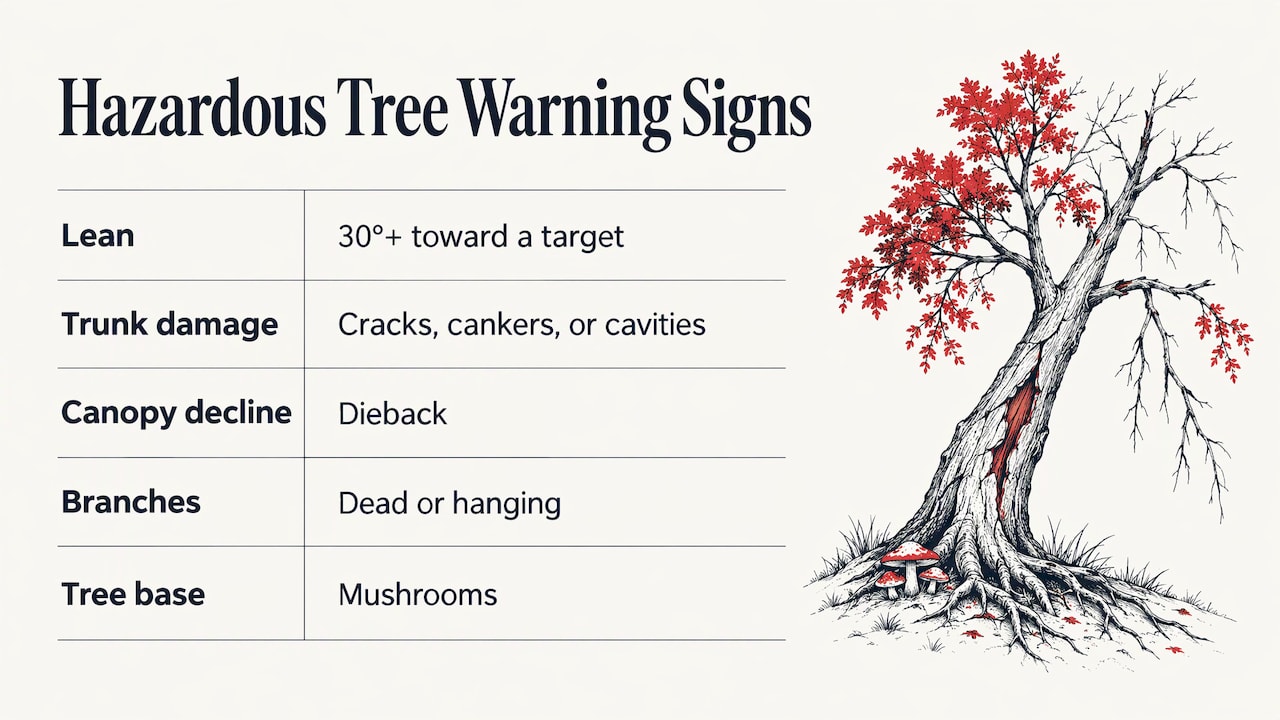
Saturated Georgia clay lets roots slip, and a tree that stood straight last week can lean this week. UGA Extension lists the warning signs of a hazardous tree: a lean of 30 degrees or more toward a target, cracks, cankers or cavities, dieback, dead or hanging branches, and mushrooms at the base. Advanced decline or obvious instability is a reason for removal, and a certified arborist can assess the rest.
The word that matters is new. A tree that has leaned for twenty years is a different problem from one that moved after a storm. If you can see a fresh crack in the soil, a raised root plate, or a gap opening beside the trunk, keep people and cars out from under it and call us. We will tell you plainly whether it has to come down or can be trimmed and monitored. If you are in Buford or Sugar Hill, we are even closer, and our Emergency Tree Removal in Buford page covers that area.
What to do in the first hour
Safety comes first. Property comes second.
- Get everyone out of the area. If the tree is on or against the house and you hear creaking or see shifting, leave the building and wait outside.
- Treat every wire as live. Georgia Power says a downed wire must be treated as energized: stay away, do not touch it or drive over it, and contact the utility immediately. A tree resting on a line can energize the trunk and the ground around it. Our guide on who to call when a tree falls on a power line walks through the order of calls.
- Call 911 for injuries, fire, or a wire down on a car or person.
- Photograph and video the damage before anything is moved. FEMA’s guidance is to assess danger and document damage with photos or video before contacting your insurer.
- Call your insurer to open a claim.
- Call a tree crew to make the tree safe and clear it.
The Georgia Forestry Commission’s storm recovery guidance says homeowners should limit their own work to minor debris. Large trunks and limbs should not be moved by one person, and leaning trees or large limbs resting on a roof are not homeowner jobs. A chainsaw on a tree under tension can kick in ways that are hard to predict, and a roof with a trunk on it may be carrying load you cannot see.
For a longer checklist, see what to do when a tree falls in your yard.
Who removes the tree when it is on a power line
The utility and the tree crew do different jobs. Georgia Power says it cuts vegetation that interferes with its lines to restore service, while cleanup of storm vegetation debris is the property owner’s responsibility. So the order is: the utility makes the line safe, then you call us to remove the rest of the tree from your property. Do not try to trim or pull anything touching a line yourself.
If the tree is on your house but the wires are clear, you can skip the wait and call us directly.
Who pays when a neighbor’s tree falls on your property
This is the question that stops many homeowners from calling at all. The short version, drawn from the Georgia Disaster Law Manual published in 2022, is this:
- If the neighbor’s tree was visibly dead or diseased before it fell, the neighbor can be held responsible for the damage.
- If a healthy tree came down in a storm, that is treated as an act of nature, and you typically turn to your own homeowners policy if the event is covered.
The manual’s general rule on neighbor liability is a guide, not legal advice. Policies differ, and removal is commonly covered only when a covered peril damages insured property. If a dispute with a neighbor is likely, talk to your insurer and, where needed, a Georgia attorney.
Two practical points. First, your photos matter more than anything: a clearly rotted trunk or dead canopy in the picture supports a claim against a neighbor. Second, the same manual says a neighbor generally may not kill or remove a tree whose trunk stands on your land, because that can amount to trespass. Do not cut down a tree on the property line without sorting out who owns the trunk.
You do not need to wait for the liability argument to be settled before the tree is off your house. Keep your photos, keep the invoice, and let the insurers sort out the rest.
Can a storm-damaged tree be saved
Sometimes. Visible damage does not automatically mean removal. The guidance from the Georgia Forestry Commission and extension specialists points to target exposure and structural condition as what decides it.
Get a professional assessment when you see:
- Deep cracks in the trunk or a split stem
- Lifted or broken structural roots
- Severe canopy loss
- Dead branches hanging in the crown
- A new lean toward the house, driveway or play area
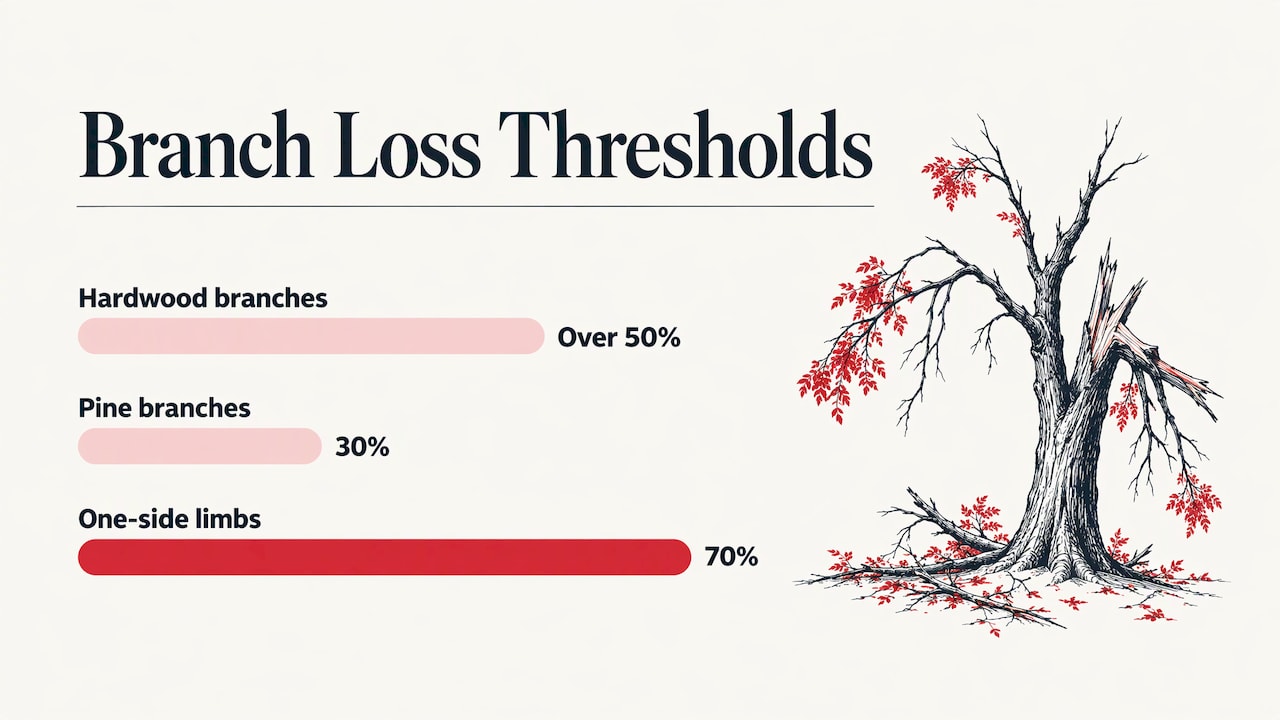
UGA Extension offers rough screening numbers: losing more than half of a hardwood’s branches, 30% of a pine’s, or 70% of the limbs on one side is a sign removal should be considered. They are general rules, not a prediction for any single tree.
A tree with smaller branch damage can often be restored by proper pruning. The Georgia Forestry Commission notes that when nothing is an immediate hazard, major pruning of a storm-damaged tree can wait six to 12 months. That is why an honest look at the tree comes before any decision. Our crew handles both tree trimming and pruning and removal, so the recommendation is based on the tree and not on the job we would rather do.
Ice and winter storms follow the same logic. Snapped limbs on an otherwise sound trunk are one thing. A split trunk or a crown that has lost most of its structure is another.
What emergency tree removal costs
We do not publish prices, because an emergency job is priced on the tree and the site, and we would rather look at it than guess. What we can tell you is what moves the number.
- Size and species. Taller, wider trees take more time and more rigging.
- What it is touching. Trees over a roof or within reach of power lines carry a 1.6× multiplier in one 2026 cost analysis, and dead or storm-damaged trees 1.25×. The same report found emergency removals were bid 37% higher than scheduled ones on average in April 2026.
- Access. A tree behind a house, over a fence or on a steep lot is harder to reach. Some need a crane.
- Cleanup. Hauling logs, brush and root balls is part of the work.
- Permits and conditions. Cost factors also include tree condition, location near structures or power lines, and permits, and that article notes emergency removal can reach up to $5,000.
Those are national figures, not quotes for Gainesville. For a real number, you need someone standing in your yard. One more note: homeowners insurance may cover removal when the tree fell because of a covered condition such as a windstorm, so open that claim early and keep your records.
When the tree is too big or too hard to reach
Some trees cannot be dropped in pieces from the ground or from a bucket: a huge oak leaning over a roof, a trunk wedged between a house and a garage, a lot with no truck access. For these, we use crane tree removal. The crane lifts sections away rather than letting them fall near your home. We own our crane and run it with our own crew, so the job is not passed to a second company on the day.
Choosing an emergency crew
After a storm, plenty of trucks go door to door. Before anyone climbs a tree on your property, you want to know a few things:
- Is the company licensed, bonded and insured? Falling a tree beside a house is the kind of work where an accident can cost a great deal. We are licensed, bonded and insured.
- Who actually does the work? We use our own crew and our own machinery, and we do not subcontract any part of the job.
- Does anyone answer the phone? Our emergency line is staffed around the clock, every day.
- Is the job finished? We stay through cleanup, not just the cut.
- How long have they been here? We have been a family business in Buford since 1987.
Our service area: Gainesville and beyond
We are based in Buford and serve Gainesville and the rest of North Georgia. For planned work as well as storms, see our tree removal in Gainesville, GA page. We also cover Flowery Branch, Sugar Hill and the wider North Georgia area.
After the tree is down
Once the tree is off your house, there is still work. Stumps, split logs, brush and debris all need dealing with. We handle storm debris removal as part of the same visit, and we grind stumps when you are ready: our stump grinding service removes the stump below grade. If the tree was a good hardwood, ask about firewood, which we also deliver.
For HOAs, property managers and businesses, the same crew handles large or recurring work, from downed trees in common areas to land clearing and retention pond maintenance.
Our perspective
We have been cutting trees in North Georgia since 1987, and the calls that stay with us are the ones that start with a family standing in the yard looking at a tree on the roof.
Our view is simple. In that moment you need a person to answer the phone, an honest read on the tree, and a crew that is licensed, bonded and insured. We keep it in-house: our own people, our own saws, our own crane, no subcontractors. When something goes wrong at a job, you should know exactly who is responsible, and it is us.
We also think you deserve a straight answer about whether a tree has to come down. A leaning oak over a bedroom is not the same as a broken limb on a sound tree. Tell us what you see, and we will tell you what we would do.
Money questions come up fast after a storm: who pays, what insurance covers, what it will cost. We cannot settle your claim, but we can explain what the tree needs, so you have the facts when you talk to your insurer or your neighbor.
R&R Tree Service Team
Need a crew in Gainesville?
If a tree is on your house, across your drive, or leaning where it should not, our emergency tree removal team is available 24/7 across North Georgia. Our own licensed, bonded and insured crew makes the tree safe, removes it, and cleans up after.

Call us or send a quote request through our site, tell us what the tree is touching, and send the photos you took. If it is not an emergency, we can still look at it and give you an honest assessment.
FAQ
What is emergency tree removal?
It is removing a tree or limb that is an immediate danger to people or property, such as one on a house, on a power line, or blocking a road or drive. The first goal is to make the site safe, then clear the tree and debris. Our crew does this around the clock.
Who do I call first when a tree falls on a power line?
Call the utility first and stay away from the wire. Georgia Power says to treat any downed wire as energized and contact them immediately. Once the line is safe, call us to remove the tree from your property.
Does insurance pay to remove a fallen tree?
Often, when the tree fell because of a covered event like a windstorm and damaged insured property. Coverage and limits vary by policy, so call your insurer after you photograph the damage. Keep your estimate and invoice for the claim.
Can I cut up a fallen tree myself?
The Georgia Forestry Commission says homeowners should stick to minor debris. Large trunks, leaning trees, and limbs on a roof are for trained crews. Call us and we will handle it safely.
Do you serve Gainesville, GA?
Yes. We are based in Buford and serve Gainesville and the rest of North Georgia with our own crew and equipment. Call us or send a request through our Gainesville tree removal page.
Sources
- Georgia Power: Tree & Vegetation Management FAQs
- FEMA: I need a tree removed from my property
- Georgia Forestry Commission: Natural Disaster Recovery
- Assessing Hurricane-Damaged Trees: decision guide
- UGA Extension Forsyth County: Hazardous Trees
- UGA Extension: Assessing storm-damaged trees
- Georgia Disaster Law Manual, September 2022
- Tree Removal Cost 2026: Price by Height and Size
- How Much Does Tree Removal Cost in 2026?
 (678) 482-9994