

Prepare Your Landscape and Tackle Large Tree Threats with These Storm-Proofing Tips
Quick answer: you storm-proof a landscape by fixing the failures in advance — remove dead and overextended limbs, deal with leaning and hollow trees before wind tests them, and clear anything overhanging roofs, driveways, and lines. No one wind-proofs a tree; what you can do is make sure the storm finds nothing ready to fail. In North Georgia — where summer thunderstorms, saturated clay, and the occasional ice event do the damage — that preparation is a fall-and-winter job, not a day-before-the-warning job.
- Most storm damage comes from limbs and trees that were visibly compromised beforehand — deadwood, cracks, leans, hollows.
- Wet soil + wind is the tree-toppler: Georgia storms drop whole trees by loosening saturated root plates.
- A lean of 30 degrees or more with a target beneath it is act-now territory, per UGA's hazard-tree guidance.
- Tall pines near houses deserve special attention — top-heavy crowns on shallow-plate roots.
- The household side — securing loose outdoor items, knowing the safe room — is Ready.gov territory.
Here's the pre-season audit our crews run on our own properties, in the order that catches the most risk for the least money.
What should a storm audit of your yard cover?
Walk the yard twice a year — after leaf-drop and after any major storm — and look for six things: dead limbs over anything you care about; cracks where big limbs meet the trunk; a new or worsening lean, especially with lifted soil on the back side; mushrooms or conks at the base or on the root flare; hollows and old topping wounds; and crowded, crossing limbs that load each other in wind. Photograph what you find — the year-over-year comparison is the diagnosis.
Which trees fail in Georgia storms?
Three repeat offenders. Tall pines on saturated ground — the top-heavy crown catches wind and the shallow plate rolls out of wet clay; whole-tree failures around here are disproportionately pines. Water oaks and silver maples past middle age — fast wood, hidden decay, big limb drops. Bradford pears at any age — the tight branch angles split in storms so reliably that we treat every mature one as pre-failed. If one of these stands over your house, get it assessed before storm season, not after.
What pruning actually reduces storm risk?
Selective thinning and hazard removal — not shearing, and never topping. Removing deadwood and weakly attached limbs takes away the most likely projectiles; thinning a dense crown lets wind pass through instead of pushing the whole sail. Topping does the opposite of what people hope: the regrowth is weakly attached and the next storm has more to grab. Timing follows the calendar in our fall trimming guide — hazards now, structure in late winter, and our trimming crew handles the ones above ladder height.
When is removal the honest storm-proofing?
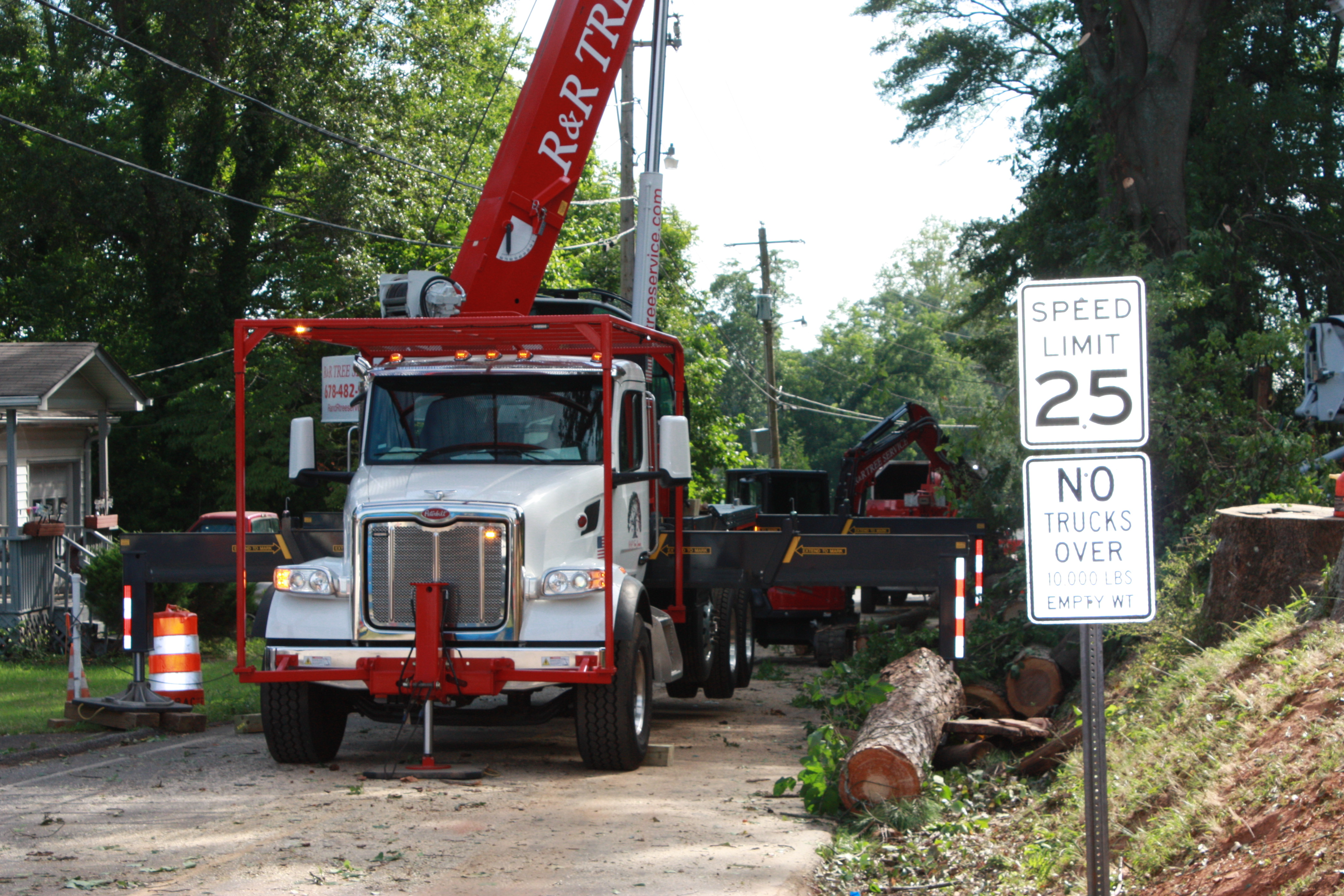
When the tree has already told you: major hollows, a spreading lean, root-plate lift, mushrooms at the flare, or a species-and-placement combination with a known ending. A planned removal on a calm week costs a fraction of the same tree through a roof — the arithmetic in our hidden-costs guide. On tight lots we take them down in sections with the crane, over the house rather than through it.
How do you read a lean — and when is it an emergency?
Trees lean for two very different reasons. A tree that has always leaned, with a curved trunk correcting toward vertical, grew that way and is usually structurally sound — wood laid down over decades compensates for the angle. A new lean is the dangerous one: it means roots are letting go. Look at the ground on the side away from the lean — lifted soil, a crack in the lawn, or a visible hump over the root plate means the tree is actively hinging, and that's a same-day call, not a watch item. After days of soaking rain, walk your big trees specifically for this; saturated clay is when root plates move.
Does prevention actually pay, or is it just peace of mind?
It pays three ways you can count. Planned work is priced as planned work — no after-hours premium, no crane mobilized at midnight. Damage never happens, so there's no deductible, no contractor season, no living under a tarp. And the insurance conversation stays simple: sudden storm damage to a maintained property is the claim adjusters process every week, while a tree that stood visibly dead through two seasons before landing on the neighbor's garage invites questions nobody enjoys. Our records help here too — every estimate and job we do for you is dated documentation that the trees were being managed.
What belongs on the storm-day checklist itself?
By the time the warning is out, the tree work is done or it isn't. What's left: bring in or anchor the furniture and trampolines that become projectiles, park vehicles clear of the trees you flagged, know where everyone shelters, and keep our number handy alongside Georgia Power's outage line. If a line comes down with the tree, Georgia Power's safety guidance is unambiguous: 30 feet back, assume it's live, call them or 911 first.
Frequently asked questions
Can a healthy tree fall in a storm?
Yes — saturated soil plus extreme wind can defeat a sound root system. But the odds are dramatically against it: the overwhelming majority of failures show prior defects. Prevention plays those odds.
Should I cable or brace a split tree?
Cabling can extend the life of a valuable tree with a specific structural flaw, but it's case-by-case and needs periodic inspection — it's a management tool, not a cure. Get an assessment before investing in hardware.
When's the best time to storm-proof?
Fall for the audit and hazard work, late winter for structural pruning — both ahead of Georgia's March-through-September storm peak. The worst time is the day a hurricane remnant enters the forecast, when every crew's board is already full.
Do you do emergency work during storms?
Our emergency crew runs 24/7, storm or calm — trees on structures and blocked access come first. One number, any hour: (678) 482-9994.
Book the audit before the season does it for you
Send photos of the trees that worry you — the lean, the dead limb, the pine over the bedroom — and we'll tell you honestly what needs action now, what can wait for winter, and what's fine. Free estimates across Buford, Suwanee, Lawrenceville, Duluth, and Gainesville from R & R Tree Service, family-owned since 1987: (678) 482-9994.
 Call (678) 482-9994