


How Much Mulch Do I Need?
Quick answer: divide your bed's square footage by 100 — that's roughly how many cubic yards of mulch you need at the recommended 3-inch depth. One cubic yard covers about 108 square feet at 3 inches, 162 square feet at 2 inches, and 81 square feet at 4 inches. University of Georgia horticulturists recommend keeping mulch 2–4 inches deep — and always a few inches clear of trunks and stems.
- The formula: square feet ÷ 100 ≈ cubic yards (at a 3" depth).
- 1 cubic yard = 27 cubic feet = about 13–14 standard 2-cu-ft bags.
- 2–4 inches deep is the UGA-recommended range — more suffocates roots, less won't hold moisture or block weeds.
- Never pile mulch against a tree trunk. The "mulch volcano" invites rot and rodents and can kill the tree.
- A typical suburban front-bed refresh runs 2–4 yards.
How do you calculate how much mulch you need?
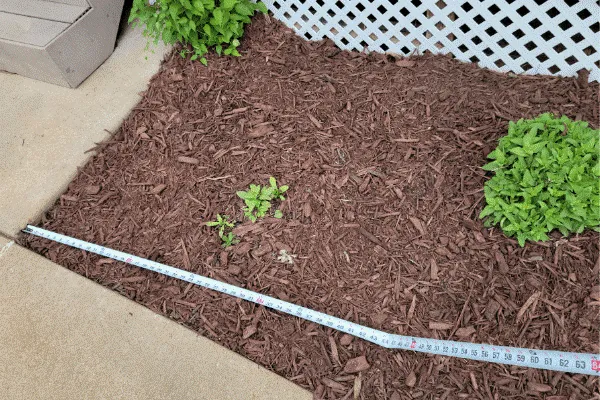
Measure first, then divide. Break the space into rectangles and circles, then add them up. Rectangle: length × width. Circle: radius × radius × 3.14. A 30-ft by 4-ft border is 120 sq ft; a circular bed 8 feet across adds about 50 sq ft. Total: 170 sq ft — call it 1.5 to 2 yards at 3 inches.
How deep should mulch actually be?
Two to four inches, and that number is doing real work. The University of Georgia's CAES recommends 2–4 inches, kept clear of plant stems: thick enough to hold soil moisture and shade out weed seeds, thin enough that water and air still reach the roots. Below 2 inches, weeds push through; above 4, roots can suffocate and some grow up INTO the mulch layer, where they dry out and girdle.
And skip the volcano. Mulch piled against a trunk holds moisture on the bark, softens it, invites borers and rodents, and slowly kills the tree it was supposed to pamper. Leave a 3–4 inch gap around every trunk — the bed should look like a donut, never a volcano.
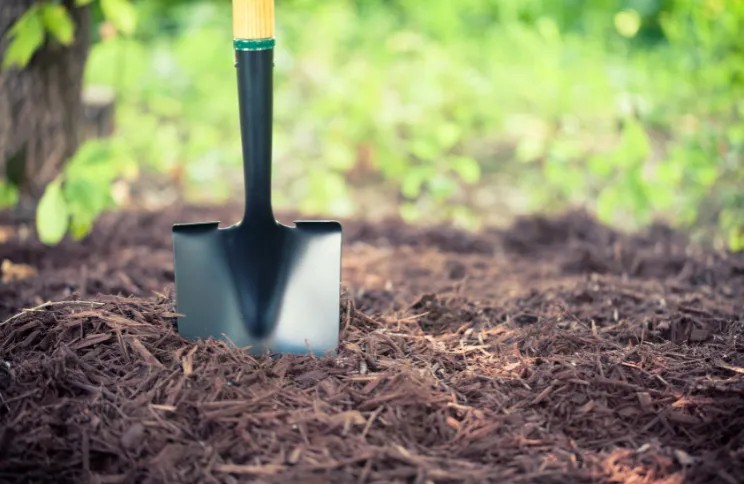
The coverage table
Per cubic yard, by depth:
- 2 inches deep — covers ~162 sq ft (lighter refresh of an existing bed)
- 3 inches deep — covers ~108 sq ft (the standard for most beds)
- 4 inches deep — covers ~81 sq ft (new beds over bare soil, or coarse mulch)
Buying bags instead? A cubic yard is 27 cubic feet — thirteen and a half 2-cu-ft bags. Past 3–4 yards, a bulk delivery usually beats bag math on both price and trips.
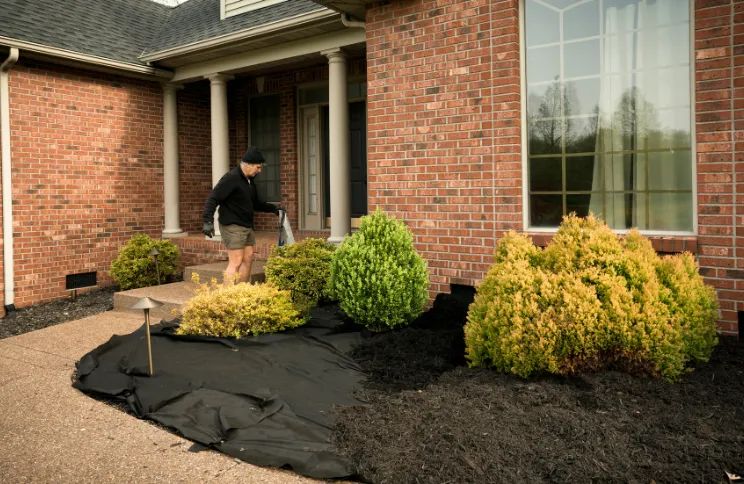
Which mulch type for which job?
Hardwood chips settle into a tidy, long-lasting layer and suit trees and shrub beds. Pine straw is the North Georgia classic under pines and azaleas — light, cheap, quick to refresh, faster to break down. Dyed mulches hold color longest; make sure the base wood is quality, not ground pallets. Fresh wood-chip mulch from tree work is the budget winner for paths and open beds — much of what we deliver starts as trees from our own local jobs, chipped, not shipped.
Frequently asked questions
How many bags of mulch are in a cubic yard?
About 13.5 of the standard 2-cubic-foot bags, or 9 of the 3-cubic-foot bags. If your project needs more than 40 bags, bulk delivery is almost always the better deal.
How much mulch do I need for 500 square feet?
At the standard 3-inch depth, about 4.5–5 cubic yards. At 2 inches, roughly 3 yards.
Should I remove old mulch before adding new?
Usually no — rake it loose, then top up to the 2–4 inch range. Remove old mulch only if it's matted solid, diseased, or already too deep.
When is the best time to mulch in Georgia?
Spring, after the soil warms, and again in fall for winter insulation. Any month works better than none — the depth rule matters more than the calendar.
Do you deliver mulch near me?
Yes — R & R Tree Service delivers by the load across Buford, Suwanee, Lawrenceville, and North Georgia. Tell us your square footage and we'll confirm the yardage before we come.
Measure once, get one delivery
Add up your beds, divide by 100, and send us the number — we'll sanity-check it for free and quote the load. Mulch delivery from R & R Tree Service — family-owned in Buford since 1987. (678) 482-9994.
 Call (678) 482-9994